
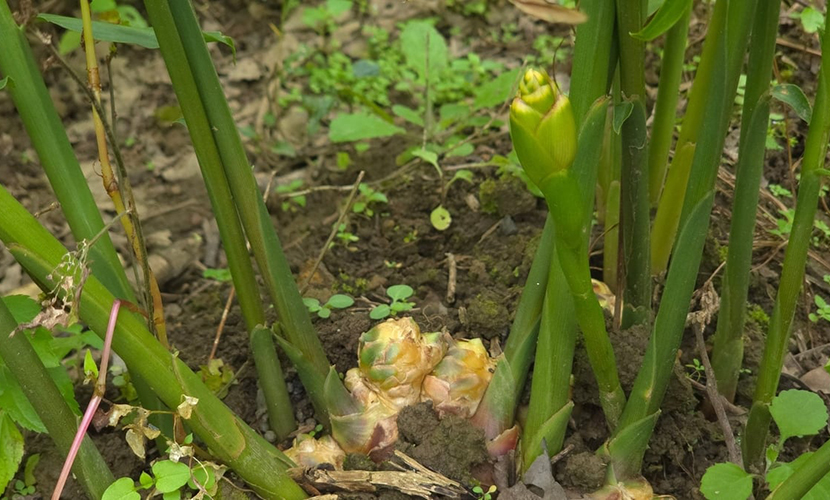
Lũng Cú is a border commune of Tuyên Quang Province (formerly part of Hà Giang Province). Vietnamese buffalo ginger plants are gradually replacing corn, opening a new path to prosperity for the people of Lũng Cú. The crop will be able to become the green gold of the northernmost region of the country.
Mr. Nguyễn Duy Long is an officer of the Lũng Cú Economic Department. Beside the lush green ginger fields that are nearly ready for harvest, he guided us. He showed us firsthand the ginger-growing model that local residents are very enthusiastic about. Vietnamese ginger has become one of the key crops bringing high economic efficiency. Notably, it is receiving strong attention from both the people and the local authorities.
Vietnamese buffalo ginger
In recent years, Vietnamese buffalo ginger has widely developed, with the farming area continuing to expand. This kind of ginger has high yields, good market prices, low labor requirements, minimal pests and diseases. Especially, it is suitable to the climate and soil conditions of the northernmost region. As a result, these factors have led residents to choose this crop.
The largest concentrated ginger-growing area is in Ma Xí B hamlet, covering 15 hectares with nearly 100 households involved. The 2024 ginger season was a bumper crop, with many families earning hundreds of millions of đồng. After this successful harvest, many households decided to abandon corn entirely and switch to ginger, doubling their cultivation area.
Mr. Mí Pó is the head of Ma Xí B hamlet. He said that Vietnamese buffalo ginger has existed in the village for a long time. However, in the past, people only grew it for use as a Vietnamese spice. Both the ginger root and leaves have medicinal properties. When traders began coming here to buy fresh ginger at high prices, many households boldly switched to cultivating the crop.
Income from Vietnamese buffalo ginger has helped residents overcome many difficulties. More and more families have learned from one another and started growing it. Ma Xí B has gradually become a specialized ginger-growing area of the commune.
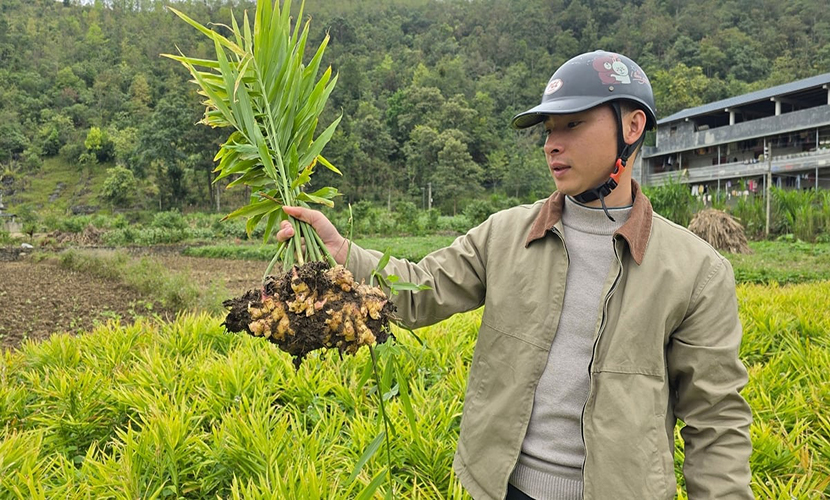
Fresh ginger from Vietnam
The ideal time for planting ginger starts around the second lunar month. Because ginger is grown in concentrated areas, it is convenient to prepare the soil, plant, and care for the crop. According to local experience, villagers cover the soil with leaves to retain moisture. Over time, the leaves decompose into fertilizer, improving soil looseness and helping the ginger grow better and yield more.
Lũng Cú commune now has 15 hamlets growing fresh ginger, with a total cultivation area of more than 150 hectares. Vietnamese buffalo ginger is mostly available in the hamlets of Ma Xí A, Ma Xí B, Khai Hoang, and Ma Lé.
With an average yield of over 30 tons per hectare and purchase prices from traders ranging from 10,000 to 12,000 đồng per kilogram, each household can earn a significant income. Therefore, they can make hundreds of millions of VND per season. The economic efficiency of Vietnamese buffalo ginger cultivation is three times higher than that of corn.
To ensure sustainable farming, Lũng Cú commune has organized training courses to guide residents on ginger planting and care techniques. In addition, the commune has strengthened communication and product promotion. It has also supported market connections and processing, helping secure stable outlets and enhance the value of the ginger crop.

Vietnamese buffalo ginger farm
Agricultural officers advise residents to farm scientifically, following an organic and sustainable approach. If Vietnamese buffalo ginger is grown this season, another crop should be planted the next season. Therefore, the soil has time to recover, limiting pests and diseases. This helps reduce the use of plant protection chemicals and facilitates organic production while protecting the ecological environment.
Ginger is a hardy crop with few pests, but it is susceptible to a specific disease—rhizome rot. If the soil is not properly cleaned and disease sources thoroughly treated, the next season can be easily infected. Pathogens left from the previous crop are usually the cause. Therefore, soil preparation and sanitation are extremely important.
Mr. Lương Triệu Luận is the Head of the Lũng Cú Economic Office. He said the locality encourages residents to shift from growing corn to growing Vietnamese buffalo ginger. In the commune’s development orientation, agricultural transformation focuses on “three crops and three livestock.” The three key crops being expanded are ginger, pears, and medicinal plants. In livestock production, the three priority animals are cattle, goats, and buffaloes.
Vietnamese source: https://nongnghiepmoitruong.vn/gung-trau–vang-xanh-cua-vung-cuc-bac-d784693.html