
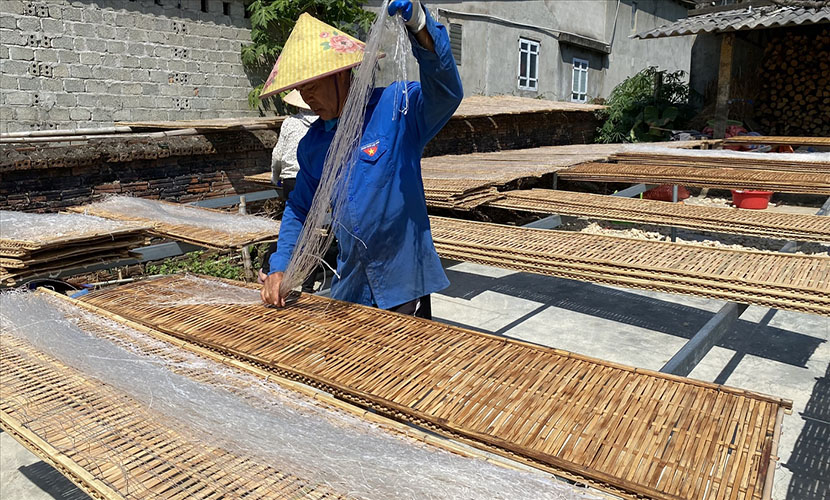
Lai Chau glass noodles have gained popularity across the country thanks to their delicious taste, chewy texture, and guaranteed safety. As a result, they are now a preferred choice for consumers throughout the year. This success has helped local people achieve a stable and sustainable income.
Binh Lu is a remote commune in Tam Duong district of the mountaineous province of Lai Chau. In early November, local households are bustling with the harvest of konjac roots and the production of glass noodles. Along village paths, alleys, or open spaces, residents set up racks to place the noodle sheets and catch the sunlight.
Lai Chau glass noodles
Families mobilize their members, taking turns to rest or have lunch briefly before continuing to dry the noodles. Meanwhile, they carefully monitor the process to ensure high-quality glass noodles. The busy atmosphere during each canna noodle season is evident everywhere. As a result, the brand of Lai Chau glass noodles is increasingly appreciated by consumers in many other regions.
The production of dry canna starch noodles entails a series of meticulous steps. In particular, the process includes planting and harvesting the canna roots, followed by grinding them into fine flour. Then, filtering the flour to remove impurities and drying the wet flour into dry flour.
Afterthat, cooking the flour, pouring it into molds to form noodles. Finally, placing the strands on bamboo racks to dry. The root harvest season is an especially busy time for local households. Therefore, they work tirelessly each day, racing against the sun to produce high-quality batches of noodles.
“This whole commune has only 5–6 canna flour mills. Therefore, during holidays, my family has to book in advance and wait in line, to grind the flour. People here often help each other out because one household alone does not have enough people for all the steps,” shared Lo Thi May, a Dao ethnic resident of Binh Lu commune.
Mr. Nguyen Ngoc Anh is the director of the Binh Lu Agricultural and Service Cooperative. He shared: “Taking advantage of sunny days, we have to mobilize all family members to get up at 4 a.m. We knead the flour, and run the machines so that the morning batch is ready by 11 a.m. Then, we immediately start the afternoon batch, aiming to dry 2–3 batches of noodles each day. Good noodles must meet standards such as a translucent brown color, thin strands, chewy and elastic texture, and a rich flavor.”
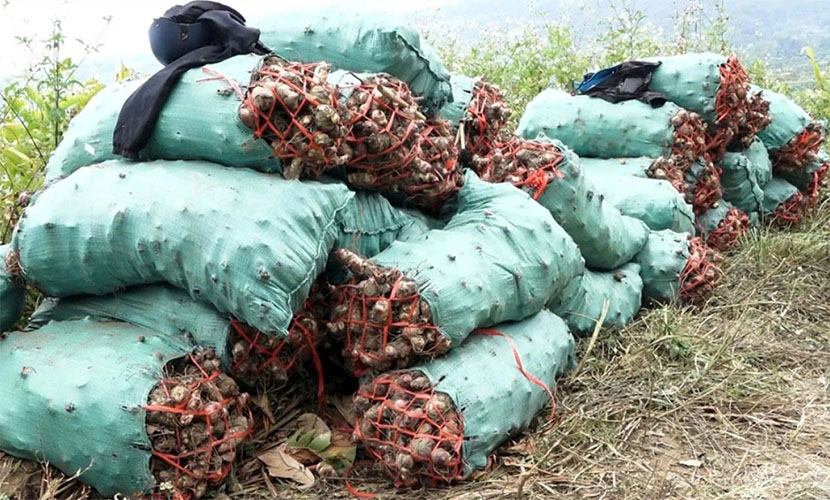
Lai Chau canna roots
“The first requirement is that the canna flour must be pure and kneaded to just the right consistency. If it is too dry or too soft, it affects the quality of Lai Chau galss noodles. If sun-drying achieves only 90%, we bring the noodles indoors to remove the strong konjac odor before cutting and packaging. On average, each day our family produces around 100 kg of dry flour, which yields over 30 kg of packaged noodles,” Mr. Anh added.
Ms. Giang, a villager, enthusiastically said: “Learning from last year, Lai Chau glass noodles always sold out near Tet. This year, my family has prepared early and worked faster, producing twice as much as last year.”
According to Ms. Giang, for many years, local people have recognized that this land is very suitable for canna roots. Therefore, they have gradually adjusted their cropping structure and practiced intercropping and staggered planting.
Now, having become familiar with the noodle-making profession, everyone is excited to see their Lai Chau glass noodles gain a recognized brand. Compared to the past, selling prices are better, allowing many households to build houses and send their children to school. The community celebrates Tet with joy and pride.
In 2018, Lai Chau province officially granted Binh Lu as a traditional canna noodle craft village. As a result, it opened a new path for local economic development. By 2022, the commune had developed 35 hectares of konjac cultivation with nearly 100 participating households. Moreover, one cooperative had been established to specialize in noodle production. Each year, the commune sells nearly 200 tons of Binh Lu canna noodles on the market, earning 10 billion VND.
Binh Lu commune has established a commercial and production cooperative for glass noodles. In addition, it has introduced modern machinery and technology into production. As a result, the quality of Binh Lu konjac noodles has steadily improved. Moreover, productivity has doubled compared to manual methods, and the product design has become increasingly attractive.
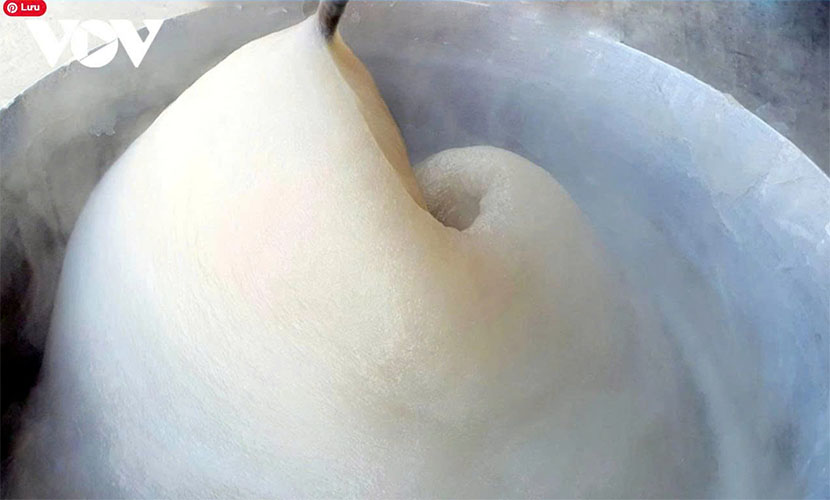
Lai Chau canna starch
To ensure that local people remain committed to growing konjac, the commune has required households and production facilities of canna flour noodles to sign commitments. Consequently, they must ensure food safety, hygiene, and environmental protection during the production process.
“Also, the commune has set up a team to regularly inspect. Additionally, it supervises konjac production facilities, preventing any violations,” said Mr. Phuong, Chairman of Binh Lu commune.
In recent years, neighboring communes have also expanded their canna cultivation areas to supply roots to local processing and noodle production facilities. As a result, the market output of konjac noodles has increased.
Mr. Nguyen Hong Quan is the Head of the Department of Agriculture and Rural Development of Tam Duong district. He said: “We have strengthened communication and guidance to encourage people to expand konjac cultivation. We have a also made efforts to promote the application of scientific and technical methods in all stages of production”.
“Today, Lai Chau glass noodles have established a strong brand and are widely popolar with consumers. The specialty Binh Lu’s canna starch noodles are not only available in Lai Chau province. Moreover, they are now available across the country, becoming a signature product representing Lai Chau,” he added.
Vietnamese source: https://baodantoc.vn/khang-dinh-thuong-hieu-mien-dong-lai-chau-1674193425004.htm