
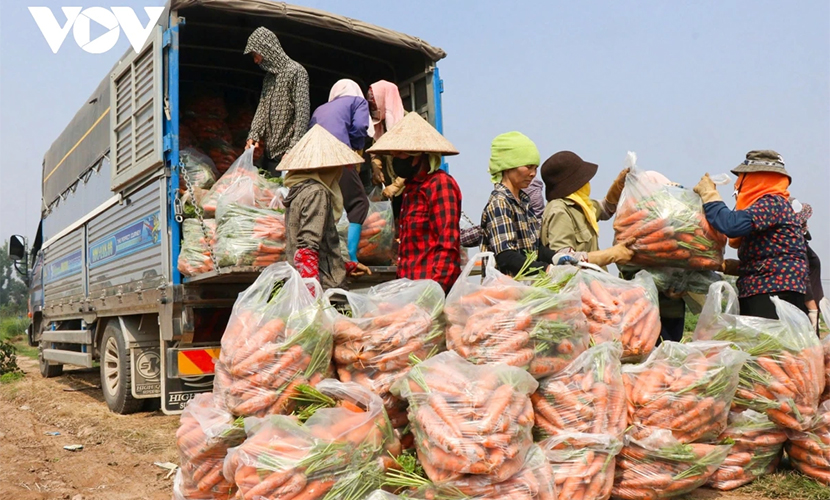
The entire province of Bắc Ninh is currently cultivating nearly 1,500 hectares of Vietnam’s fresh carrots. Many households growing Vietnamese carrots in the province are extremely anxious. They face the risk of losing their entire winter crop as prices have dropped sharply.
Mr. Hạp Tiến Viên is a local farmer in Cao Đức Commune, Lương Tài District, Bắc Ninh Province. In the bitter early-year cold, his family cannot help but feel distressed as they harvest the last remaining rows of Vietnam’s fresh carrots.
Mr. Viên shared that this winter his family planted over 7,000 square meters of Vietnam’s carrots. Due to the impact of the flood, the entire crop was sown about a month later than usual. In previous years, each sào of carrots yielded more than two tons and sold for 9–12 million VND. Even in years when prices dropped, farmers could still earn around 8 million VND per sào (360 m²).
Vietnam’s fresh carrots
Because he had established long-standing trading relationships with fresh carrot wholesalers, Mr. Viên could sell most of them. However, with more than 5,000 square meters of Vietnam’s fresh carrots with low prices, his family is now facing significant difficulties.
“Things are unusual for Vietnam’s fresh carrots this year. Even though the carrots are of good quality and high yield, each sào only sells for five million VND. The investment for each sào, including machinery, labor, fertilizer, and land rent, is around 3.5 million VND. This means farmers put a lot of effort and energy, yet still lose one million VND per sào“.
He shared “I have been growing Vietnam’s fresh carrots on the riverbank land for nearly 10 years. However, this is the first year that carrot prices have plunged to the bottom at harvest time, wasting the hard work of many families.”
Similarly, Ms. Vũ Thị Dương is another farmer from Trung Kênh Commune, Lương Tài District, Bắc Ninh Province. She said that for many years her family has regularly cultivated over 3.5 hectares of riverbank land. Income from agriculture has helped her family make a living and support their children’s education. However, this year’s carrot price drop has caused serious economic difficulties for the household.
“In previous years, when prices were good, traders often came directly to buy from the farm. This year, only households with pre-arranged deals and deposits were able to sell, while others had to find buyers themselves. Some families could not find a market and ended up plowing under their crops,” Ms. Dương shared.
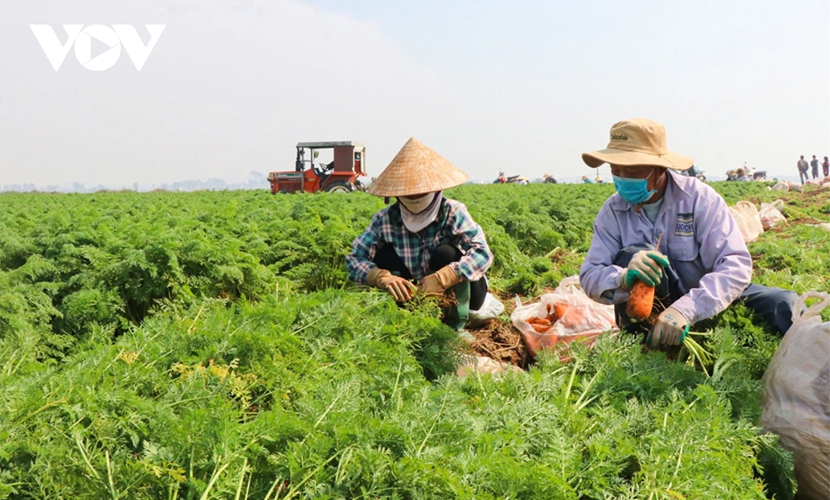
Vietnamese carrot farm
Not only Vietnam’s fresh carrots have fallen in price. Many other winter crops such as kohlrabi, cabbage, onions, and various vegetables are facing similar difficulties.
Mr. Nguyễn Văn Cường is a farmer from Vạn Ninh Commune, Gia Bình District. He shared that his family cultivates five hectares of carrots and three hectares of kohlrabi and cabbage. Currently, the family has sold Vietnam’s fresh carrots at a low price of three million VND per sào. Meanwhile, the selling prices for kohlrabi at 500 đồng per head, and cabbage at 1,000 đồng per kilogram.
“In previous years, the harvest season was bustling with laughter, as traders and farmers worked busily in the fields. Now, with Vietnamese fresh carrot prices so low, many families are reluctant to tend their fields. Several farmers plan to wait before harvesting to prepare the land for summer planting,” Mr. Cường said.
Ms. Phạm Thị Khuy is Vice Chairwoman of the Cao Đức Commune People’s Committee in Gia Bình District. She shared that for this winter crop season, farmers in the commune planted over 300 hectares of vegetables. This includes 260 hectares of carrots—115 hectares early-season and 145 hectares mid-to-late season.
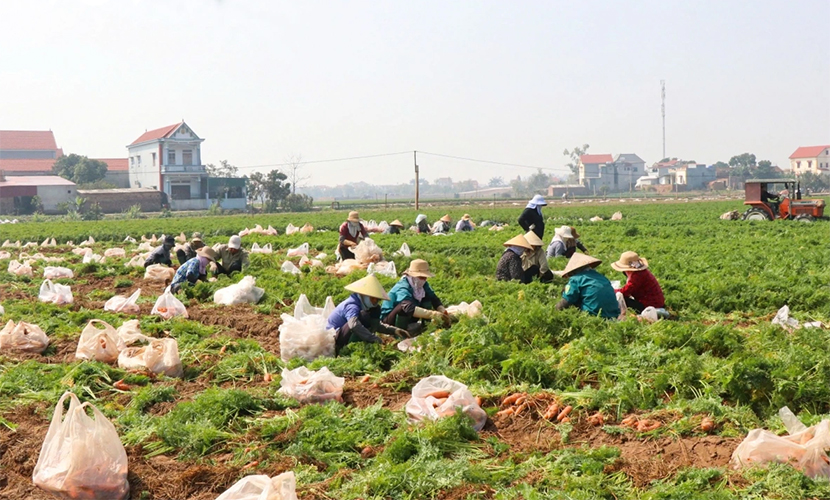
Vietnamese carrot harvesting process
Currently, all early-season carrots have been harvested. About 90 hectares of mid-to-late season crops remain and are facing difficulties in sales. As a result, some households have to manually pull out the crops to prepare the land in time for the summer melon planting season.
Mr. Dương Đình Toản is the Deputy Head of the Lương Tài District Agriculture Office in Bắc Ninh Province. He shared that for this winter crop season, the district planted over 1,200 hectares of various vegetables. The key ones were carrots, onions, garlic, green squash, and pumpkins. From the beginning of the season, the district directed the specialized office to focus on promoting support policies.
In addition, the province advised and guided farmers on planting, care techniques. Also, it integrated pest management according to the technical requirements of each crop. These measures help ensure yield, quality, and food safety.
“Although it is harvest time, low prices have led to the current situation of falling crop prices. This is due to multiple objective and subjective reasons. These include misaligned planting schedules, farmers producing in large volumes, and low, unstable market consumption,” Mr. Toản explained.
Vietnamese source: https://vov.vn/kinh-te/ca-rot-mat-gia-nong-dan-o-bac-ninh-lao-dao-post1155588.vov