
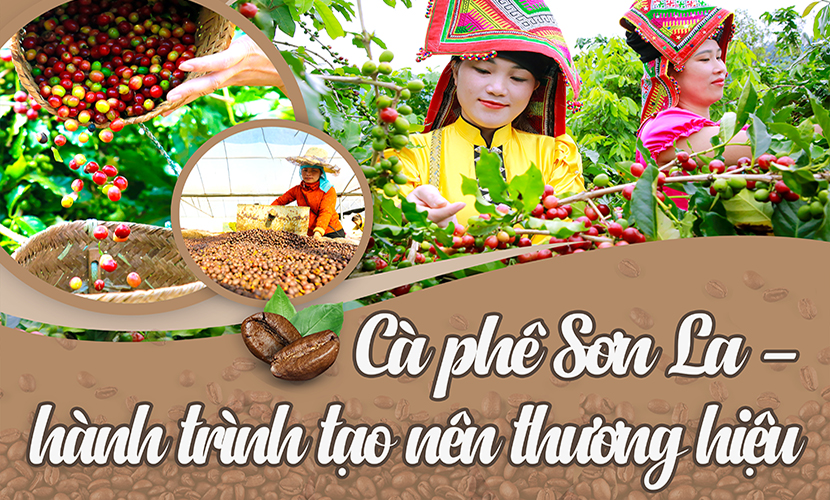
After thirty years taking root in the Northwest region, Vietnamese coffee trees have established themselves as a key crop. They have opened up a pathway for developing a high-tech, commodity-oriented agricultural economy. In addition, this agicultural economy has integrated with value chains and international integration.
During the 2021–2025 period, Son La’s coffee sector achieved many positive results. As a result, it laid a solid foundation for the sustainable development strategy through 2035.
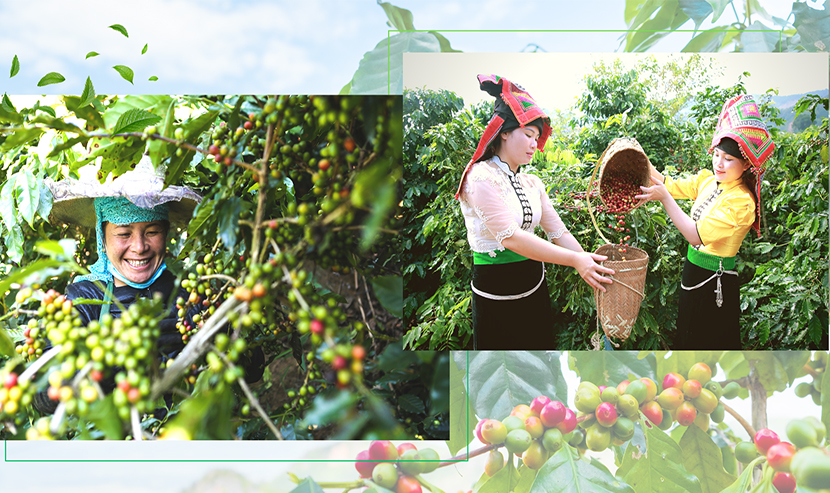
Vietnamese coffee trees
Currently, Son La province has 24,300 hectares of Vietnamese coffee trees, which is a 36% increase in comparison to 2021. Therefore, this area has reached 121% of the planned target. The coffee bean output will be able to reach 37,724 tons, up 41.1% from 2021.
Thanks to increasingly complete purchasing and processing systems, coffee prices have been stable. Also, market access has been favorable, so local farmers have motivations to expand coffee cultivation.
On average, each hectare produces eleven tons of fresh coffee cherries. The prices range between 15,000–20,000 VND/kg, generating revenues of 170–200 million VND/ha. After deducting costs, profits exceed 140 million VND/ha. This attractive income contributes significantly to improving the livelihoods of tens of thousands of coffee-growing households.
Son La coffee, especially the Arabica variety, is mostly suitable with on basalt, limestone, and ancient alluvial soils at elevations of 600–1,200 meters. In addition, the region’s cool climate and ideal temperatures from 15°C to 24°C create excellent conditions for coffee cultivation.
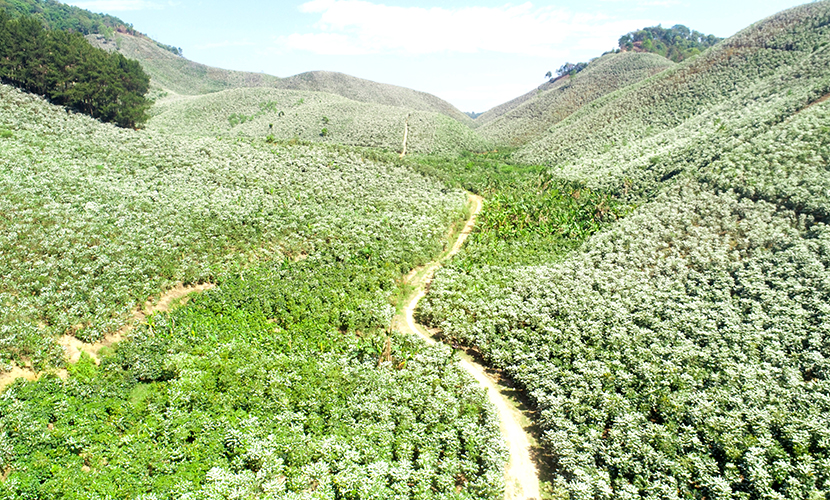
Son La coffee hills
These specific soil and ecological conditions help create a balanced flavor, light aroma, elegant acidity, and sweet aftertaste. As a result, these qualities have become the distinctive characteristics of Son La’s coffee.
Most coffee plantations still rely on rainfall. However, only a small portion is equipped with water-saving irrigation systems such as drip or sprinkler irrigation. Drought during flowering and fruit-setting periods or heavy rains that cause soil erosion continue to be major challenges. In addition, frost damage and leaf burn caused by icy dew also affect coffee production.
Currently, the Catimor variety accounts for over 90% of the coffee area and has advantages in adaptability and rust resistance. However, it produces small beans with relatively low yields. Some areas planted since 2000 are aging, resulting in low productivity.
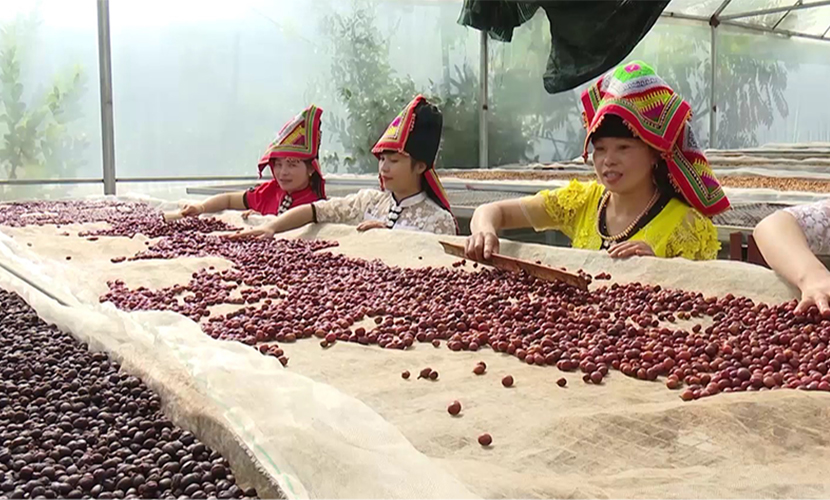
Processing-son-la-coffee
To improve this, Son La has trialed several new varieties of Vietnamese coffee trees such as THA1, TN7, TN9, H1, Starmaya, and TN2. Also, the province has carried out replanting and grafting renovation over 2,818 hectares, achieving only 36.1% of the planned target.
The main reason is farmers’ reluctance due to high investment costs and long establishment periods. This is despite the fact that current coffee prices remain favorable. Son La has established three parent gardens and 5,000 parent plants to produce seeds.
The province produces a large quantity of high-quality coffee bean and cuttings each year. As a result, it supplies nearly 9,000 kg of seeds and 10,500 cuttings for planting new areas, replanting, and grafting renovation in key coffee-growing communes.
According to statistics, Son La currently has 28 Vietnamese enterprises engaged in coffee production and processing. Among them, 26 facilities specialize in preliminary and deep processing.
Meanwhile, production link models between enterprises, cooperatives, and farmers are becoming increasingly effective. Consequently, these models create concentrated raw material areas that ensure both quality and stable market access.
The province now has five industrial processing facilities and more than 15 preliminary processing establishments. Together, these facilities meet over 50% of the fresh coffee cherry output, while the remaining portion is still manually processed, which affects coffee bean quality.
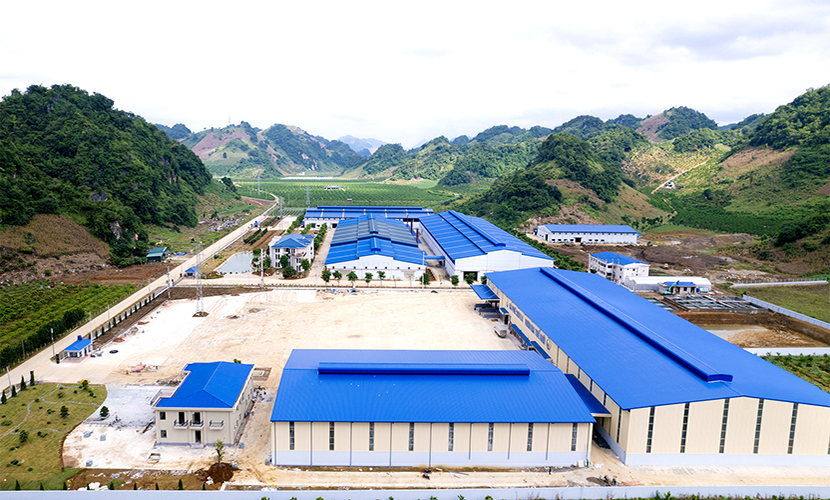
Son La coffee factory
In addition, many enterprises have invested in wastewater treatment systems. Furthermore, they use by-products to produce organic fertilizer, contributing to environmental protection.
In the first six months of 2025 alone, Son La exported 17,800 tons of coffee beans, worth nearly $70 million. This accounted for more than 68% of the province’s total export value. Looking ahead, the projected export for 2025 is 34,000 tons, equivalent to $100 million. The main markets are European Union, North America, the Middle East, and ASEAN.
Mr. Nguyen Thanh Cong is the Vice Chairman of the Son La Provincial People’s Committee. He stated that the province has certified 23,448 hectares of coffee for sustainability (RA, 4C), surpassing the target by 156%.
Son La coffee brand
Additionally, 141 hectares of Vietnamese coffee trees meet Vietgap standards, 543 hectares are organic-orientation, and 38.6 hectares have planting area codes. Specialty coffee covers 1,120 hectares with a production of 1,000 tons. Since 2017, Son La coffee has been granted geographical indication protection.
Currently, seven organizations, including enterprises and cooperative, have the rights to use this geographical indication. In addition, Son La coffee has five OCOP-certified products, including one 5-star and four 4-star products. These certifications help enhance the brand value of Son La coffee beans. Consequently, they also increase its added value of Vietnamese coffee trees in the market.
Recently, Son La province has cooperated with the German Development Cooperation (GIZ) to implement the “Northwest Coffee” application. Through this program, farmers receive cultivation data, pest and weather forecasts, and support in adapting to climate change.
The project has supported experimental replanting on 35.7 hectares with new varieties and supplied 9,500 macadamia trees for intercropping. In addition, it has organized over 50 training courses for more than 1,400 farmers planting Vietnamese coffeee trees.
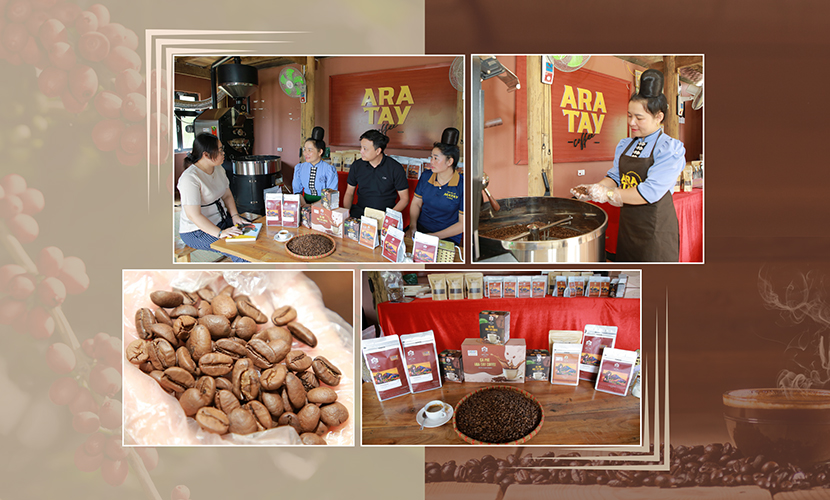
Son La coffee trade fair
International organizations such as CARE and SRD have also supported livelihood development. Aslo, they promoted women’s roles in coffee production in Son La. During the 2026–2030 period, Son La aims to expand coffee cultivation to 25,000 hectares, targeting a production of 40,000 tons.
By 2035, the goal is to reach 27,000 hectares of coffee cultivation and produce 47,000 tons of coffee. In particular, the area of specialty coffee and certified sustainable zones will increase significantly, forming five high-tech zones in key districts.
Moreover, Son La prioritizes deep processing by establishing coffee industrial clusters, increasing industrial processing rates to 80% and deep processing to 25%. As a result, 85% of the coffee output will be allocated for export.
Comprehensive solutions in science and technology, sustainable cultivation, and support for linkages, market development, credit, and branding are being implemented. At the same time, these efforts will continue to be vigorously promoted.
Vietnamese source: https://nhandan.vn/son-la-tap-trung-phat-trien-ben-vung-cay-ca-phe-post899577.html