
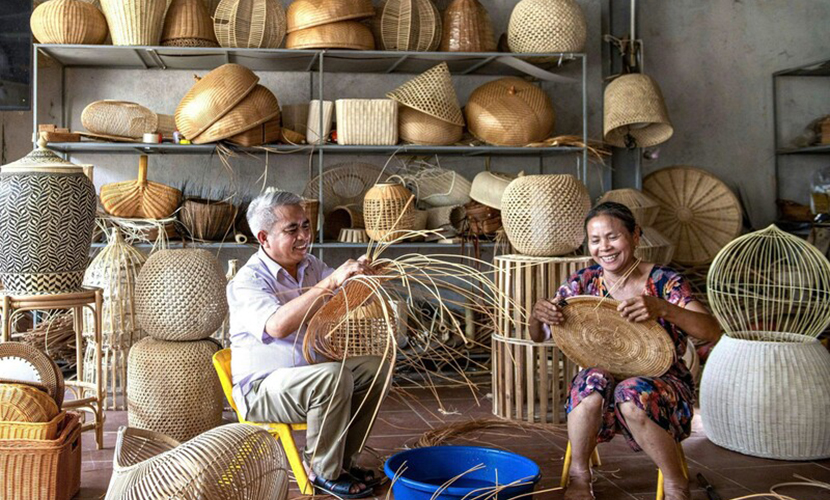
Vietnamese craft exports are distinctive products, markedly different from many other manufacturing industries. Most production facilities belong to traditional craft villages, operating on a small scale and with strong community involvement. Yet it is precisely from these villages that products emerge carrying the “soul” of the nation. They embody cultural values, heritage, and the unique creative spirit of the Vietnamese people.
Introducing culturally unique products to the international market is exciting and challenging. In this context, Vietnam’s signing of free trade agreements (FTAs) with numerous countries is seen as a valuable opportunity. These agreements create conditions for Vietnam’s handicraft enterprises to expand their markets and enhance competitiveness. They also help introduce Vietnamese products to friends around the world.
Vietnamese craft exports
However, global conflicts and wars are significantly affecting international trade, particularly in major markets. Unlike essential industries such as textiles or footwear, Vietnamese craft exports mainly serve decorative and artistic purposes rather than daily necessities. When the global economy faces difficulties, consumers tend to cut spending on these items, posing a major challenge for businesses.
Additionally, China, with its large-scale production capacity and low costs, remains a formidable competitor in the international market. The ceramics sector, a typical field in handicrafts, is experiencing fierce competition. China possesses large, modern factories with low production costs. In contrast, Vietnam’s handicraft facilities are still largely small-scale and dispersed across craft villages.
As a result, despite attracting international interest, Vietnamese craft businesses face difficulties in fulfilling large orders and meeting consistent quality standards. This represents both an opportunity for growth and a challenge to overcome.
In the context of the global shift toward green consumption and sustainable development, major markets are imposing increasingly strict requirements. Exporting companies must comply with environmental and social responsibility certifications, such as SA 8000 or VSCI. These certifications are not only commitments to sustainable development but also a “passport” for Vietnamese handicrafts to access high-end markets.
However, achieving these standards requires factories to be sufficiently large and equipped with modern production processes. They also need support from professional management systems, which is a major challenge for most Vietnamese handicraft enterprises today.
To meet international standards, Vietnamese businesses in the ceramics and handicraft export sectors should invest substantial capital. They also need to allocate significant floor space for production systems, waste treatment, and supporting facilities. This poses a considerable challenge for small and medium-sized establishments, which make up the majority of the industry.
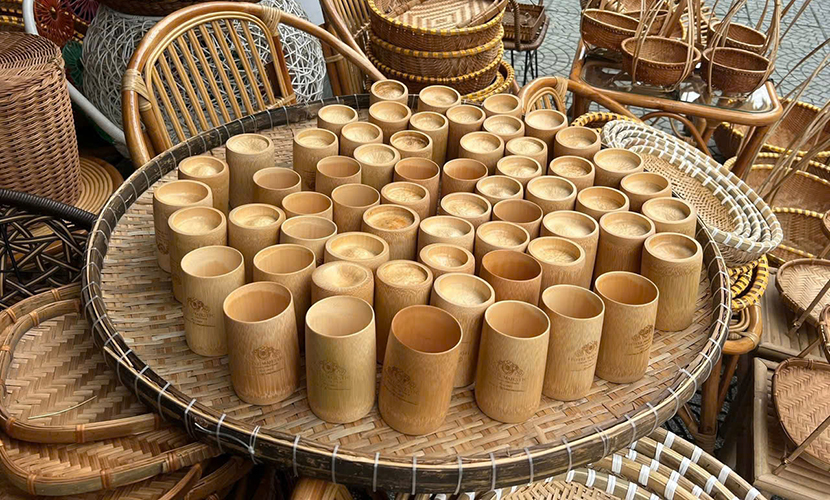
Vietnamese bamboo products
In particular, Vietnamese handicraft businesses should comply with regulations on reducing greenhouse gas emissions. Also, establishing standard waste treatment systems and using environmentally friendly materials have become mandatory. In addition, international importers require Vietnamese craft exports to be packaged in eco-friendly materials.
Currently, businesses are striving to find new recycled materials, which are trending in many countries. However, domestic supply is still limited and costly, making the transition to environmentally friendly materials challenging.
Although Vietnam has abundant ceramic raw materials, management and extraction at the mines remain inefficient. This situation results in unstable supply and quality, directly affecting production capacity. As a result, many Vietnamese craft businesses should import materials from abroad. This increases costs and reduces competitiveness in the international market. This is also a major challenge for Vietnam’s handicraft sector.
Another distinctive challenge is logistics. According to international standards, a 20-foot container can carry 24–28 tons of goods. However, for domestic transport in Vietnam, regulations only allow 20–22 tons. This forces businesses to unload cargo at ports and transport it in smaller batches, significantly increasing logistics costs.
Moreover, Vietnam’s handicraft production facilities must comply with international standards on environmental protection, fire safety, labor management, and other legal regulations. To meet these requirements, businesses need factories of a relatively large scale, with adequate facilities and management systems. Meanwhile, most Vietnamese production establishments remain small-scale, village-based operations, making compliance with international standards a significant challenge.
There is still significant potential in the international market for Vietnamese handicraft sector. However, Vietnamese craft companies face numerous challenges in meeting export standards. These difficulties are not only related to production scale but also to management and operational capacity. They directly impact the sustainable development of the entire industry.

Vietnamese ceramic products
To overcome these barriers, we recommend establishing model operations in craft village areas, particularly for product lines with strong export potential. In this model, the government would act as a “patron,” providing support in terms of facilities and equipment.
It would also create favorable conditions for enterprises to implement production that meets international standards. Engaging consulting experts and advisors would help create export-ready models. This would enable smaller businesses to learn, standardize processes, and enhance their competitiveness.
In addition, trade promotion plays a key role. Vietnamese handicraft products have unique characteristics and cannot rely solely on e-commerce channels. Organizing international trade promotion activities, participating in major trade fairs, and meeting foreign partners in person are essential to expand markets. These activities also increase the chances of signing contracts.
Currently, enterprises hope for support from the Ministry and Hanoi authorities in allocating budgets to participate in major international fairs. However, the existing organizational mechanisms have not been fully effective. Previously, businesses were often placed in shared spaces, with only small tables per unit, failing to create the professionalism expected by international importers.
Therefore, we recommend focusing support on enterprises with export capabilities. This includes arranging international-standard booths that are neatly and professionally presented to make a strong impression on clients.
Moreover, efforts should be made to organize international trade fairs in Vietnam. Previously, Hanoi and Ho Chi Minh City successfully hosted international fairs locally, allowing businesses to reach foreign clients at lower costs. Another advantage is that attendees could visit production facilities directly and evaluate enterprise potential. This, in turn, increases the likelihood of contract signing for Vietnamese craft exports.
However, in recent years, fairs in Hanoi, despite being international in scale, have not effectively attracted foreign visitors. Therefore, rebuilding the fair model and improving the quality of VIP booths and internationally-standard exhibition areas is necessary. This would create an effective trade promotion channel that supports Vietnamese craft exports in reaching global markets.
Vietnamese source: https://congthuong.vn/xuat-khau-thu-cong-my-nghe-thach-thuc-lon-tu-nguon-nguyen-lieu-va-logistics-428460.html
If you are interested in Vietnamese craft exports, please contact us:
Company: Agrideco Vietnam Co., Ltd.
Address: No 02, Alley 325 Kim Nguu, Vinh Tuy Ward, Hanoi, Vietnam
Tel/Kakao Talk/Whatsapp: +84 989 649 804
Website: https://agridecovietnam.com
Email: agridecovietnam@gmail.com