
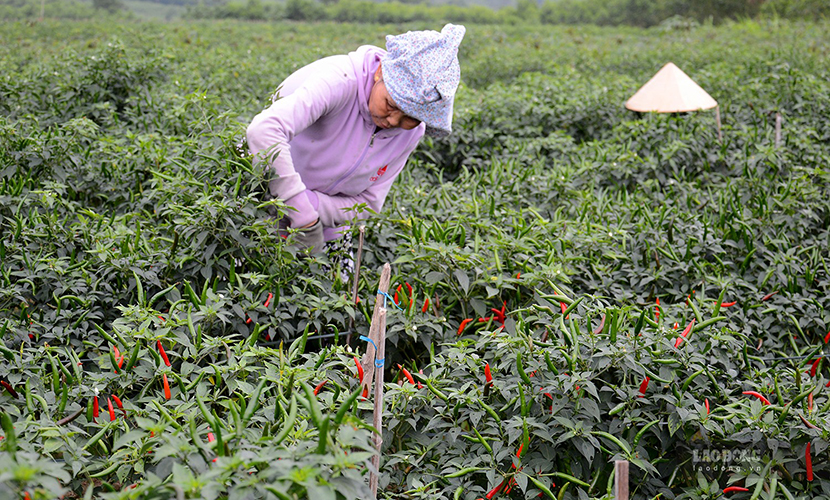
Although chili peppers are spicy, farmers in Quảng Ngãi are enjoying sweet returns from the crop as prices have risen to VND 35,000–40,000 per kilogram. At these prices, farmers can earn profits of tens of millions of Vietnamese dong per sào from Vietnamese chili cultivation.
Quảng Ngãi is considered Vietnam’s chili-growing capital. For more than half a month, local farmers have been busy harvesting their chili crop. While growers suffered heavy losses last year as prices fell to just a few thousand Vietnamese dong per kilogram, this season has brought a dramatic turnaround. Chili prices are now several times higher than a year ago. As a result, farmers can recover their production costs after the first harvest alone.
Nguyễn Ngọc Bút is a farmer in Đông Hòa Hamlet, Tịnh Giang Commune, Sơn Tịnh District. He said, “This season, my family planted three sào of Vietnamese chili peppers. Under favorable conditions, each sào yields about one tonne of chilies. Production costs have increased compared to previous years due to higher fertilizer prices. However, at current market prices, chili growers can still earn substantial profits.”
Vietnamese chili cultivation
Across the chili-growing fields in the districts of Sơn Tịnh, Bình Sơn, Tư Nghĩa, and Mộ Đức, farmers are busy harvesting their crops. Lê Thị Ánh, a farmer in Thế Bình Hamlet, Nghĩa Hiệp Commune, said that chili prices had collapsed at the same time last year. This year, however, prices have surged unexpectedly due to strong demand from the Chinese market. As a result, growers are earning substantial profits from Vietnamese chili cultivation.
Although chili prices are favorable, adverse weather conditions have made this season more challenging. Many chili fields have been affected by pests and diseases. Even so, the high selling prices have enabled farmers to remain profitable. According to local growers, if prices stay above VND 20,000 per kilogram, each sào of chilies can generate profits. These range from tens of millions to several tens of millions of Vietnamese dong.
Vietnamese chili cultivation depends heavily on demand from the Chinese market, which is highly unpredictable. Whenever demand in China is strong, chili prices can surge dramatically. Conversely, when the market weakens, chili growers in Quảng Ngãi often suffer heavy losses. As a result, local farmers often liken chili farming to a gamble. They believe success depends largely on luck.

Vietnamese fresh chili
According to the Quảng Ngãi Department of Agriculture and Rural Development, more than 878 hectares of Vietnam’s chili peppers were cultivated across the province during this winter-spring crop. This exceeded the planned area by more than 213 hectares.
To ensure the sustainable development of chili production in terms of cultivated area, pricing, and market access, Quảng Ngãi aims to establish specialized chili-growing zones geared toward commercial production. The province also seeks to strengthen partnerships with Vietnamese spice enterprises through contract farming. This will help farmers secure stable markets and avoid the recurring cycle of overproduction followed by price collapses.
Vietnamese source: https://laodong.vn/kinh-doanh/nong-dan-quang-ngai-thu-lai-3-chi-vang-moi-sao-ot-1174967.ldo
If you are interested in Vietnamese chili exports, please contact us:
Company: Agrideco Vietnam Co., Ltd.
Address: No 02, Alley 325 Kim Nguu, Vinh Tuy Ward, Hanoi, Vietnam
Tel/Kakao Talk/Whatsapp: +84 989 649 804
Website: https://agridecovietnam.com
Email: agridecovietnam@gmail.com