
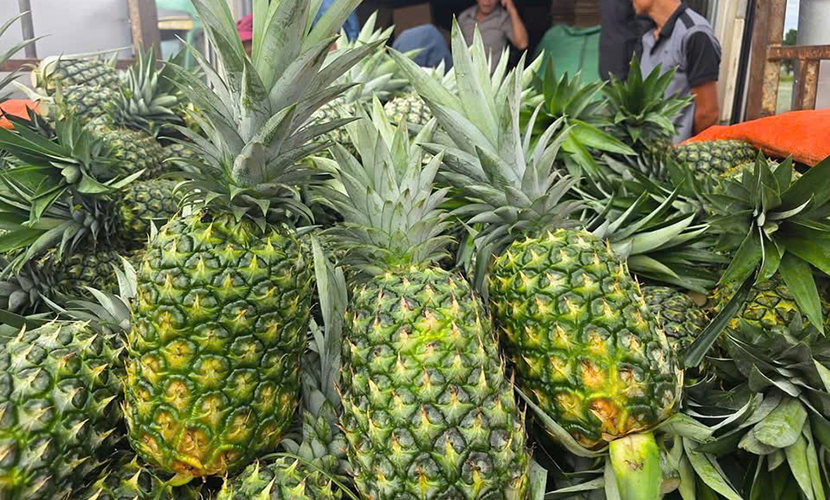
Vietnamese pineapples have recently been intercropped with macadamia and coffee under a “short-term gains to support long-term investment farming model. Accordingly, they are already demonstrating outstanding economic value in Pú Nhung Commune, Điện Biên Province. The crop is opening up a new development path by increasing the value of production and processing. It is also helping expand raw material areas for OCOP products under the Pú Nhung brand.
During the month of May, the fields and hillsides across Đề Chia A, Đề Chia B, Phiêng Pi, and Chua Lú villages are blanketed in lush green. New crops such as macadamia and coffee thrive there, while long rows of Vietnamese pineapples grow beneath them. Their spiky leaves surround large, plump fruit, and the sweet aroma of ripe pineapples fills the air.
While busy harvesting Vietnam’s pineapples, a farmer from Đề Chia B Village happily shared: “We used to grow maize, our traditional crop, but its yields were low and prices were unstable. In recent years, villagers have switched to macadamia and coffee, with pineapples intercropped beneath them.”
Mr. Lầu A Vàng is the Head of Đề Chia B Village. He shared that the village is home to 147 households with nearly 700 residents. “At first, people only planted pineapples as an intercrop under the “short-term gains to support long-term investment model. This was because Vietnamese pineapples can be harvested quickly.”
Vietnamese pineapples
“Meanwhile, coffee takes about three years and macadamia around six years before producing a crop. Compared with maize, Vietnamese pineapples generate two to three times higher economic returns. They also provide more stable yields. As a result, many families have improved their incomes and gradually escaped poverty,” he added.
Intercropping pineapples with coffee and macadamia has helped the family of Mr. Lầu A Sùng in Đề Chia B Village steadily improve their livelihood. He said, “In our first pineapple harvest in 2024, we produced more than 11 metric tons and earned around VND 80 million. Since we started earning income from pineapples, our family’s living conditions have improved significantly. We can also better support our children’s education.”
Another household in Đề Chia B Village, led by Mr. Giàng A Thào, cultivates more than 5,000 square meters of pineapples. The family is likely to produce about 12 metric tons this season. Income from Vietnamese pineapple sales has enabled him to invest in additional macadamia and coffee seedlings for new fields. As a result, his family’s standard of living has gradually improved.
Mr. Nguyễn Văn Bách is the Chairman of the People’s Committee of Pú Nhung Commune. He said that the commune currently has 320 hectares of Vietnamese pineapples intercropped with macadamia and coffee, delivering outstanding economic returns. For the new planting season, local farmers have registered to cultivate an additional 100 hectares. This expansion will include both concentrated plantations and intercropping.
To give pineapple growers confidence in market demand, the Pú Nhung Commune authorities have proactively invited processing companies to survey the area. This also helps prevent the common situation of “a bumper harvest leading to falling prices.” They have also facilitated connections between businesses and farmers to establish a stable production and marketing system for pineapples.
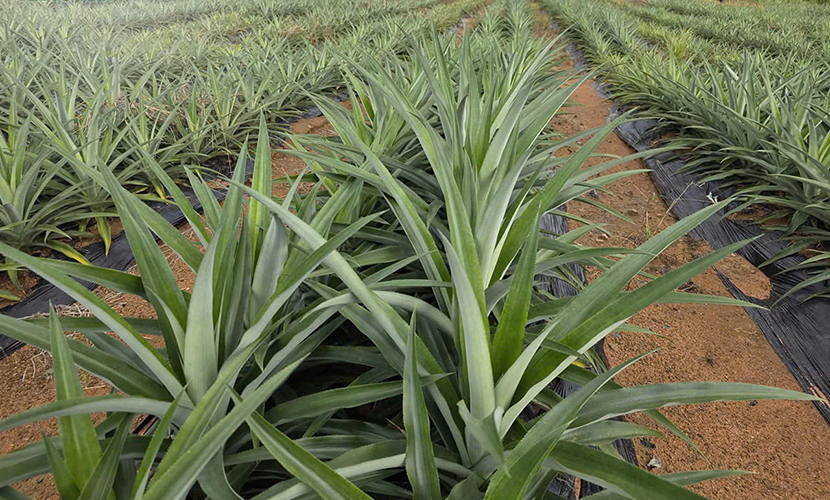
Vietnamese pineapple cultivation
With support from the local government, a Vietnamese foodstuff company has signed a cooperation agreement with the commune. The company has also committed to purchasing the entire pineapple harvest from local farmers. This partnership is considered a key driving force, giving growers the confidence to expand cultivation.
In addition to increasing production areas and supporting product marketing, the People’s Committee of Pú Nhung Commune has developed a roadmap to build an OCOP brand for Pú Nhung pineapples.
Mr. Nguyễn Văn Bách said, “With its advantages in cultivation area, concentrated production zones, and product quality, Pú Nhung pineapples have all the necessary conditions to become a flagship OCOP product of the commune. The participation of businesses further strengthens this potential. Once recognized as an OCOP product, they will establish a stronger market position. They will also gain access to larger distribution channels and move toward export markets.”
The close cooperation among the local government, businesses, and residents of Pú Nhung Commune has created an effective agricultural development model. It is improving local livelihoods while contributing to the commune’s broader socio-economic development.
Vietnamese source: https://nhandan.vn/ngot-ngao-huong-dua-pu-nhung-post960998.html
For more information about Vietnamese pineapple exports, please contact us:
Company: Agrideco Vietnam Co., Ltd.
Address: No 02, Alley 325 Kim Nguu, Vinh Tuy Ward, Hanoi, Vietnam
Tel/Kakao Talk/Whatsapp: +84 989 649 804
Website: https://agridecovietnam.com
Email: agridecovietnam@gmail.com