
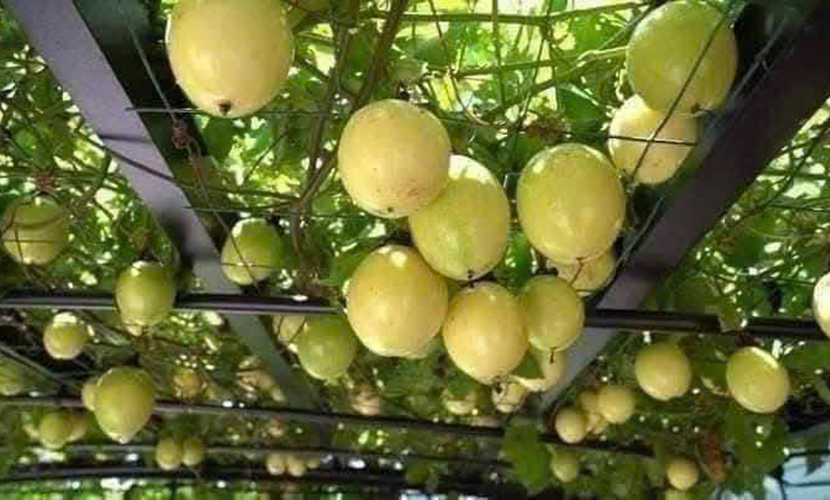
The cultivation of Vietnam’s passion fruits has been a promising agricultural model that provided livelihoods for many people in Son La. However, in recent years, the area planted with passion fruit has been shrinking. According to an estimate, there was only about 600 hectares of land for passion fruit cultivation. Notably, this was down from over 3,000 hectares in 2018.
Mr. Trang Van De is a farmer who currently grows 750 passion fruit plants in Phieng Cai village. He shared that passion fruit used to be the main source of income for his family in previous years. However, the cultivation model of this crop is becoming increasingly less effective.
He add: “A few years ago, we only planted second and third-season passion fruit. At that time, with 260 plants, we still earned about 60 million VND per year. This year, my wife and I invested in first-season plants. However, as of now, the 750 plants have only brought in about 30 million VND in income.”
Vietnam’s passion fruits
Similarly, at another household growing Vietnam’s passion fruits in Chieng Son commune, the situation is not much better. The farmer shared that during the “golden years” of 2018, his family grew over 500 passion fruit plants. At that time, red passion fruit had high value. The purchasing price of one kilogram of red passion fruit could be 30,000 VND, or even up to 40,000 VND.
However, the price of Vietnamese passion fruit has declined over the years, forcing him to reduce the scale. This year, the price of passion fruit has continued to plummet. Each kilogram now fetches only 4,000-6,000 VND only. Therefore, his family has “abandoned” the garden and switched back to planting corn and cassava.
Son La province first piloted the passion fruit cultivation model in 2015. After the pilot period, the province allowed Vietnamese export companies to expand the passion fruit growing area. The target was to reach 5,000 hectares of land for this fruit.
Initially, passion fruit was the “golden fruit” for farmers in Son La. More specifically, one hectare of well-grown passion fruit could generate an income of up to 600-700 million VND per year. Vietnamese fruit companies would purchase and process the passion fruit grown in Son La. Then, they would export to promising international markets such as the UK, France, Switzerland, and the Netherlands.
However, in the past four years, the supply of raw materials for these companies’ agricultural processing plant has not met quality requirements. Earlier, the company had hoped that when the plant went into operation, it would run at full capacity, processing about 120 tons of fresh fruit per day. However, currently, the plant processes an average of less than ten tons of fruit per day. The number of workers at the plant has also decreased from 100 to about 20.
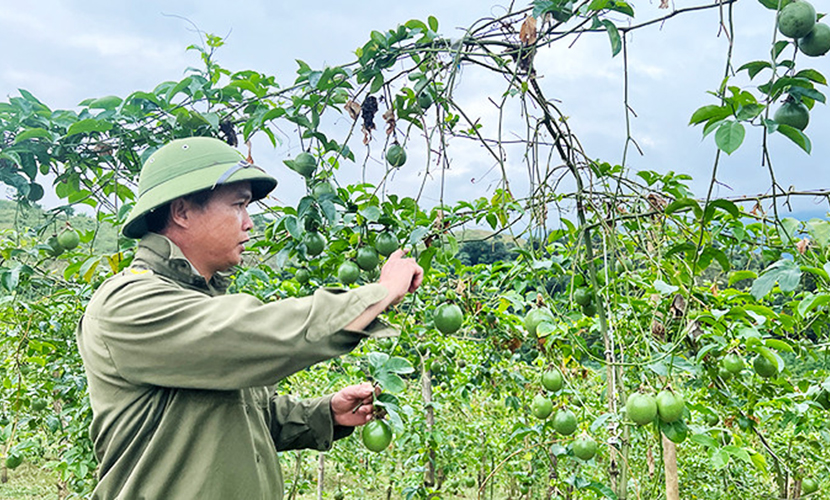
A farm of Vietnam’s passion fruits
“From February to May this year, our plant was almost completely idle because we did not have enough Vietnam’s passion fruits to process. This is truly a difficult problem since we are completely dependent on the people for our raw materials,” said Mr. Mai Van Quang, Deputy Director of a partnered company.
Mrs. Nguyen Thi Hoa is the Vice Chairwoman of the Moc Chau District People’s Committee. According to her, this district is one of the largest areas for passion fruit cultivation in Son La province. However, at this time, passion fruit farming is an economically ineffective model. There are many reasons for the shrinking area of passion fruit cultivation.
The first reason is that passion fruit is a difficult crop to grow. It is hard to intensively cultivate, and the plants are very susceptible to viruses and pests. Once infected, the disease can spread quickly. In most cases, when a passion fruit garden is infected with viruses or pests, farmers will destroy the entire garden. As a result, they have to let the land rest for about nine months to a year.
Moreover, after the “golden” period in 2018, the COVID-19 pandemic also caused difficulties for passion fruit exports. This was especially problematic since China was the main market for fresh passion fruit. Additionally, the implementation of the “four-house” linkage model (businesses – government – cooperatives, cooperative groups – people) has also been ineffective.
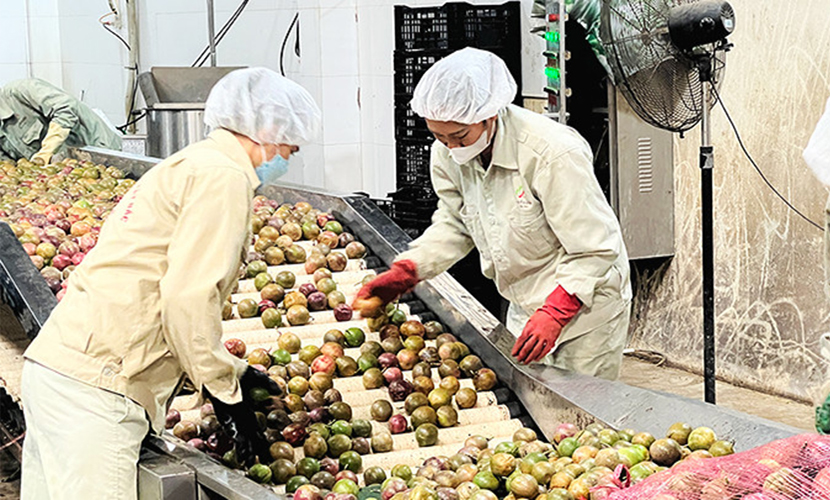
Vietnam’s passion fruit factory
In reality, the role of cooperatives as intermediaries to connect businesses with local farmers has been very weak in recent years. Mr. Quang emphasized that cooperatives have not fulfilled commitments regarding the quantity of Vietnam’s passion fruits and purchase prices with the company.
In light of this situation, partnered companies stated that they had to shift to cooperating with distributors and agents. Specifically, based on the daily processing needs of the plant, they contact distributors and agents to place orders and make payments.
Meanwhile, the distributors and agents directly purchase from the farmers. Although this method prevents them from controlling its raw materials for production, it is a temporary solution while the cooperatives fail to meet their commitments.
With the current situation, to achieve the goal of restoring the area of passion fruit cultivation as outlined, both local authorities and businesses will need to collaborate. They must find practical policies and effective solutions to create a positive direction for passion fruit farming in this region in the coming years.
Vietnamese source: https://nhandan.vn/tim-loi-ra-cho-chanh-leo-o-son-la-post787608.html