
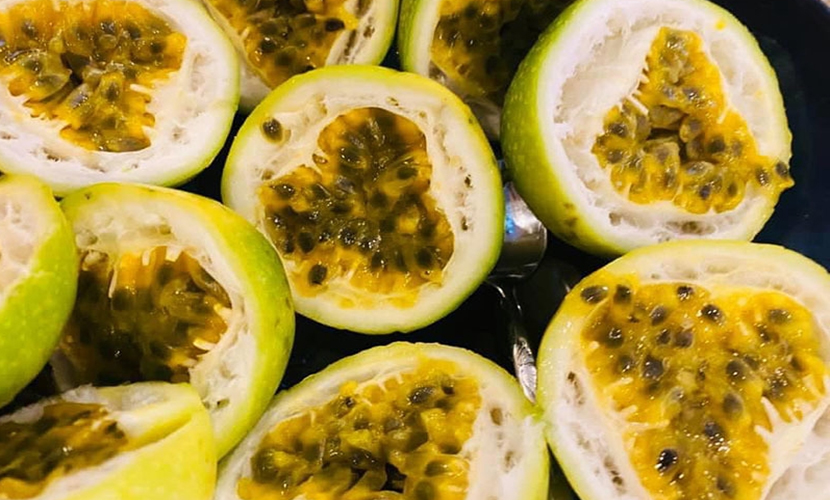
Since 2015, the passion fruit cultivation model has been piloted in Son La province. Passion fruit is easy to care for and has a short harvesting period, yielding fruit within four months. After the trial period, Son La passion fruit model has recognized as a highly potential model. Therefore, the province has expanded the passion fruit raw material area, aiming to reach 5,000 hectares.
The tropical monsoon climate, significant day–night temperature variation, and fertile soil contribute to the quality of passion fruits in Son La. As a result, the fruits are large, yellow when ripe, richly pulped, aromatic, and sweet. Passion fruit has many health benefits, resulting in stable demand and economic benefits for local people.
Son La passion fruit is consumed within the province and is increasingly being distributed to other provinces. In Hanoi, Son La passion fruit is sold in supermarkets and local markets.
With strong market demand, Son La passion fruit offers many opportunities for local residents to increase their income. Along with ensuring production processes and pest control, promoting production linkages and maintaining stable product output will gradually establish commercial agricultural production areas. In doing so, passion fruit cultivation will develop sustainably and support local economic growth.
Currently, the total area of passion fruit cultivation in Son La is over 750 hectares. Of which, more than 710 hectares are productive. The average yield is 9.4 tons per hectare, with an annual output exceeding 67,200 tons.
Within the province, passion fruit is mainly available in Mai Son, Thuan Chau, Moc Chau, and Van Ho districts. Due to its economic effectiveness, Son La passion fruit is gradually replacing less profitable crops in the province.
To sustainably develop passion fruit as a commercial crop, the province approved a project. Through this initiative, the province aims to build “Son La passion fruit” certification trademark.
Son La passion fruit
In 2020, the “Son La Passion Fruit” certification trademark granted registration by the Intellectual Property Office. Specifically, the area covers the districts of Van Ho, Moc Chau, Yen Chau, Mai Son, Thuan Chau, and Phu Yen.
To build the brand, farmers need to gradually apply science and technology to improve yield and quality while ensuring stable output. Based on this, the province granted certification trademark usage rights to organizations and cooperatives. The project implementing unit provided 100 handbooks, 4,500 leaflets, 60 posters, 6,600 packaging units, and 9,900 labels to the participating passion fruit producers.
Thus, Son La province selected six local cooperatives to support trademark use rights. In addition, they provide QR code traceability systems, product traceability labels, and packaging identification systems to help consumers recognize Son La passion fruit.
In addition to domestic consumption, Son La passion fruit is available to many markets worldwide, including China and France. To ensure quality supply and meet export standards, the province places great importance on establishing cultivation codes.
At the beginning of 2023, Son La province was granted four cultivation codes, covering 66.5 hectares for Bao Sam Agricultural Cooperative and Thanh Dat Cooperative in Chieng Luong commune, meeting export requirements.
Bao Sam Agricultural Cooperative in Chieng Luong commune, Mai Son district, currently has 30 hectares of passion fruit. Additionally, the cooperative collaborates with local households in Chieng Luong and Pieng Pan communes to cultivate nearly 70 hectares.
By applying scientific advances in production, the cooperative’s passion fruits achieved high yield, quality, and attractive appearance, meeting export standards. In January 2023, China approved three cultivation codes for Bao Sam Cooperative, covering 56.5 hectares, allowing official exports to China.
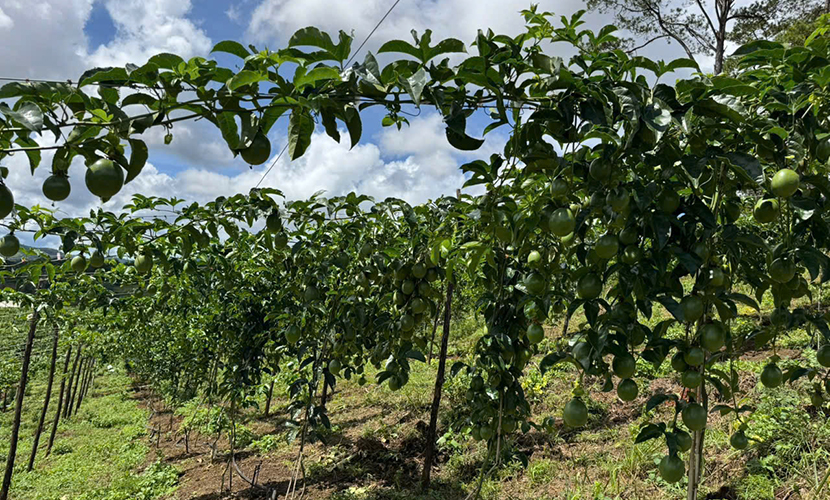
Son La passion fruit farm
For Thanh Dat Cooperative in Chieng Luong commune, the General Administration of Customs of China approved one cultivation code, covering 10 hectares, meeting conditions for official export to China.
Along with granting cultivation codes and meeting export requirements, the province continues to strengthen the establishment, management, and monitoring of passion fruit cultivation codes. The province especially focuses on controlling pests such as aphids and fruit flies and monitoring pesticide residues to comply with international market regulations. Consequently, the output of Son La passion fruit is favorable, with increasing orders from domestic and foreign companies.
The potential for passion fruit development is very high. In particular, the recent U.S. decision to allow imports of Vietnamese passion fruit has opened new prospects for the national fruit sector and for the province. Therefore, Son La needs to continue promoting, guiding, and supporting farmers, cooperatives, and businesses. In particular, this involves establishing cultivation codes and packing facility codes.
To ensure abundant, high-quality passion fruit supply, the “Project on the Development of Crop Production towards Safety, Sustainability, and High-Tech Application for 2021-2025, with Orientation to 2030” sets the target of reaching 4,260 hectares of passion fruit and 38,740 tons by 2025. The area for processing and export will be 1,500 hectares in 2025 and 2,000 hectares in 2030.
To achieve these targets, local authorities and businesses need to collaborate. They must find practical policies and effective solutions to create a positive development path for passion fruit in the region. In particular, Son La province needs to focus on implementing the “Four-Party Linkage” model. At the same time, it should develop the passion fruit raw material areas within the province.
Vietnamese source: https://sanphamvungmien.vn//san-pham-vung-mien/mien-bac/2024/10/chanh-leo-son-la-duoc-nguoi-tieu-dung-ua-chuong-mang-lai-hieu-qua-kinh-te-cao