
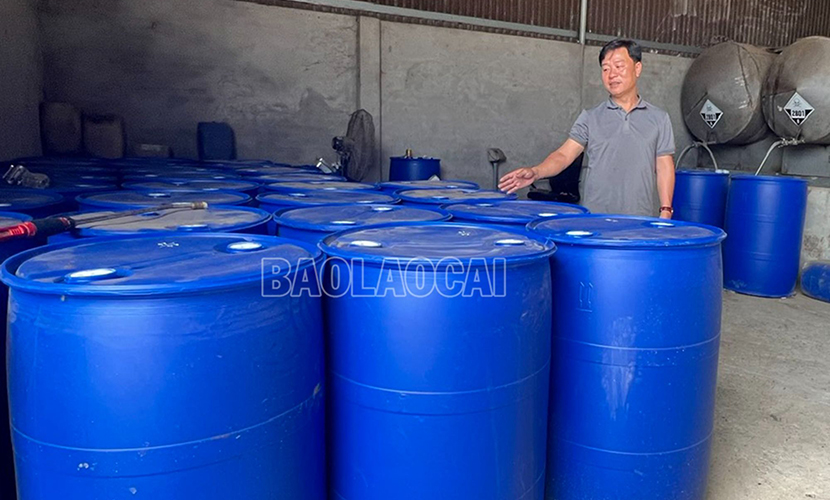
Since the beginning of 2023, Vietnamese cinnamon essential oil has been difficult to sell. Specifically, the selling prices have remained low and it could not export due to unsuitable regulations. Recently, the Ministry of Health and the General Department of Customs have issued specific guidelines. Therefore, the export of Vietnamese cinnamon essential oil has rebounded.
According to calculations, producing one kilogram of cinnamon essential oil costs approximately 400,000 – 480,000 VND. Since early 2023, the selling price of cinnamon essential oil has fallen significantly, decreasing from 600,000 VND/kg to 360,000 VND/kg. On some occasions, it has even dropped to 280,000 VND/kg. As a result, businesses have experienced financial losses, temporarily suspended production, and accumulated excess raw materials.
Vietnamese cinnamon essential oil
Export activities faced significant obstacles, leaving hundreds of tons of Vietnamese cinnamon essential oil unable to reach international markets. Consequently, companies halted the purchase of raw materials, resulting in the spoilage of thousands of tons of ingredients.
Since the end of April 2024, the export of cinnamon essential oil has improved. The market has expanded, and prices have gradually risen, providing an encouraging signal for businesses.
After a period of minimal production, the cinnamon essential oil factory of Trieu Duong has now resumed stable operations. Currently, the company uses an average of 30–50 tons of raw materials per day. This produces about 0.7 tons of essential oil, reaching roughly 80% of the factory’s capacity.
Mr. Vu Van Thang is the Director of Trieu Duong factory. He shared: “We hope that both domestic and international markets will stabilize. This would create favorable conditions for businesses to produce and for locals to sell raw materials.”
The smooth consumption of Vietnamese cinnamon essential oil is also a positive signal. It helps thousands of cinnamon-growing households in the province reduce worries about selling their raw materials.
Mr. Dang Van Minh from Ban Cai Commune (Bac Ha) said: “Since the end of last year, the price of cinnamon branches and leaves dropped sharply, at times reaching only 600 VND/kg. With such low prices, the revenue could not even cover labor costs for harvesting. Therefore, many households did not prune branches and leaves for sale. Recently, prices have stabilized (ranging from 1,600 to 1,900 VND/kg), providing cinnamon growers with additional income.”
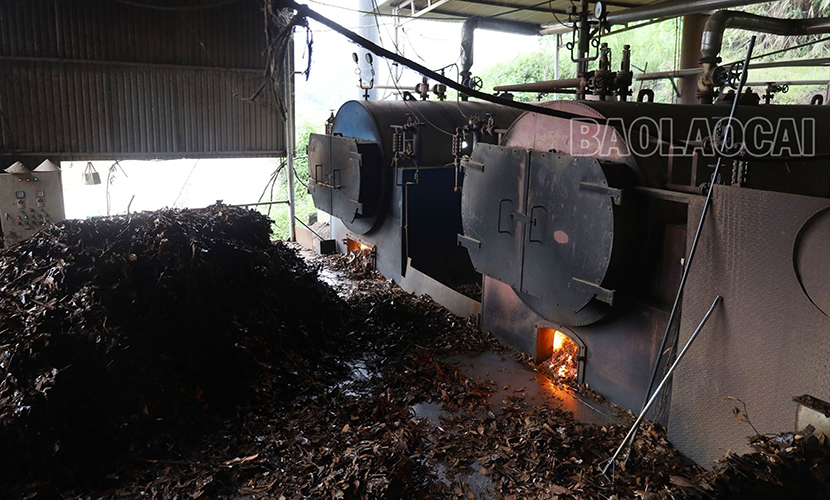
Vietnamese cinnamon essential oil factory
Bao Thang District currently has four cinnamon essential oil processing factories. The annual output reaches more than 140 tons of Vietnamese cinnamon essential oil. Like other processing facilities in the province, many factories faced significant challenges and operated at minimal capacity in 2023. However, they have now resumed activity.
Mr. Hoang Minh Thai is the Director of Hoang Thai Company (Xuan Quang Commune, Bao Thang District). He shared: “Recently, the market for Vietnamese cinnamon essential oil has become more favorable. Selling prices have increased by approximately 10–20% compared to the end of last year. However, the volume of exported goods remains low due to challenges in the global market. With a designed capacity of 70 tons of essential oil per year, the company is currently producing only 50%.”
“Cinnamon essential oil prices reached a low point at the end of 2023, when they were only 280–330 million VND per ton. However, they have begun to increase over the past month. At present, they are between 360–400 million VND per ton. According to forecasts, these prices will be able to improve further. This is due to regulatory issues regarding export product codes being actively addressed by the relevant authorities.
Mr. Vu Hong Diep is the Deputy Director of the Provincial Forest Protection Department. He stated: “Vietnamese cinnamon products currently mostly export in raw form for use as food or flavoring. Therefore, applying a single code meant for medicinal herbs has unintentionally created difficulties for businesses. This has prevented local cinnamon growers from selling their products”.
“Recently, the General Department of Customs provided specific guidance for companies on declaring export purposes. As a result, it has helped revive cinnamon essential oil exports. This development has encouraged local farmers to harvest cinnamon. At the same time, businesses are actively purchasing, processing, and producing cinnamon essential oil and other cinnamon products.”
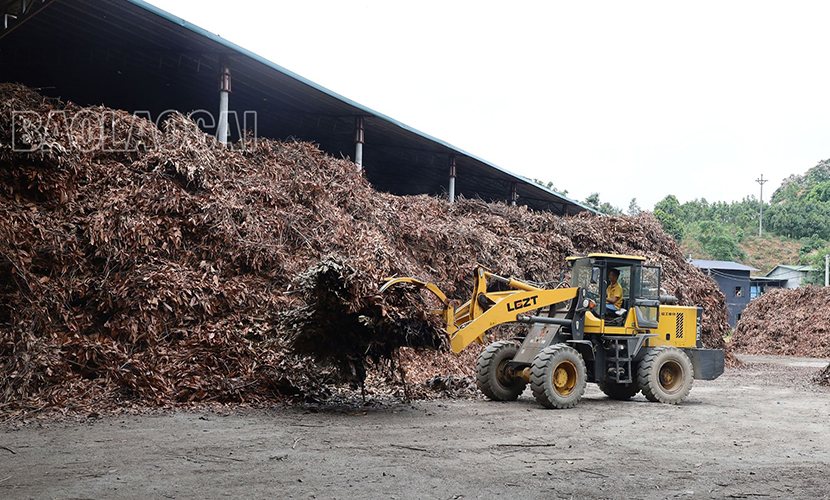
Vietnamese cinnamon essential oil materials
There are currently more than 58,000 hectares of cinnamon in the province. Each year, this area yields around 9,000 tons of cinnamon barks and nearly 120,000 tons of branches and leaves. At present, the province has nine companies and one cooperative producing Vietnamese cinnamon essential oil.
The designed processing capacity of these facilities ranges from 60 to 120 tons of essential oil per year per facility. The basic extraction technology uses steam-based distillation. The province’s total cinnamon essential oil output reaches over 450 tons per year.
Raw materials for essential oil extraction (cinnamon branches and leaves) are mainly purchased through small local collection points. About 85% of the province’s essential oil output is exported to markets in China, India, and Japan. The remaining 15% serves domestic demand.
Vietnamese cinnamon essential oil is primarily extracted from leaves and small branches trimmed annually to promote tree growth. Although it is a by-product of cinnamon cultivation, it generates significant income that helps farmers reinvest in production.
The province’s cinnamon essential oil output will be able to increase significantly as many local raw material areas reach harvest time. Along with the expansion of organic cinnamon cultivation areas, the province is prioritizing the deep processing of cinnamon products, including essential oil. This effort aims to enhance the value and sustainability of this key agricultural sector.
Vietnamese source: https://baolaocai.vn/xuat-khau-tinh-dau-que-khoi-sac-tro-lai-post384256.html
If you are interested in Vietnamese cinnamon essential oil exports, please contact us:
Company: Agrideco Vietnam Co., Ltd.
Address: No 02, Alley 325 Kim Nguu, Vinh Tuy Ward, Hanoi, Vietnam
Tel/Kakao Talk/Whatsapp: +84 989 649 804
Website: https://agridecovietnam.com
Email: agridecovietnam@gmail.com