
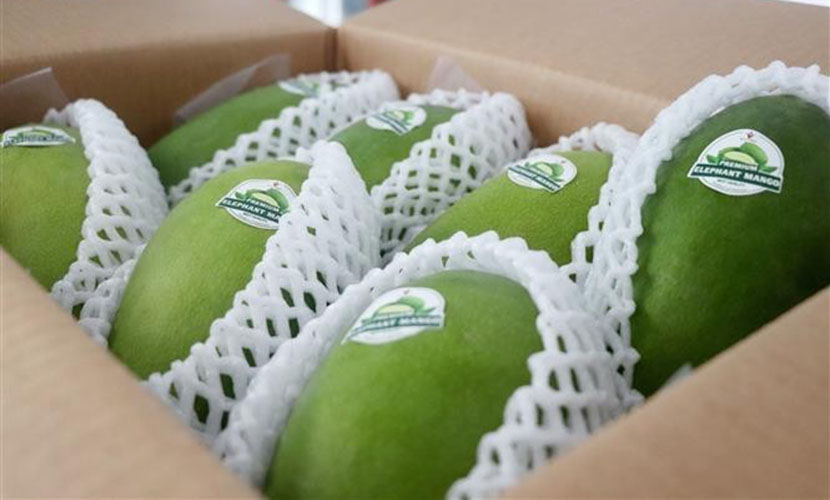
In recent years, Vietnam’s mangoes have become one of the key fruit crops in Mekong Delta. They have generated significant economic value for local farmers. Since the beginning of October, mango growers have had even more reason to celebrate. Mango prices have shown an upward trend. They increased by between VND 2,000 and VND 10,000 per kilogram, depending on the variety.
In An Giang Province, Grade 1 green-skin mangoes have prices ranging from VND 12,000 to VND 15,000 per kilogram. Meanwhile, Grade 2 fruit sells for between VND 6,000 and VND 8,000 per kilogram. Keo mangoes are also selling at VND 10,000 to VND 12,000 per kilogram. For households that have established partnerships with cooperatives, selling prices can be 10–20 percent higher than prevailing market rates.
The price increase largely attributes to the current off-season period. During this time, mango production is lower than in the early months of the year, resulting in limited supply. At the same time, demand for both domestic consumption and export markets has risen significantly.
Vietnam’s mangoes
Vietnam’s Ministry of Agriculture and Environment has set ambitious goals for the mango industry by the year of 2030. These include approximately 140,000 hectares of mango cultivation, annual production of 1.5 million tons, and an export value target of USD 650 million. To achieve these objectives, Vietnam’s mangoes will need not only sufficient production volumes. They will also need consistent quality capable of meeting increasingly stringent standards in both domestic and international markets.
Mr. Đặng Văn Phước is a farmer in Cù Lao Giêng Commune, An Giang Province. In just over ten days, nearly one hectare of Keo mangoes owned by him will be ready for export to South Korea. This year, favorable fruit-setting rates and strong market prices have given him plenty of reasons to be optimistic.
He said: “Compared with previous years, prices are much higher, providing great support for farmers. At current price levels, after deducting production costs, we can still earn a profit margin of around 50 percent.”
At present, the Mekong Delta’s mango industry directs most of its production toward export markets. However, to access these markets, growers must first comply with standards such as VietGAP and GlobalGAP. From flowering induction and fruit bagging to post-harvest handling and storage, every stage of production must strictly adhere to established protocols.
Mr. Lê Thanh Tùng is a farmer in Cao Lãnh Ward, Đồng Tháp Province. He shared: “The orchard must keep clean. We apply pesticides according to the approved list and strictly observe the required pre-harvest intervals. There must also be designated facilities for handling plant protection chemicals. Packaging materials must be collected and disposed of properly. This includes incineration at designated sites.”
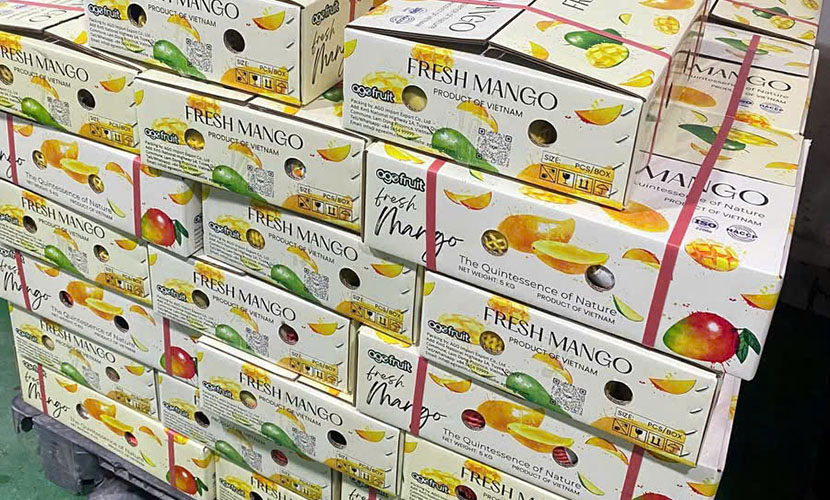
Vietnamese mango carton boxes
Mr. Nguyễn Minh Hiền is the Director of the Cù Lao Giêng Cooperative in An Giang Province. He stated: “To meet export market requirements, Vietnam’s mangoes must be free of pesticide residues and prohibited substances. Any inputs that importing countries do not allow are removed from our production process. This helps ensure compliance with their standards.”
Mr. Trần Thanh Hiệp is Deputy Director of the Department of Agriculture and Environment of An Giang Province. He noted: “We will continue strengthening partnerships with Vietnamese mango businesses to establish production linkages. We will also develop standards and regulations that farmers can follow. At present, greater transparency is necessary in both product traceability and market connectivity.”
The Mekong Delta currently has nearly 2,000 hectares of mango orchards certified under VietGAP and GlobalG.A.P. standards. In addition to China, Vietnamese mangoes are available in demanding markets such as the United States, South Korea, Japan, the Netherlands, and New Zealand. Expanding export markets not only enhances the value and reputation of Mekong Delta mangoes but also contributes to the overall growth of Vietnam’s fruit and vegetable export earnings.
It is clear that Vietnam’s mangoes are gaining an increasingly strong foothold in global markets. However, between 80 and 90 percent of the mangoes are available as fresh fruit. This heavy reliance on fresh exports leaves the industry vulnerable to price fluctuations and market uncertainties. As a result, many Vietnamese businesses are seeking ways to ensure that Vietnamese mangoes are not only delicious but also generate greater and more sustainable value.
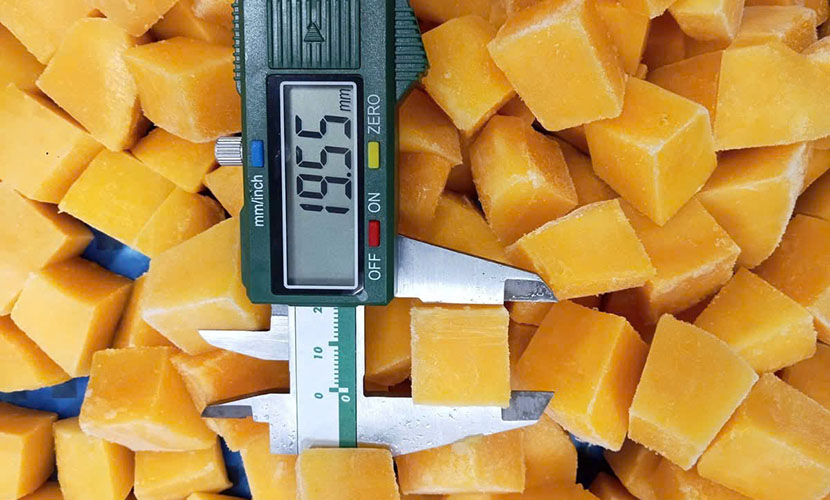
Vietnamese frozen mangoes
Mr. Huỳnh Hữu Lộc is the Director of Hòa Lộc RR Mango Company. He explained: “Frozen mango products can be stored for at least six months to one year. This helps overcome transportation time constraints and allows consumers to enjoy mangoes out of season.”
Mr. Trần Thanh Hiệp is the Deputy Director of the Department of Agriculture and Environment of An Giang Province. He commented: “By investing in deep processing, the value of Vietnamese agricultural products extends far beyond that of fresh produce. It generates several times greater economic returns. For this reason, the agricultural sector is actively inviting businesses to invest in An Giang. We commit to listening to enterprises and creating the most favorable conditions possible for the development of processing industries.”
Mr. Huỳnh Thanh Hiệp is the Director of Nam Huy Company in Đồng Tháp Province. He added: “More support is necessary from local authorities. In particular, assistance is required in facilitating access to advanced machinery and equipment and serving as a bridge between businesses and production areas.”
Vietnamese source: https://vtv.vn/hanh-trinh-trai-xoai-tu-vuon-ra-the-gioi-100251019112953979.htm
If you are interested in Vietnamese mango exports, please contact us:
Company: Agrideco Vietnam Co., Ltd.
Address: No 02, Alley 325 Kim Nguu, Vinh Tuy Ward, Hanoi, Vietnam
Tel/Kakao Talk/Whatsapp: +84 989 649 804
Website: https://agridecovietnam.com
Email: agridecovietnam@gmail.com