
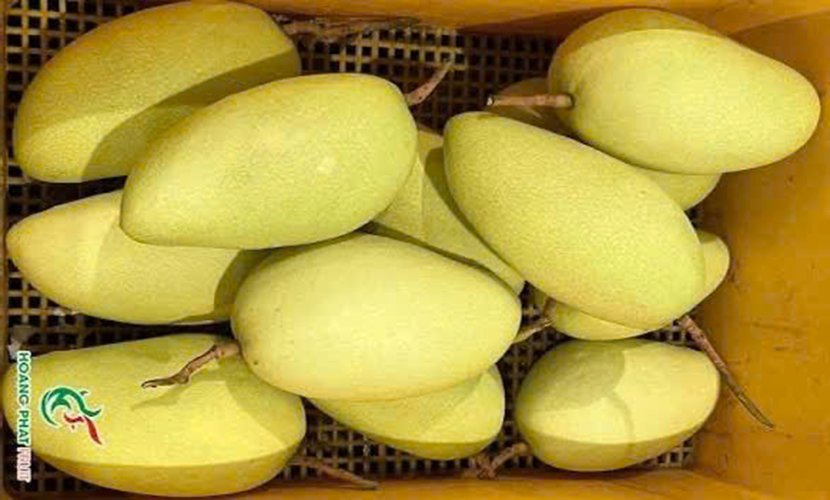
After getting off the coach from Hung Yen to Song Ma in Son La Province, we met Mr. Nguyen Van Vuong, Director of the Song Ma Mango Agricultural Service Cooperative, who took us directly to Co Kieng Village in Huoi Mot Commune. There, he and fellow cooperative members work with local farmers to produce export-quality Vietgap mangoes.
During our conversation, Mr. Vuong told us that his family originally came from Hung Yen. He explained that they settled in the former Song Ma District in the early 1960s. At that time, land was abundant and the population was sparse, making it ideal for livestock raising and crop cultivation. Most households practiced subsistence farming, ensuring they had enough food and rarely faced hunger.
As Vietnam’s agriculture gradually shifted toward commercial production, however, Song Ma’s remote location limited farmers’ access to modern farming techniques. With small-scale production and a traditional crop structure, most local households remained poor.
The situation did not begin to change until 2015. That year, the Ministry of Agriculture and Rural Development sent agricultural experts to work alongside local extension officers. Through hands-on technical guidance, farmers converted low-value cropland into export-quality Vietgap mangoes and other high-value fruit crops. The transformation has had a positive impact on the local community. Thanks to it, Mr. Vuong and many ethnic minority families have steadily and significantly improved their livelihoods.
Export-quality Vietgap mangoes
To maximize productivity, Mr. Vuong and the cooperative members carefully selected suitable hillside sites. The soil is more than one meter deep, rich in organic matter and nutrients, and has a pH ranging from 6.0 to 7.5. They also prioritized locations near mountain springs, allowing water to gravity-feed through an automatic irrigation system. This is particularly important during the first one to three years after planting, as well as during flowering, fruit set, and fruit development.
This approach has significantly reduced the cooperative’s spending on fertilizers while eliminating the need to invest in electric pumps, fuel, and irrigation equipment. Three years after planting, each mango tree produces an average of 45–50 fruits. This is equivalent to a yield of around 10 tonnes per hectare after excluding fruit that does not meet export standards.
To achieve high yields and maximize the proportion of export-quality fruit, the cooperative follows VietGAP standards throughout production. It cultivates the GL4 mango variety, applies balanced fertilization, and implements Integrated Pest Management (IPM). Biological crop protection products are applicable whenever possible. Meanwhile, regular pruning, shoot pinching, and post-harvest orchard sanitation are carried out to maintain tree health. The cooperative also places strong emphasis on applying well-decomposed organic manure and bio-organic fertilizers.
Before planting, each tree receives a basal application of 6–30 kilograms of organic or bio-organic fertilizer, depending on the fertilizer type. After harvest, the same types of fertilizer are appliable again as top dressing. NPK fertilizer is applied at a rate of only 1.5–2 kilograms per tree. Applications take place during the early fruiting stage, throughout fruit development (April–May), and immediately after the harvest season.
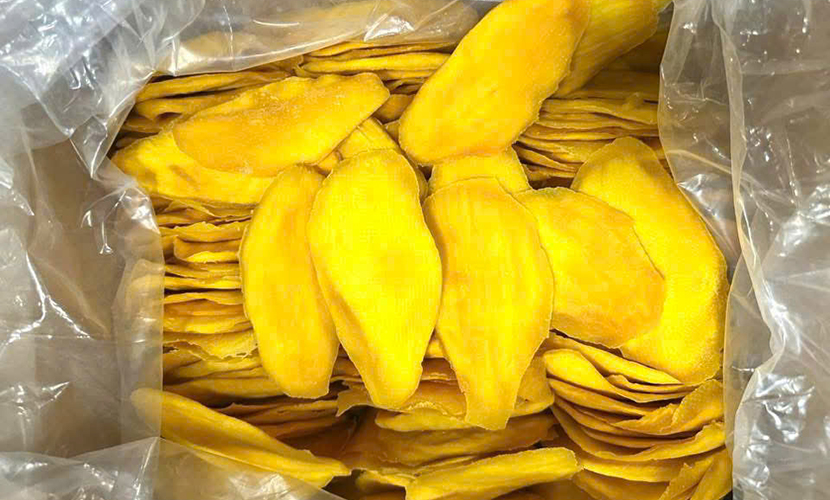
Dried mangoes from Vietnam
In addition, unproductive, diseased, and pest-infested branches are removed regularly. Before flower bud differentiation, typically in late October, the trees are sprayed with high-phosphorus fertilizer. Meanwhile, the tips of tertiary and quaternary shoots produced during the first vegetative flush are pinched. This practice stimulates abundant flowering and improves fruit set.
According to Mr. Vuong, export-quality Vietgap mangoes in the area are susceptible to a wide range of pests and diseases. These include anthracnose, powdery mildew, leaf-eating caterpillars, shoot borers, stem borers, thrips, aphids that attack flowers and young fruit, and oriental fruit flies. Among these, however, thrips, fruit flies, and stem borers cause the most severe damage.
To effectively control these three major pests, the cooperative sprays against thrips as soon as young fruit begins to form. It then bags the fruit when it reaches about the size of a thumb to protect it from fruit fly infestation. After each harvest, limewash is also appliable to the trunks and bases of the trees to help prevent stem borer attacks.
In addition, orchard inspections are carried out regularly. When stem borer holes are detected, a steel wire is inserted into the tunnels to kill the larvae. Alternatively, plant protection chemicals mix with soil to seal the entry holes. These holes can be identified by sawdust-like frass protruding from the bark.
Thanks to these cultivation practices, the cooperative has consistently achieved strong production results. As a result, its 10-hectare mango plantation has produced around 100 tonnes of fruit annually under Mr. Vuong’s leadership since 2020. This has generated more than VND 1.3 billion in revenue and approximately VND 800 million in profit each year.
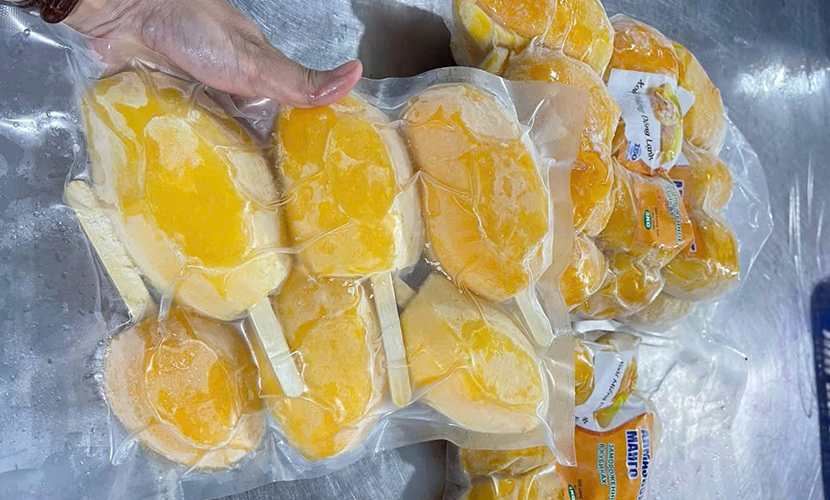
Frozen mangoes from Vietnam
In 2025, the lunar calendar included an intercalary month. As a result, the flowering, fruit set, and harvesting of mangoes and other fruit trees were delayed by about one month compared with the previous year. Nevertheless, the cooperative still expects to harvest around 100 tonnes of mangoes, with 80% meeting export standards. Estimated profit is likely to reach VND 900 million.
“We have achieved these production results not only through improved farming practices. They have also been made possible by support from the Son La Department of Agriculture and Environment. The department granted the cooperative a growing area code and provided environmentally friendly fruit-bagging materials. In addition, it implemented several other policies to encourage agricultural production,” Mr. Vuong said.
Looking ahead, Mr. Vuong plans to further increase the economic value of the cooperative’s mango orchards beginning in 2026 by inducing off-season flowering and fruit production on part of the plantation. The technique involves spraying the tree canopy with the plant growth regulator PBZ (Paclobutrazol) in October.
It also includes removing the main-season flower panicles the following February and applying NPK fertilizer to the root zone. Using this method, the trees are likelyto flower and set fruit again about two months later. This will allow harvests to take place in August and September. The technique has already successfully adopted on a commercial scale in Mai Son Commune, Son La.
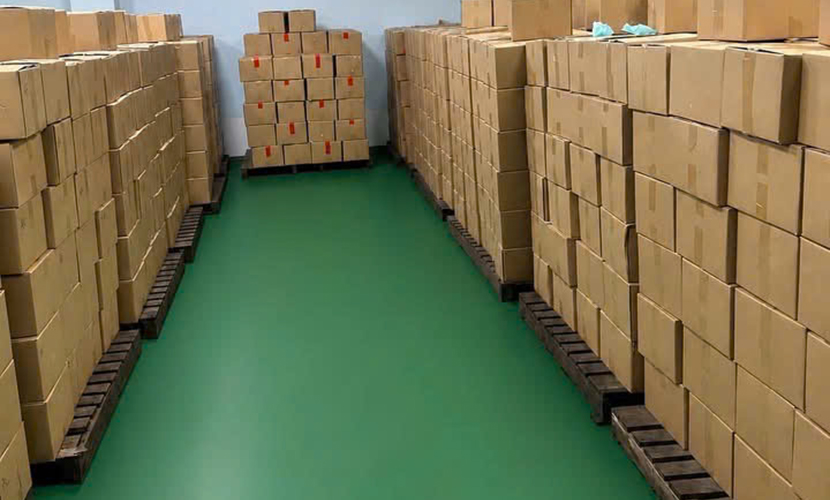
Vietnamese mango exports
Export-quality Vietgap mangoes to China must harvest at the proper stage of physiological maturity and exhibit the characteristic traits of the variety. The fruit should have green skin with an attractive appearance and be free from bruises, scratches, and pest or disease damage. It must also comply with regulations on chemical residues and harmful microorganisms. Each mango must weigh at least 0.7 kilograms and have firm, sweet, aromatic flesh with minimal fiber and a small seed.
The former Song Ma District currently has more than 1,700 hectares of export-quality Vietgap mangoes, with total output estimated at 4,850 tonnes. The growing area is fairly evenly present across the new communes. These include Muong Hung (262 hectares), Song Ma (more than 260 hectares), Chieng Khoong (257 hectares), Chieng So (243 hectares), Muong Lam (174 hectares), Chieng Khuong (163 hectares), Nam Ty (135 hectares), Bo Sinh (134 hectares), and Huoi Mot (80 hectares).
If you need more information about Vietnamese mangoes, please do not hesitate to contact us:
Company: Agrideco Vietnam Co., Ltd.
Address: No 02, Alley 325 Kim Nguu, Vinh Tuy Ward, Hanoi, Vietnam
Tel/Kakao Talk/Whatsapp: +84 989 649 804
Website: https://agridecovietnam.com
Email: agridecovietnam@gmail.com