
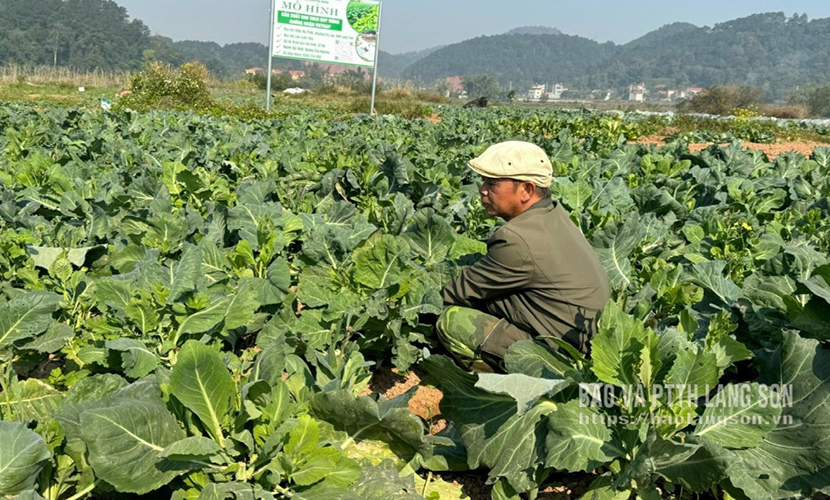
In recent years, the area under Vietgap vegetable production in Ky Lua Ward has continued to expand. The model has not only helped improve the quality and productivity of Vietnamese vegetables. It has also gradually transformed local farmers’ production practices and mindset.
Na Pinh Residential Area is one of the largest vegetable-growing areas in Ky Lua Ward. In the past, local farmers mainly cultivated vegetables using traditional methods. However, since mid-2025, many households have adopted Vietgap vegetable production, following a more systematic and standardized cultivation process.
Mr. Dinh Van Ket is a farmer from Na Pinh. He said: “My family has been cultivating six sao (approximately 2,160 square meters) of Chinese kale, cabbage, and kohlrabi under Vietgap standards since October 2025. Since then, I have attended three training courses organized by local agricultural authorities on Vietgap production practices. We have also received 400 kilograms of organic fertilizer and biological crop protection products to support production.”
“Initially, complying with Vietgap requirements, such as composting, fertilization, and harvesting procedures, was challenging. However, we have clearly seen the benefits. In our first harvest under the Vietgap model, vegetable yields increased by around 20%. Product quality and appearance also improved significantly.”
Vietgap vegetable production
The Vietgap vegetable production model first introduced in Ky Lua Ward in 2017, covering just 12 hectares. To expand the cultivation area, local authorities have implemented various measures over the years. These include raising awareness of the benefits of Vietgap farming, providing technical training, and assisting farmers with the procedures required to participate in the program.
Since 2025, for example, the ward has encouraged local households to develop an additional five hectares of Vietgap-certified vegetable production. It has also coordinated with relevant agencies to organize three training courses for more than 100 farming households. In addition, leading farmers have received nearly 10 tonnes of fertilizers and agricultural inputs, while many have participated in study tours to successful production models in neighboring provinces.
As a result, the total area of Vietgap-certified vegetables in Ky Lua Ward has expanded to nearly 30 hectares. Between 2020 and 2025, the ward added an average of more than three hectares each year. A total of 38 households now participate in the model, making Ky Lua one of the largest Vietgap vegetable production areas in the province, which has more than 70 hectares of VietGAP-certified vegetables overall. Most of the cultivation is availablle in Na Pinh, Na Han, and Bac Dong II residential areas.
According to participating farmers, Vietgap vegetable production is more demanding than traditional cultivation. It requires strict compliance with standardized farming practices. Organic fertilizer, for example, must be composted for at least 15 days before application. Crop protection products must also be applied at the appropriate growth stages, and vegetables can only be harvested at least 15 days after spraying.
Despite these stricter requirements, inspections conducted by the Ky Lua Ward Department of Economy, Infrastructure and Urban Development have shown positive results. Participating households are implementing the standards diligently and with increasing professionalism.
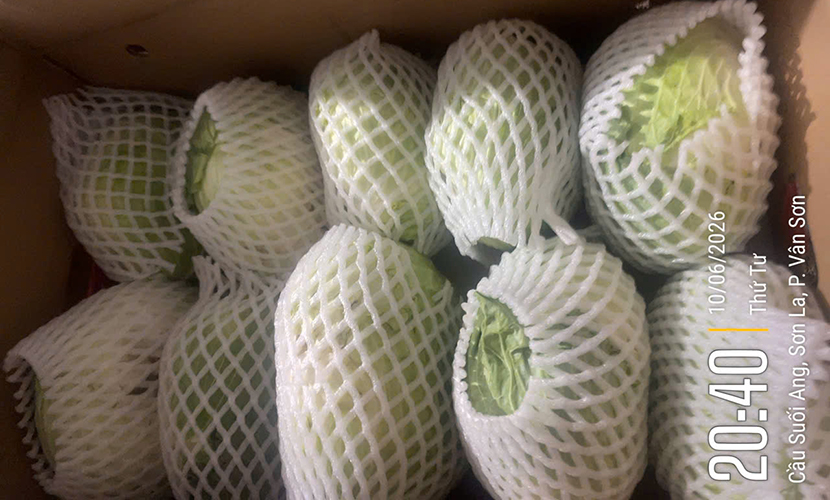
Chinese cabbage exports
Farmers reported that yields of vegetables such as Chinese kale and kohlrabi have increased by 10–20% compared with conventional cultivation. Laboratory tests have also confirmed that harvested vegetables meet Vietgap food safety standards. This has encouraged many households to further expand production.
Hoang Van Hai, another farmer from Na Pinh, said his family currently cultivates two sao of Vietgap-certified kohlrabi. During the latest harvest, yields increased by around 20% compared with traditional farming. Meanwhile, selling prices at the end of 2025 ranged from VND 20,000 to VND 30,000 per kilogram. Encouraged by these results, his family plans to double its Vietgap cultivation area.
Nguyen Thanh Nguyen is the Head of the Department of Economy, Infrastructure and Urban Development of Ky Lua Ward. He said the ward currently cultivates more than 200 hectares of vegetables each year. Given this strong production potential, local authorities are continuing to develop plans to expand Vietgap vegetable production in collaboration with relevant agencies. Priority will be given to key local crops such as kohlrabi, Chinese kale, cabbage, and mustard greens.
The ward will also continue to strengthen farmer training, public awareness campaigns, and technical support. This will encourage broader participation in the VietGAP model. It will also improve the quality and productivity of vegetable production while promoting more modern and sustainable farming practices.
Vietnamese source: https://baolangson.vn/nhan-rong-mo-hinh-rau-vietgap-5072149.html
If you are interested in Vietgap vegetable exports, please contact us:
Company: Agrideco Vietnam Co., Ltd.
Address: No 02, Alley 325 Kim Nguu, Vinh Tuy Ward, Hanoi, Vietnam
Tel/Kakao Talk/Whatsapp: +84 989 649 804
Website: https://agridecovietnam.com
Email: agridecovietnam@gmail.com