

In recent years, farmers in Dai Tu District have increasingly introduced Vietnamese exported jicama into areas with limited irrigation. They have also adopted a cropping system of one rice crop followed by two jicama crops each year. The cultivation model has gradually expanded to more communes, helping improve economic returns per hectare of farmland.
Early November marks the beginning of the jicama harvest season, following the completion of the summer-autumn rice harvest. It also coincides with the start of land preparation for the winter crop. Traveling through My Yen, Van Yen, and Ky Phu communes, groups of farmers are harvesting Vietnamese jicama across the fields. Local farmers often exchange labor to help one another.
Typically, five to seven people pull up the roots. Meanwhile, another two or three transport and stack the harvested jicama along inter-commune roads. This makes it easier for trucks to collect the produce. This season, farmers staggered planting from July to September, allowing harvests to continue through the Lunar New Year.
Vietnamese exported jicama
Ms. Pham Thi Duoc is a farmer from Gio Hamlet in Ky Phu Commune, Thai Nguyen Province. From her view, farmers can cultivate Vietnamese exported jicama during multiple seasons each year. “We start the spring crop between February and March and harvest it from May to June. The current crop, meanwhile, is the autumn-winter season. Farmers here typically grow two jicama crops and one rice crop annually. However, this is only possible if the autumn-winter crop is planted early enough to allow spring rice cultivation in December.”
“This year, however, unfavorable weather delayed planting, so many households will skip the spring rice crop and grow another vegetable crop instead. The harvest has been excellent, with uniform, high-quality roots and yields approaching three tonnes per sao. My family grows three sao of Vietnamese exported jicama. We have just harvested about 10 tonnes, generating nearly VND 30 million in revenue.”
Thanks to its strong economic returns, Vietnam’s jicama cultivation has gradually become an important commercial crop in recent years. It now provides substantial income for farmers in communes such as Ban Ngoai, Van Yen, My Yen, and Ky Phu. During this autumn-winter season alone, Dai Tu District cultivated more than 80 hectares of jicama. Ban Ngoai Commune, the first locality in the district to adopt large-scale jicama cultivation, accounts for more than 40 hectares. Most of the area is available in Quang Trung, Khau Giao 1, and Khau Giao 2 hamlets.
Previously, farmers alternated one rice crop with one jicama crop, mainly on higher fields with limited water supplies. After recognizing the crop’s profitability, however, they gradually expanded cultivation and increased cropping intensity. As a result, Vietnam’s jicama has become one of their primary crops throughout the year.
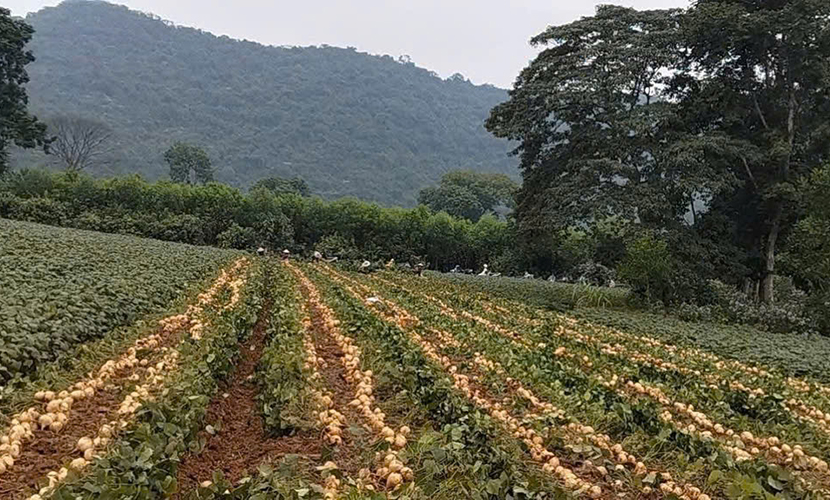
Vietnamese jicama farm
This season, farmers have been particularly happy with average yields of nearly three tonnes per sao. At a selling price of around VND 3,000 per kilogram, growers earn profits of approximately VND 6–7 million per sao after production costs. This is roughly five to six times higher than cultivating rice.
Hoang Van Thanh is the Head of the Dai Tu District Department of Agriculture and Rural Development. He said the district has focused in recent years on diversifying agricultural production, promoting commercial farming, and increasing returns per unit of cultivated land. Vietnam’s jicama has emerged as one of the crops that best meets these development objectives. With favorable growing conditions this year, yields are liikely to surpass previous seasons. This will enable farmers to generate more than VND 300 million per hectare.
Vietnamese exported jicama has therefore become one of the district’s most economically effective crops and is well suited to local farming conditions. Farmers across Dai Tu District are continuing to expand cultivation, particularly by intercropping jicama on fields with limited irrigation. This approach helps improve land-use efficiency and increase household incomes.
Vietnamese source: https://baothainguyen.vn/kinh-te/201711/hieu-qua-tu-trong-cu-dau-367E99A/
For more information about Vietnamese jicama exporters, please contact us:
Company: Agrideco Vietnam Co., Ltd.
Address: No 02, Alley 325 Kim Nguu, Vinh Tuy Ward, Hanoi, Vietnam
Tel/Kakao Talk/Whatsapp: +84 989 649 804
Website: https://agridecovietnam.com
Email: agridecovietnam@gmail.com