
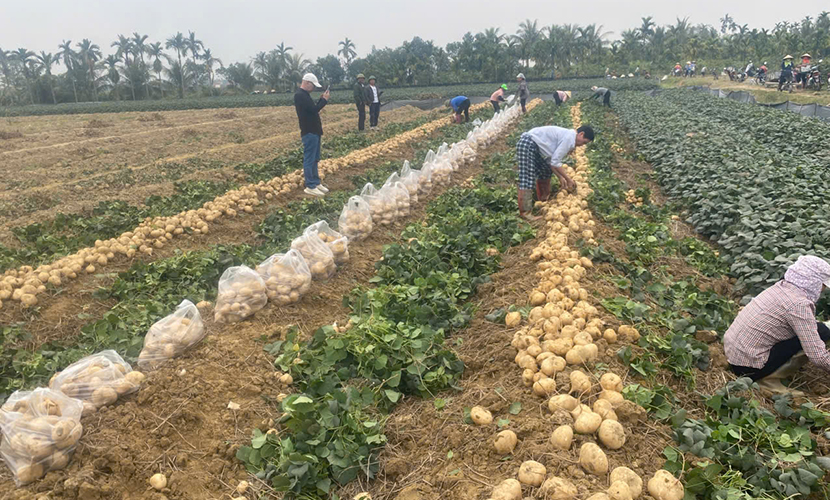
In recent years, Luc Nam District has developed several specialized vegetable-growing areas. These include Vietnamese jicama cultivation in Bao Son Commune and various bean crops in Thanh Lam Commune.
The formation of these specialized production zones is partly due to Luc Nam’s favorable conditions for commercial vegetable cultivation. They include local farmers’ solid cultivation knowledge and regular training programs from the agricultural extension system. These long-established farming practices have enabled local households to earn a stable income.
Ms. Giap Thi Them is a farmer in Yen Thien Village, Bao Son Commune. Her family is a typical example of successful investment in vegetable production. Vietnamese jicama cultivation is her main crop for economic development. In the most recent season, she cultivated 8 sao of Vietnamese jicama. Favorable weather conditions helped the crop grow well and achieve a yield of 3.5 tons per sao. With a farm-gate price of VND 5,000 per kilogram, she earned a profit of more than VND 10 million per sao.
Vietnamese jicama cultivation
According to Ms. Them, Vietnamese jicama cultivation is relatively easy to do. However, achieving high yields, large roots, and a crisp, non-fibrous texture requires suitable growing conditions. Therefore, farmers should select light loam or sandy loam soils that are rich in organic matter, loose, well-drained, and slightly elevated.
Newly reclaimed land often delivers particularly high yields because Vietnam’s jicama performs well in previously uncultivated fields. Besides choosing suitable soil, maintaining adequate soil moisture and applying balanced fertilization are also essential. Ms. Them carefully balances nitrogen, phosphorus, and potassium fertilizers with well-composted manure or other organic bio-fertilizers.
She also noted that although Vietnamese jicama cultivation is straightforward, it requires considerable labor. Ridge preparation before planting is especially demanding, as jicama beds are typically 1.5–1.8 meters wide and 0.3–0.4 meters high. To ensure timely planting, neighboring households often cooperate by helping one another with land preparation and sowing activities.
About one month after planting, farmers should carry out the first topping. Thereafter, every 7–10 days, farmers should remove flowers, buds, and young shoots that extend above the ridge surface using knives or pruning shears. This practice encourages the plant to shift from vegetative growth to root development. As a result, it increases root weight and improves root quality. If the plants show signs of poor growth or yellowing leaves, farmers should apply additional fertilizer.
Many households in the village cultivate jicama alongside Ms. Them, including the family of Mr. Bui Van Trang, who also earns a good income from the crop. According to Mr. Trang, his family grows 8–9 sao of jicama every year. Knowing that jicama is highly sensitive to waterlogging, he carefully manages irrigation to maintain only adequate soil moisture.
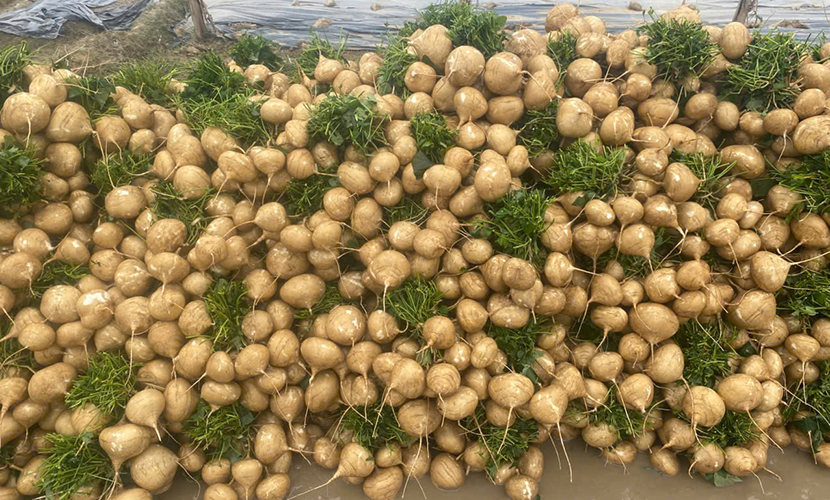
Vietnamese jicama
The main pests and diseases affecting jicama include leaf rollers, stem rot, leaf spot, and sap-sucking insects such as aphids and planthoppers. In addition to applying crop protection products on a regular basis, Mr. Trang often inspects his fields after every rainfall. This helps him detect problems early and take timely corrective measures.
According to the experience of Bao Son farmers, Vietnamese jicama cultivation can do in multiple seasons throughout the year. The Spring crop is typically planted between February and March and harvested from May to June. Meanwhile, the Autumn–Winter crop is planted from July to September for harvest around the Lunar New Year holiday.
Mr. Nguyen Van Thuy is an agricultural officer of Bao Son Commune. He said that thanks to the economic benefits generated by jicama, the crop has gradually become an important commercial commodity for local farmers in recent years. It has provided a significant source of income for many households in the commune.
Currently, farmers in Bao Son are continuing to expand the cultivation area, particularly through intercropping on fields with limited water availability. This approach helps improve production efficiency and increase household income.
Vietnamese source: https://khuyennongvn.gov.vn/thong-tin-thi-truong/thi-truong-trong-nuoc/bac-giang-trong-cu-dau-cho-thu-nhap-on-dinh-20044.html
If you are interested in Vietnamese jicama exports, please contact us:
Company: Agrideco Vietnam Co., Ltd.
Address: No 02, Alley 325 Kim Nguu, Vinh Tuy Ward, Hanoi, Vietnam
Tel/Kakao Talk/Whatsapp: +84 989 649 804
Website: https://agridecovietnam.com
Email: agridecovietnam@gmail.com