

Vietnamese passion fruits are making a strong mark on the global agricultural export map. Over the past 10 years, the export value has increased more than ten folds. It rose from $20 million in 2015 to $222.5 million in 2023.
On December 12, the Agriculture and Environment Newspaper, in coordination with the Department of Crop Production and Plant Protection and the Department of Agriculture and Environment of Gia Lai province, organized a forum. The event was titled “Sustainable Development of the Passion Fruit Sector through Value Chain Linkages.”
The forum aimed to provide a comprehensive assessment of Vietnam’s passion fruit production, processing, consumption, and export. It also sought to update global market trends and discuss sustainable development solutions for the sector.
Vietnamese passion fruits
Mr. Tô Văn Huấn is the representative of the Department of Crop Production and Plant Protection. At the event, he stated that Vietnamese passion fruits have experienced “rapid” growth in the international market. The export turnover rose from $20 million in 2015 to $222.5 million in 2023. By October 2025, it had already reached the annual target.
In the first 10 months of 2025 alone, exports exceeded $202 million despite global market fluctuations. This demonstrates stable demand and the increasingly strong position of Vietnamese passion fruits.
According to Mr. Huấn, Vietnam has many advantages in terms of terrain, soil, and climate suitable for growing Vietnam’s passion fruit. These conditions are particularly favorable in the Central Highlands and several other regions. The crop has a short growth cycle of 4–5 months and offers high yields. The consumption market is extensive, with over 80% of products processed or consumed fresh.
Currently, there are 43 passion fruit varieties in Vietnam. These varieties meet the demand for both fresh consumption and advanced processing, such as juice, concentrate, and frozen products. More than 80% of production is destined for export. This highlights the growing role of passion fruit in the country’s key agricultural product structure.
According to the Gia Lai Department of Agriculture and Environment, the total area of Vietnamese passion fruits nationwide reaches about 12,600 hectares. Accordingly, the production volume exceeds 178,500 tons. The Central Highlands alone accounts for 88% of the area, demonstrating a strong trend of concentration and specialization. Since July 2022, Vietnamese passion fruit has been exported officially to China—a large, nearby, and highly potential market.
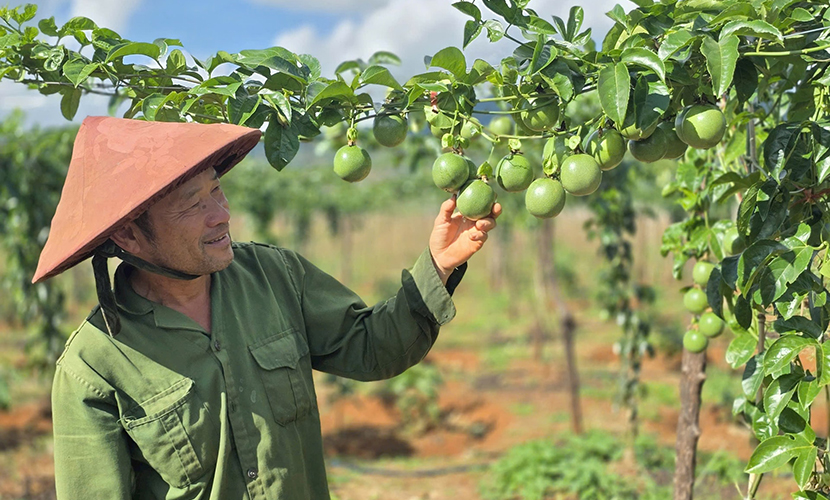
Vietnamese passion fruit farm
This milestone has created a strong boost for the sector. Strict requirements regarding cultivation area codes, packaging standards, and plant quarantine have encouraged farmers and businesses to upgrade production processes. This has gradually led to the formation of closed value chains.
As a result, many Vietnamese fruit enterprises have proactively linked with cooperatives and farmers to build synchronized production, processing, and consumption models. These efforts help reduce risks, increase value, and meet international market requirements. This is also an important step in preparing Vietnamese passion fruits to gradually expand into the U.S., Europe, and Japan. These are markets with high standards but significant value.
At the forum, experts noted that the global passion fruit market is changing rapidly, presenting both opportunities and challenges. Current consumption trends favor natural, minimally processed, organic, nutrient-rich, and low-sugar products. This provides favorable conditions for passion fruit to expand its market share.
However, importing countries are also tightening requirements on food safety, quarantine, chemical residues, and ESG criteria. Enterprises aiming to export must obtain certifications such as HACCP, ISO, BRC, Halal, and Globalgap.
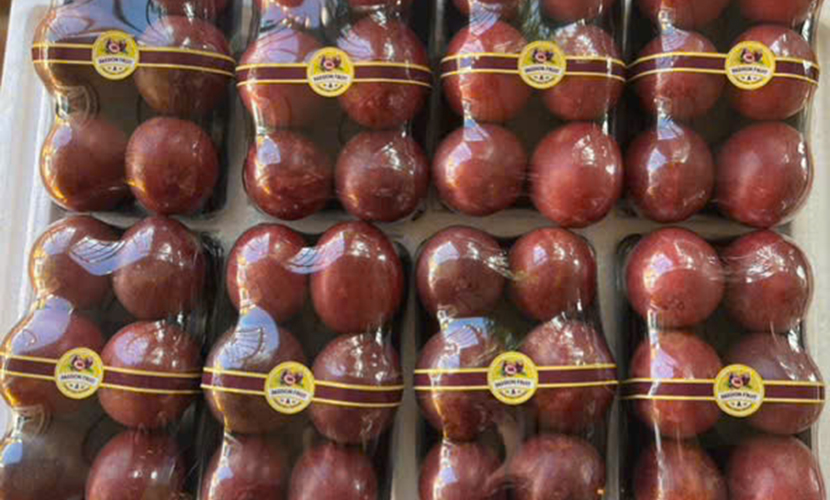
Violet passion fruit from Vietnam
According to the Key Fruit Development Plan for 2025–2030, Vietnam will maintain passion fruit cultivation areas at 12,000–15,000 hectares. Accordingly, the annual production will be likely to reach 250,000–300,000 tons. Key regions include Gia Lai, Lâm Đồng, Đắk Lắk, Quảng Trị, Nghệ An, and Sơn La.
To achieve these goals, delegates proposed focusing on planning large raw material zones and strictly controlling varieties. They also recommended standardizing processes according to Vietgap or Globalgap. They also recommended promoting digital transformation in farm management and traceability. Additionally, they suggested investing heavily in advanced processing and strengthening linkages under the “five-party” model.
Experts emphasized that only when value chains are sustainably reinforced can the passion fruit sector withstand market fluctuations. From impressive export growth to the formation of large cultivation areas in the Central Highlands, Vietnamese passion fruits are gradually asserting a new position within Vietnam’s agricultural sector. Its development highlights both economic potential and strategic importance in the country’s agriculture.
Vietnamese source: https://doanhnghieptiepthi.vn/giua-bien-dong-thi-truong-chanh-leo-viet-nam-van-giu-da-tang-truong-manh-161251212152159947.htm