
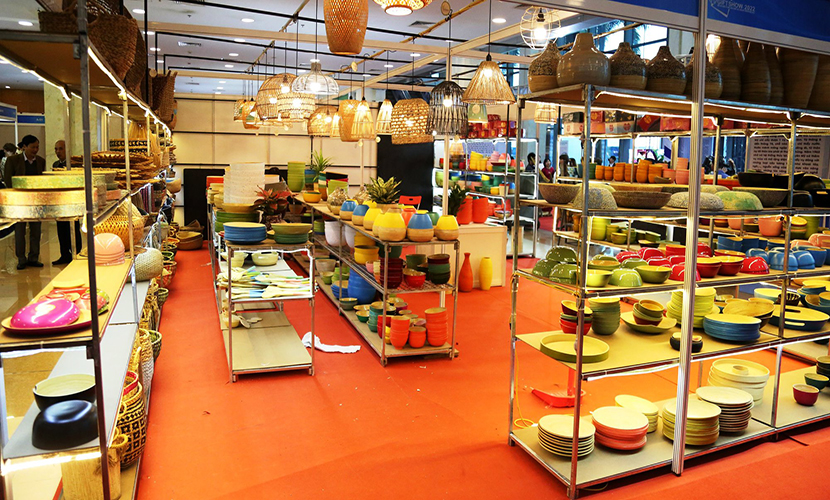
To quickly reach the $5 billion export milestone, Vietnam’s craft exports need a comprehensive strategy. This includes enhancing production capacity and promoting creative design. It also involves strengthening training and especially innovating trade promotion toward more modern and digitalized approaches.
Currently, Vietnam has more than 5,400 traditional craft villages and a rich repository of culturally distinctive products. However, Vietnam’s handicrafts sector still faces many challenges. These challenges relate to enhancing production capacity, building brands, and expanding into international markets.
Vietnam’s craft exports
Although the government has introduced support policies ranging from tax incentives and training to trade promotion, the results have remained limited. Many Vietnamese craft enterprises are unable to meet the requirements for documentation, paperwork, and complex rules of origin.
Dr. Nguyễn Thị Thu Hường is a lecturer from Hanoi Open University. She noted that Vietnam’s craft exports have been growing strongly, from $2.23 billion in 2019 to nearly $4 billion in 2024. They are projected to reach $4.5–5 billion in 2025.
However, to quickly achieve the $5 billion target, the sector must increase the share of high-value products based on design and branding.

Vietnamese decoration products
Associate Professor Dr. Đặng Mai Anh is the Acting President of the University of Industrial Fine Arts. He noted that in reality, Vietnamese handicraft products have shown many positive changes in terms of aesthetics as well as cultural and artistic value.
However, the period from 2024 to 2028 will be one of intense competition for the handicrafts sector on a global scale. To seize opportunities, Vietnam’s handicrafts industry must invest in technology, improve quality, and apply digital platforms to expand markets.
Based on this reality, Dr. Đặng Mai Anh proposed strengthening connections between artisans and global consumers. He also recommended developing craft village brands linked with culture and tourism, and expanding exports through cross-border e-commerce. This is a trend that many countries have already embraced. Vietnam needs to participate quickly to maintain its competitive advantage.

Vietnamese planting baskets
In terms of policy completion toward 2030, many experts emphasized the need to accelerate digitalization. This includes building a national e-commerce platform for Vietnam’s handicraft products and supporting enterprises in joining international marketplaces. It also involves developing 3D/VR virtual showrooms and facilitating cross-border B2B and B2C connections.
At the same time, it is necessary to develop design support centers and enhance digital skills training, as well as support intellectual property registration. Additionally, simplifying tax and customs procedures and planning raw material zones linked with sustainability certification are essential.
Vietnamese source: https://doanhnghieptiepthi.vn/can-chien-luoc-toan-dien-de-nganh-hang-thu-cong-my-nghe-can-moc-5-ty-usd-xuat-khau-161251211221619712.htm