
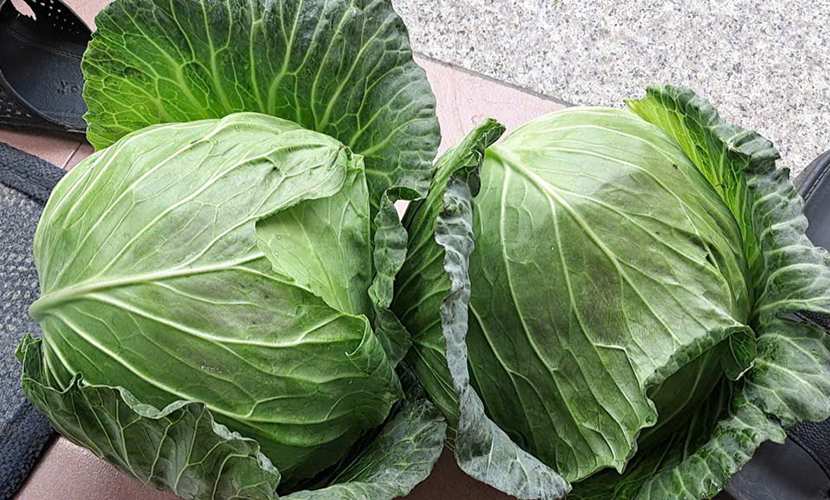
Mộc Châu Plateau in Sơn La Province is endowed by nature with a cool climate year-round and fertile soil. This makes it highly suitable for Vietnamese cabbage cultivation and other short-term crops.
Taking advantage of these conditions, Mr. Nguyễn Văn Quân from Là Ngà 2 village reclaimed his garden land. He borrowed 40 million VND from Agribank to install an irrigation system and began cultivating vegetables for economic development. Thanks to this step, his family’s life has entered a new phase, with steadily increasing income and a successful escape from poverty.
Mr. Nguyễn Văn Quân shared: “Previously, my family was in very difficult circumstances with unstable income. My elderly parents were often sick, so the burden fell on my wife and me. Fortunately, I had a few plots of rice fields of about 1 hectare left by my parents. We worked hard to grow rice every year and did not worry about buying rice. However, household expenses were still very tight. Thanks to training courses organized by the Mộc Châu District People’s Committee and the introduction of economic development models, including Vietnamese cabbage cultivation, I had the opportunity to escape poverty.”
Vietnamese cabbage cultivation
Thanks to diligence and hard work, Mr. Quân reclaimed 1 hectare of rice land. He also installed an automatic irrigation system to grow Vietnamese cabbage. He said: “After I started growing cabbage, everything went very smoothly. The crop is suitable for the local climate, so it grows very well. I find Vietnamese cabbage cultivation requires low production costs, and the market for the product is relatively stable. During harvest season, traders and cooperatives in the district come directly to the garden to harvest, pack, and purchase the produce. Therefore, my family’s cabbage always has at good prices.”
Regarding cultivation techniques, Mr. Quân said Vietnam’s cabbage farming is simple and inexpensive. It is not as complicated as raising livestock or poultry. Before sowing cabbage seeds, farmers need to soak them in warm water at 50°C for about 20 minutes. Then they soak them in cold water for 8–10 hours. The seeding rate is 1.5–2.0 grams per square meter.
After sowing, the soil must be covered with a 1–2 cm layer of straw. It is then watered thoroughly using a watering can 1–2 times per day.
Thanks to his bold decision to pursue a new economic direction and apply scientific and technical advances in cabbage cultivation, Mr. Quân’s family has escaped poverty and become one of the more prosperous households in Là Ngà 2 village. Not only is he successful in production, but he also actively participates in cultural and social activities. He also helps guide other disadvantaged families in cabbage farming to improve their livelihoods.
According to Mr. Quân, since switching to vegetable farming, his family’s living conditions have improved significantly, and they no longer face financial hardship as before. Compared to lowland provinces, Vietnamese cabbage cultivation in Sơn La Province faces less competition. As a result, the market for his products remains relatively stable.
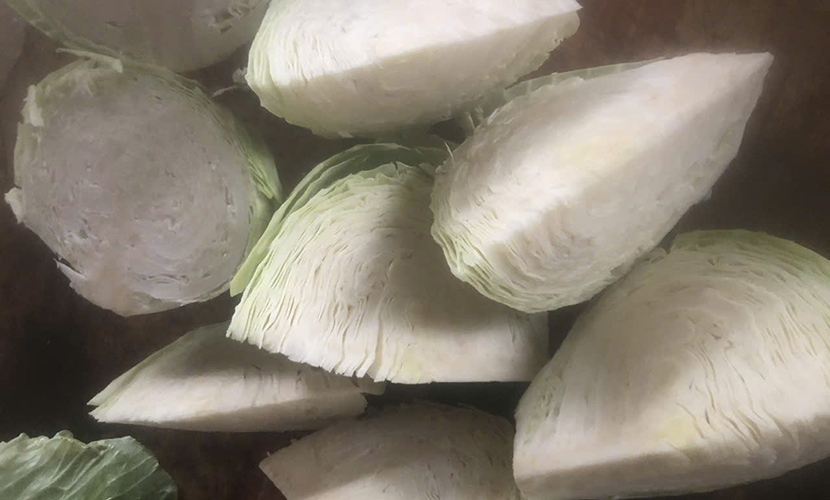
Vietnam’s cabbage sections
“At harvest time, Vietnamese export companies drive trucks directly into the fields to buy the vegetables. They harvest and pack the produce themselves, so I hardly have to do any of the harvesting work. Currently, I sell cabbage at the farm gate for 11,000 VND per kilogram. I grow two cabbage crops per year. Each crop earns a profit of more than 60 million VND, totaling about 120 million VND per year,” Mr. Quân confirmed.
Mr. Trần Xuân Thành is the Head of the Department of Agriculture and Rural Development of Sơn La Province. He stated that clean vegetable farming is currently a new direction that helps many poor households increase and stabilize their incomes. Vegetables are short-term crops that can be harvested quickly without requiring large investment costs.
To support local households in economic development, the district has organized training courses to guide farmers in cultivation techniques. In addition, the district has provided fertilizers and seedlings to help people grow fruit trees on sloping land. It has also encouraged households to apply science and technology in production and livestock farming, contributing to poverty reduction in the locality.
Vietnamese source: https://giaoducthoidai.vn/thoat-ngheo-nho-trong-rau-cai-bap-o-cao-nguyen-moc-chau-post613421.html
If you are interested in Vietnamese cabbage exports, please contact us:
Company: Agrideco Vietnam Co., Ltd.
Address: No 02, Alley 325 Kim Nguu, Vinh Tuy Ward, Hanoi, Vietnam
Tel/Kakao Talk/Whatsapp: +84 989 649 804
Website: https://agridecovietnam.com
Email: agridecovietnam@gmail.com