
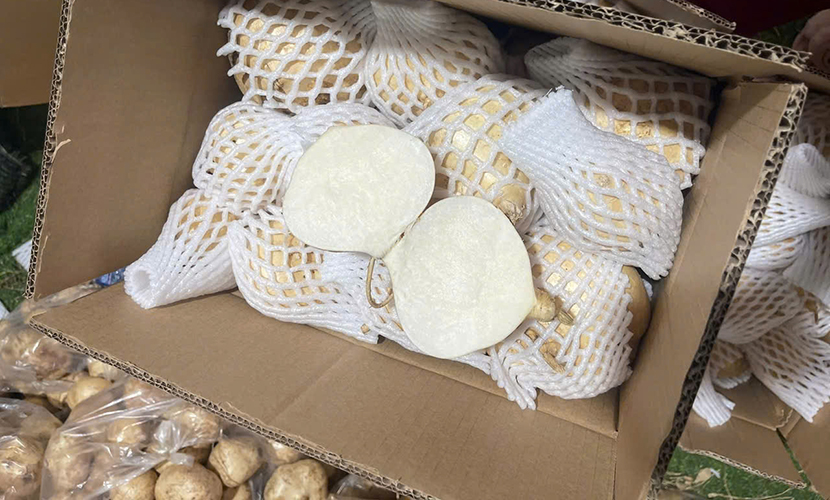
Kim Thành District is the kingdom of Vietnamese yam bean of Hải Dương Province. In the 2023–2024 winter crop, local farmers were happy with both a good harvest and high prices. As a result, they earned profits of about 13–14 million VND per sào (one sào equals 360 square meters).
Mr. Trần Văn Lượng is the Chairman of Hưng Tiến Agricultural Service Cooperative in Kim Tân Commune, Kim Thành District. He said that the cooperative has 31 members. These members cultivate about 30 hectares of Vietnamese jicama under Vietgap standards.
In this year’s winter crop, Vietnamese yam bean has enjoyed a good harvest, with superior appearance, yield, and quality. Moreover, selling prices are higher than last year, so the members are very happy.
Vietnamese yam bean
According to Mr. Lượng, the current farm-gate price of Vietnamese yam bean is about 6,500 VND per kilogram. This price is 1,000 VND per kilogram higher than last year. On average, households achieve around 3 tons per sào. After deducting input costs of about 6–7 million VND per sào, jicama farmers earn an average profit of 13–14 million VND per sào.
Mr. Nguyễn Văn Uyên is a local farmer in Viên Chử Hamlet, Kim Tân Commune. His family has four sào of Vietnamese yam bean. At present, his family has already sold out all of the entire jicama-growing area to traders. They are just waiting for the appropriate time to harvest. His family’s jicama yield is about 4–4.5 tons per sào. This year, Mr. Uyên sells each sào of jicama to traders for about 20 million VND.
Kim Thành is the “capital” of Vietnamese yam bean cultivation in Hải Dương Province. Notably, the best-quality jicama is grown in Kim Tân Commune. Freshly harvested jicama has an ivory-white, smooth skin. It is juicy, refreshingly sweet, and contains very little fiber. Nearly all jicama-growing areas are contracted by traders before harvest.
To increase the value of jicama and affirm that it is a safe product for consumers, farmers in Kim Thành have proactively adopted Vietgap production standards. At the same time, they strictly follow these standards throughout the cultivation process.

Vietnamese yam bean harvesting
Mr. Uyên said: “To produce high-quality jicama, we strictly comply with the care guidelines provided by agricultural specialists. We apply fertilizers and control pests on a regular schedule. In addition, we use only approved products as instructed by the district Department of Agriculture and the cooperative. About 15–20 days before harvest, we absolutely do not use any plant protection chemicals.”
Notably, Mr. Uyên’s family rotates their fields once a year so that jicama in the following season achieves higher yields. This is also a key practice to minimize pests and diseases. For example, on the same field where jicama is grown this year, they may switch to melon cultivation the following year. Consumption of this product has become increasingly convenient. This is partly thanks to recent investments in upgrading rural transportation infrastructure.
In addition to accumulated farming experience, Kim Thành farmers have also applied technological advances to jicama cultivation and care. Agricultural officers have provided training to households across the district’s entire jicama-growing area. Through this process, scientific and technical knowledge has been transferred into production.
Currently, most jicama farmers in Kim Thành District produce under Vietgap standards. Of this area, 25 hectares in Kim Tân Commune and 7 hectares in Đồng Cẩm Commune hold official certification.

Vietnamese yam bean farm
Among winter crops, jicama is a key agricultural product of Kim Thành District. According to the Kim Thành District Department of Agriculture and Rural Development, in the 2023 winter crop the district had about 480 hectares of jicama. This year’s output is likely to be comparable to that of the previous season.
Every year, the Kim Thành District Party Committee and the District People’s Committee pay close attention to directing specialized agencies and local authorities. Their focus is on guiding farmers from technical training in cultivation and care to post-harvest preservation, in order to enhance the value and branding of the district’s signature product. Recently, Vietnamese yam bean produced by the Hưng Tiến Cooperative in Kim Tân Commune was once again assessed and recognized as a 3-star OCOP product.
At the same time, under the “One Commune, One Product” (OCOP) program, Kim Thành District has supported the organization of trade promotion activities for OCOP products, including jicama. The district has developed channels for introducing and selling OCOP products in connection with gift items. It has also supported OCOP producers in participating in trade fairs and exhibitions.
In addition, promotional delegations have been organized to introduce OCOP products to markets both inside and outside the province. The district has prioritized the use of OCOP products for display and the design of gift packages at conferences and events, and has organized OCOP fairs.
Vietnamese source: https://dantocmiennui.baotintuc.vn/nong-dan-thu-lai-cao-tu-cu-dau-post344325.html