
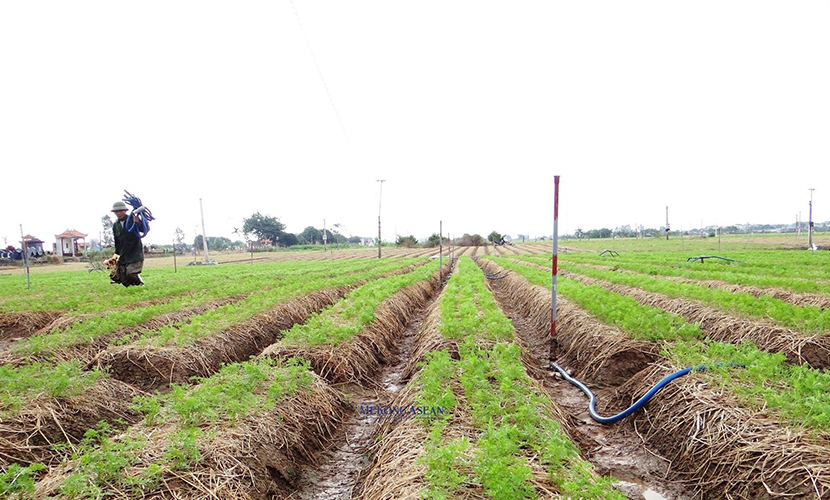
In Cẩm Giàng District (Hải Dương), Vietnamese carrot trees have become a traditional and key crop. As a result, they have contributed to farmers’ prosperity in the district for nearly 45 years. Currently, the total annual cultivation area of Vietnamese carrots in the district is about 550 hectares. The yield is 38 tons per hectare, producing 20,900 tons per year.
According to information from the district, farmers have developed Vietnamese carrot trees since 1979. Specifically, this development has taken place in the alluvial areas along the Thái Bình River in Cẩm Văn and Đức Chính communes.
Vietnam’s carrots later expanded to other communes within the district. In addition, cultivation spread to communes in Nam Sách District, Chí Linh City, and other localities in provinces such as Bắc Ninh, Thái Bình, and Hà Nam.

Vietnamese carrot preparation
Local farmers in Cẩm Giàng grow Vietnamese carrot trees in concentrated commercial areas. It follows production processes under Vietgap standards, ensuring clean, safe, high-quality carrots with attractive appearance. These products have established a strong position in both domestic and international markets.
Mr. Nguyễn Văn Thiện is the Head of the Agriculture and Rural Development Department of Cẩm Giàng District. He stated that in the winter–spring crop season, the district plants about 500 hectares of carrots. The average yield is 38.8 tons per hectare, with a total output of 19,400 tons. Production is concentrated in the fertile alluvial lands along the Thái Bình River. In addition, it also takes place in some converted rice fields in Đức Chính, Cẩm Văn, Cẩm Vũ, and Cao An communes.
Most of Cẩm Giàng’s carrot production is purchased and transported to companies, businesses, and traders within the district. There, Vietnamese carrot trees undergo preliminary processing, storage, and further processing. Then it is distributed to provinces in Central and Southern Vietnam and major cities, accounting for about 50% of the output.
The remaining 50% is purchased by factories for processing and storage. Subsequently, these products are exported to countries in the Middle East, South Korea, Japan, Malaysia, and Thailand.
Vietnamese carrot trees
According to Mr. Thiện, there are currently 20 enterprises and private traders in the district collecting carrots. They are mainly in Đức Chính and Cẩm Văn communes. These businesses purchase about 50–100 tons of carrots per day from farmers.
In addition, enterprises and supermarkets both within and outside the province are also purchasing carrots in Cẩm Giàng District. Examples include Go! (BigC) Supermarket, Vinmart, and others.
Mr. Nguyễn Đức Thuật is the Director of Đức Chính Agricultural Service Cooperative. He stated that recently, among 11 companies that came to discuss cooperation, three South Korean companies visited for the first time. They surveyed the Đức Chính carrot production area for potential collaboration and procurement promotion. The remaining companies, from Malaysia, Laos, and South Korea, have previously cooperated in purchasing carrots in past years.
When visiting to discuss carrot procurement cooperation, these companies also examined the production process. In addition, they negotiated product specifications, including appearance, size, and quality. The selling price of fresh carrot is agreed upon before harvest based on market conditions.
“To meet export standards, Đức Chính Commune continues to maintain 95 hectares of Vietgap carrots. In addition, the commune has three export cultivation area codes covering 30 hectares. Carrots from these coded cultivation areas have been officially exported to markets in countries such as South Korea, Malaysia, Japan, and several Middle Eastern countries. Currently, Đức Chính Agricultural Service Cooperative is continuing to contact and seek carrot buyers both domestically and internationally. This is to promote agricultural product consumption in 2023–2024,” Mr. Nguyễn Đức Thuật added.

Harvesting Vietnamese carrot
Mr. Nguyễn Văn Côn is the Vice Chairman of the People’s Committee of Cẩm Giàng District. He stated that in recent years, the district has strengthened investment in infrastructure for specialized carrot cultivation areas. This includes irrigation canals, internal roads, and advanced water-saving irrigation systems. In addition, to preserve products after harvest, the district has utilized ODA loans to support purchasing households in investing in cold storage facilities.
To date, Vietnamese carrot trees have gradually developed and established their brand. Vietnamese carrot received a collective trademark certification in 2008 and renewed in 2018. It also received the Vietnam Agricultural Gold Brand award in 2017. Additionally, fresh carrots from Đức Chính Commune were awarded the 4-star OCOP product certification by the Hải Dương Provincial People’s Committee in 2019. The certification was renewed in 2022.
Although the district’s carrot production is large, the harvest period is concentrated within about three months. Meanwhile, the number of carrot purchasing enterprises remains limited. The cold storage system is still insufficient. Post-harvest processing technology for carrots is limited, failing to meet the requirements for large-scale production and export.

Vietnamese carrot factory
In addition, production costs are high due to labor expenses and expensive seeds. The rate of mechanization is still low and not synchronized. Also, farmers mostly harvest in a mannual maner. Production along the value chain linked to consumption is not yet sustainable.
Major domestic and provincial enterprises participating in Vietnamese carrot exports are still few. Export market capacity remains limited. Efforts in trade promotion, product marketing, and market expansion are still constrained in scale, quantity, and methods.
Sharing with Mekong ASEAN, some businesses and production establishments suggested and proposed that authorities at all levels strengthen promotion and marketing. They also suggested investing in production and processing technology for carrots, in order to boost exports.
At the same time, they recommended support in finding markets and trading partners. They also suggested including carrot product promotion in the national trade promotion program. As a result, this would help expand consumption markets both domestically and internationally.
Vietnamese source: https://mekongasean.vn/hai-duong-hon-4-thap-ky-ca-rot-gan-bo-voi-nong-dan-huyen-cam-giang-18155.html
If you are interested in Vietnamese carrot exports, please contact us:
Company: Agrideco Vietnam Co., Ltd.
Address: No 02, Alley 325 Kim Nguu, Vinh Tuy Ward, Hanoi, Vietnam
Tel/Kakao Talk/Whatsapp: +84 989 649 804
Website: https://agridecovietnam.com
Email: agridecovietnam@gmail.com