
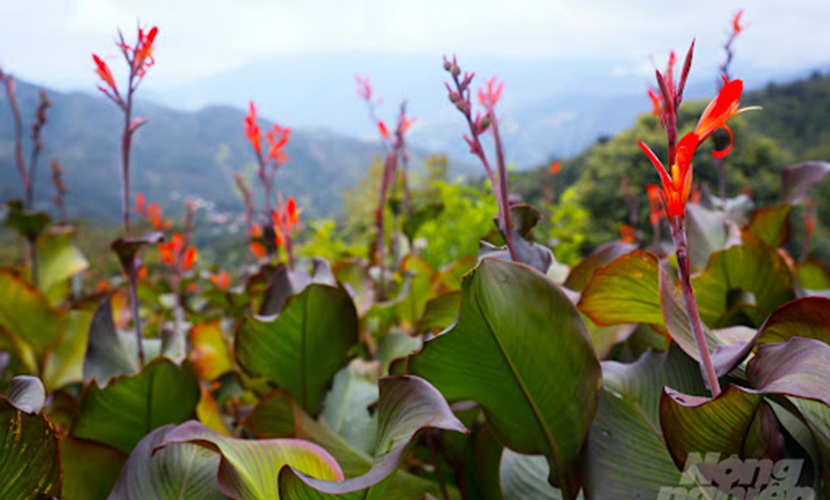
From a minor crop grown on a small scale, Vietnamese arrowroot has now expanded significantly and become a key crop. It plays an important role in local economic development. Also, it helps improve incomes for residents in the highland commune of Bản Xèo, Lào Cai Province.
Arriving in Bản Xèo these days, visitors can see Vietnamese arrowroot plants covering both sides of the roads. They stretch from small household gardens to vast hillside fields.
The cheerful voices of ethnic H’Mông, Dao, and Giáy farmers working on their fields create a lively atmosphere throughout the area. The sound of motorbikes struggling uphill while carrying sacks full of freshly harvested arrowroot roots adds to the vibrant scene.
While busily harvesting the main-season arrowroot crop on his family’s hillside field, Mr. Cứ A Vàng, a H’Mông ethnic resident in Tả Lèng Village, happily shared his thoughts. He said that this year’s arrowroot crop has produced a good harvest.
With only about 0.5 hectares of farmland, his family expects to harvest 10 tons of fresh roots. At the current price of around VND 2,500 per kilogram, the crop will bring a significant income to support their daily life.
Vietnamese arrowroot
For highland residents in Bản Xèo Commune, Vietnamese arrowroot is not an unfamiliar crop. For generations, local people have grown small areas of arrowroot to make Vietnamese vermicelli and noodles for household consumption.
However, in recent years, market demand has increased and arrowroot vermicelli has become an OCOP-certified product. Therefore, Vietnamese arrowroot has transformed into a commercial crop. It has also become an important tool for poverty reduction.
San Lùng Village Head Tẩn Dùn Thiều said: “In the past, local people faced many difficulties. They relied mainly on low-yield rice and maize crops. Poor transportation conditions also made trade and product circulation extremely challenging.”
Since residents were encouraged to switch to arrowroot cultivation, along with the Government’s investment in transport infrastructure, goods have become easier to transport. As a result, people’s living standards have also gradually improved. The village currently has 124 households, with 70 households growing arrowroot on a total area of more than 30 hectares.
Besides selling fresh roots to traders, many households in Bản Xèo have proactively established arrowroot vermicelli cooperatives. They have also formed production linkages with farmers. These models create a closed value chain from cultivation to processing and consumption. This helps prevent the situation of “bumper crops but falling prices.
As a result, farmers have become more confident in investing in fertilizers and expanding cultivation areas. They have also applied proper production techniques to improve efficiency.
Ms. Cồ Thị Hiền is the Director of Hưng Hiền Arrowroot Vermicelli Cooperative. She said that recognizing the potential of arrowroot and drawing on accumulated experience, her family decided to invest in establishing a cooperative. The goal was to connect with local farmers. The cooperative currently employs 10 local workers directly involved in production. Dozens of households also participate in its Vietnamese arrowroot cultivation network.

Vietnamese arrowroot starch
On average, the facility produces 1-2 quintals of dried vermicelli per day, equivalent to around 5 tons of fresh arrowroot roots. With current demand exceeding supply, the cooperative purchases all harvested roots from farmers.
Thanks to Vietnamese arrowroot cultivation, many households in Bản Xèo that were previously classified as poor or near-poor have gradually improved their livelihoods. They have also achieved stable incomes.
Mr. Lý Láo Tả’s family in San Lùng Village owns 1 hectare of farmland, which previously was mainly used for maize cultivation with low returns. In recent years, recognizing the potential and economic benefits of arrowroot, his family boldly switched to growing the crop.
With favorable climate conditions and technical guidance from local authorities, his family now harvests more than 20 tons of fresh arrowroot roots each year. After deducting expenses, they earn nearly VND 50 million annually.
Recently, thanks to the Government’s support program for eliminating temporary housing, his family received VND 60 million. Combined with savings accumulated from successful arrowroot harvests, the dream of building a solid house has finally come true. The new house is not only a shelter from the elements but also a foundation that gives the family greater confidence in the future.
“I am very happy to have a new house. We no longer have to live in temporary conditions like before. Now that our life is more stable, I will continue expanding the Vietnamese arrowroot cultivation area. I will also focus on economic development and ensure my children receive a proper education,” Mr. Tả said excitedly.
Bản Xèo Commune has a population of 7,338 people, mainly from the Dao, H’Mông, and Giáy ethnic groups. More than 1,000 households in the commune are classified as poor or near-poor.
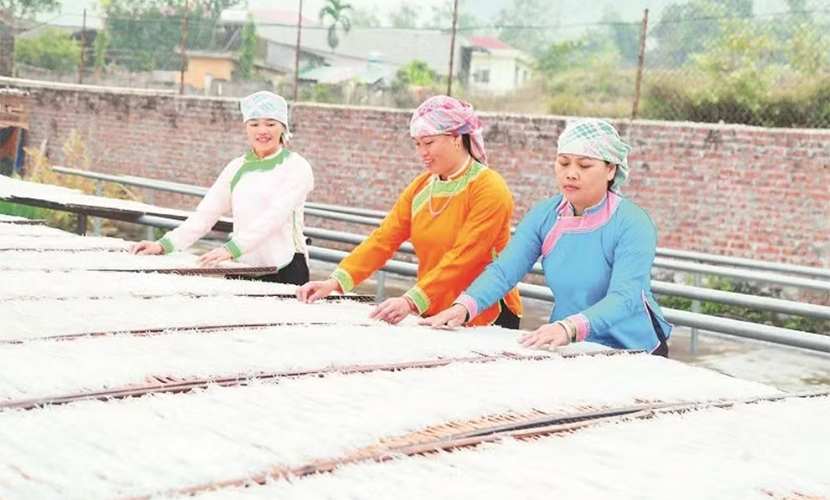
Vietnamese arrowroot noodles
In 2025, the commune had nearly 100 hectares of arrowroot, with estimated output exceeding 2,500 tons of roots. Average productivity reached 20-25 tons per hectare, while selling prices ranged around VND 2,500 per kilogram.
According to estimates, each hectare of arrowroot generates an average income of more than VND 60 million. This is two to three times higher than other crops such as maize and upland rice.
Mr. Ngô Quốc Cường is the Standing Deputy Secretary of the Commune Party Committee. He said: “We have identified Vietnamese arrowroot as a key crop in the commune’s agricultural economic structure. This is not only because of its high productivity and economic efficiency. The crop is also well suited to local soil conditions, easy to cultivate, and closely linked to the traditional arrowroot vermicelli processing industry.
“Our goal is to develop a concentrated production area with strong consumption linkages and turn arrowroot into a specialty product associated with the Bản Xèo brand.”
In the coming period, the locality plans to expand arrowroot cultivation by an additional 40 hectares in villages such as Cửa Cải and Ná Din. At the same time, local officials will provide technical guidance to farmers on proper cultivation and care practices. These efforts will contribute to higher productivity and incomes.
Vietnamese source: https://nhandan.vn/cay-dong-rieng-xoa-ngheo-o-ban-xeo-post923205.html
For more information about Vietnamese arrowroot products, please contact us:
Company: Agrideco Vietnam Co., Ltd.
Address: No 02, Alley 325 Kim Nguu, Vinh Tuy Ward, Hanoi, Vietnam
Tel/Kakao Talk/Whatsapp: +84 989 649 804
Website: https://agridecovietnam.com
Email: agridecovietnam@gmail.com