
With large supply volumes and short harvesting periods, Vietnamese vegetable exports require new production approaches. These approaches focus on expanding export markets.
With a cultivated area of approximately 380,000 hectares, the winter crop season in northern Vietnam covers a substantial area. As a result, it has been identified by the crop production sector as a major production season. It contributes to increased farmer incomes and the development of local agricultural brands.
This year, winter crops have also received many positive signals. These signals come from both domestic and international markets.
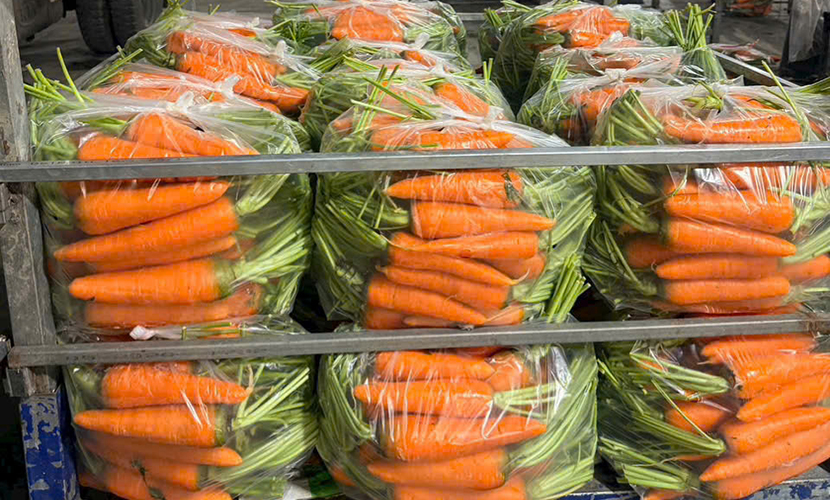
Ms. Ngo Thi Thu Hong is the Director of a Vietnamese vegetable company. According to her, many winter crops, particularly carrots and cabbage, are available for overseas consumption. On average, the company exports about 80–100 containers of carrots to South Korea each year.
Vietnamese vegetable exports
In addition, the company has expanded its supply chain partnerships for other Vietnamese vegetable exports such as chili peppers, Chinese cabbage, and lettuce. These efforts aim to meet customers’ kimchi production needs.
“This year, our two main competitors—China and Taiwan—have faced difficulties due to poor harvests and delayed harvesting. As a result, our company has partnered with six to eight processing facilities to boost carrot production. We also hope these facilities will continue to scale up operations. This will help build absolute trust with international partners,” said the the Director.
Hai Phong is one of the key winter vegetable-growing regions in northern Vietnam. There were significant challenges at the beginning of the season due to successive storms and prolonged rainfall.
Despite this, the 2025–2026 winter crop season was a comprehensive success, achieving the highest value in the past five years. Prices of many Vietnamese vegetable exports have doubled or tripled compared to the same period last year. Favorable market conditions have resulted in both good harvests and high prices.
Notably, the onion and garlic growing area covers approximately 7,100 hectares, with an estimated output of 120,000–130,000 tons. Production value ranges from VND 320–470 million per hectare, with profits of VND 210–355 million per hectare.
Many onion and garlic products have been certified under Vietgap standards and collective trademarks. These products are mainly consumed domestically, with a portion dried and exported to Japan, South Korea, and Taiwan.

Vietnamese violet cabbage
Regarding carrot-growing areas with an output of approximately 65,000–70,000 tons, an expert stated that up to 80% of carrot production is cold-stored and exported. Export markets include South Korea, Japan, Thailand, Malaysia, and the Middle East.
Many Vietnamse export enterprises have participated in investment linkages and product off-take arrangements. These activities contribute to increased value and greater stability for the growing areas.
“However, winter crop production still faces numerous challenges,” assessed the expert. Contract farming linkages remain limited, sales are largely dependent on traders, and cold storage and post-harvest processing infrastructure is insufficient. In addition, production costs are high and mechanization is not yet synchronized.
A clear shift in mindset among farmers and businesses toward market orientation, quality, and higher-value segments was also evident. Ms. Nguyen Thi Thu Huong is the Deputy Director of the Department of Crop Production and Plant Protection. She noted a clear change in discussion topics.

Vietnamese tomatoes
Previous crop production forums often centered on concerns about “bumper harvests leading to falling prices.” In contrast, this year most questions focused on improving production practices, meeting market requirements, and enhancing product value.
Ms. Huong frankly pointed out major constraints in current winter crop production. These include short growing cycles and concentrated harvesting periods that easily lead to supply gluts. Other issues include fragmented landholdings, which hinder the development of large raw material zones. In addition, there are limitations in mechanization, inconsistent technical processes, heavy dependence on imported vegetable seeds, and persistent market risks.
On that basis, the crop production sector has identified the winter crop season as a continued pillar. The domestic market will serve as the foundation, while exports have gradually expanded. Production will reach “industrial agriculture,” ensuring consistency in quality, appearance, food safety, and plant quarantine standards. Harvest periods have extended to reduce market risks of Vietnamese vegetable exports.
In terms of policy, the Department of Crop Production and Plant Protection is advising on the development of a decree on planting area codes and packing facilities of Vietnamese vegetables. This decree emphasizes strong decentralization to local authorities. At the same time, the department is promoting a “soil health” program. It is also sharing soil data with farmers and enterprises to enable more efficient fertilizer use.
Vietnamese source: https://baodautu.vn/khai-mo-thi-truong-xuat-khau-cho-cay-trong-vu-dong-d467804.html