
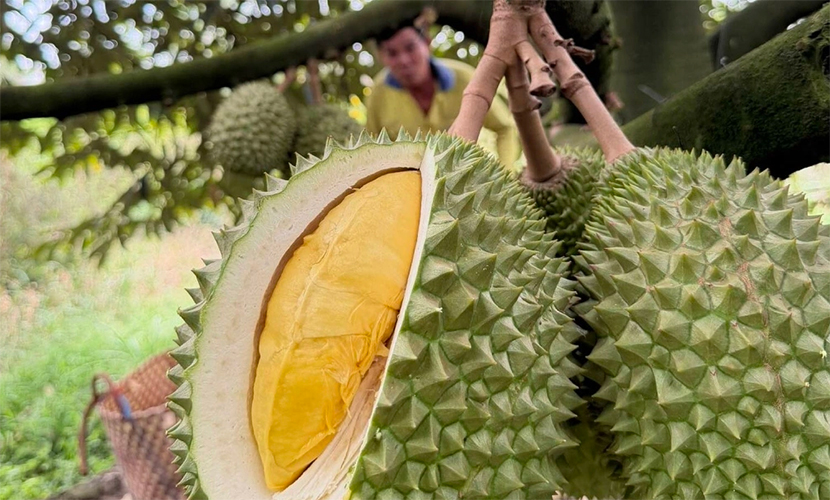
Vietnam durian exports have surged at the beginning of the year. Specifically, grade A Monthong has reached up to 155,000 VND per kilogram, and Ri 6 has hit 87,000 VND. They doubled the price compared to the same period last year.
From the sixth day of the Lunar New Year holiday, durian warehouses across the Mekong Delta simultaneously reopened for business. Export order increases coupled with limited off-season supply, have pushed prices to their highest level in three years.
At warehouses, Monthong — the key variety for export — Grade A is selling at 147,000–155,000 VND per kilogram. This figure is more than double the 40,000–70,000 VND recorded during the same period last year. Grade B has prices at 126,000–127,000 VND per kilogram. For Ri 6, traders are paying 80,000 VND per kilogram for Grade A and around 70,000 VND for Grade B.
Mr. Thanh is a trader operating in the Tien Giang area (now part of Dong Thap Province). He said he had planned to collect about 40 tons of Monthong at the start of the year. However, he managed to secure only around 20 tons in the first two days. He attributed this to a 30–40% drop in off-season supply.
Vietnam durian exports
“The demand of Vietnam durian exports has rebounded after the Lunar New Year holiday. In the meanwhile, the volume of export-quality fruit remains limited. Therefore, prices have risen quickly,” he said.
China is the market that absorbs the majority of Vietnamese durians. In addition, partners in Japan, Canada, and the United States have also increased orders compared to the end of last year. Therefore, overall demand from international markets has shown a positive trend.
However, these markets impose strict requirements on growing area codes, traceability, and pesticide residue control. Vietnam’s fruit businesses note that shipments meeting export standards have higher-than-average prices.
Despite the sharp price increase, the actual benefits for growers are not entirely proportional. Particularly, costs for off-season flowering treatment, fertilizers, and labor have risen 10–20% compared to last year. Many farmers said off-season durian is inherently limited.
Moreover, not all growing areas have official codes or direct links with export companies. As a result, farmers often have to sell through intermediaries at lower prices than those paid for export-qualified fruit.
According to data from the Ministry of Agriculture and Environment, the value of Vietnam durian exports in 2025 reached approximately USD 3.86 billion. This figure was up more than 20% in comparison to the previous year.
Also, it accounted for nearly half of the country’s total fruit and vegetable export value. The agency assessed that durian continues to be the main driver of growth in the fruit sector. This is due to the signing of official export protocols and market expansion.

Vietnamese dried durians
Vietnamese exporting companies believe that if the current momentum in orders continues and no new technical barriers arise, the turnover of Vietnam durian exports this year could exceed USD 4 billion. However, they note that this scenario depends largely on the ability to comply with increasingly stringent regulations from China — the key consumption market.
Recently, China introduced regulations requiring many Vietnamese agricultural products to obtain confirmation letters from competent authorities and to register exporting enterprises. As a result, management controls have been tightened. These requirements compel businesses and growing areas to complete legal documentation, enhance quality control standards, and strictly adhere to production processes.
Experts say that if enterprises and farmers effectively meet technical requirements and residue control standards, Vietnamese durian will retain its competitive advantage. As a result, it can leverage its large output and flexible harvest seasons. However, they also note that when the main harvest season begins, increased supply could lead to adjustments in domestic prices.
Therefore, the prospect of surpassing the USD 4 billion mark depends not only on market demand. It also depends on the sector’s ability to adapt to policy changes and organize sustainable production across the entire value chain.
Vietnames source: https://vnexpress.net/sau-rieng-len-155-000-dong-mot-kg-cao-nhat-3-nam-5043194.html