
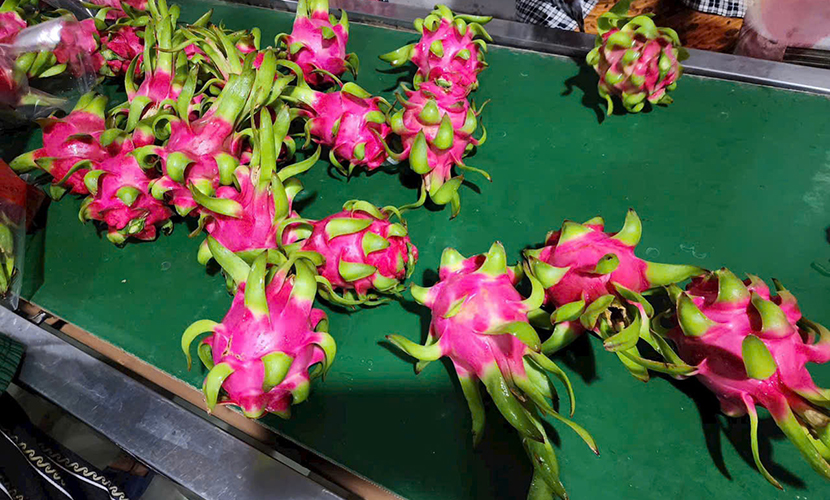
Once generating export revenues of over USD one billion a year, Vietnamese dragon fruits are now experiencing a sharp decline in export value. They have fallen to their lowest level in more than a decade.
According to customs data, in the first 11 months of 2025, dragon fruit export turnover reached USD 485.2 million, down 0.8% year-on-year. This is the lowest level since 2014, indicating that a product which once led Vietnam’s fruit export sector has entered a period of deep adjustment.
Previously, the 2014–2018 period was a boom phase for Vietnam’s dragon fruit. Accordingly, the export revenues rose steadily and exceeded USD one billion annually. In which, the export value peaked at around USD 1.3 billion in 2018. After that milestone, dragon fruit exports began to stagnate and decline. This occurred amid rapid changes in consumer markets and intensifying international competition.
Vietnamese dragon fruits
China remained the largest destination for Vietnamese dragon fruits. Specifically, in the first 11 months of 2025, the export turnover reached more than USD 301.7 million. This figure accounted for about 62.2% of total export value. However, exports to this market fell by 4.5% year-on-year. This decline reflects a slowdown in import demand as domestic supply has become increasingly abundant.
By contrast, exports to several newer markets recorded certain growth. Shipments to India reached nearly USD 41.8 million, up 6.4%. Meanwhile, exports to Thailand surged by 71.1% compared with the same period last year. Even so, the scale of these markets remains relatively small. As a result, they are insufficient to offset the decline in the key market.
Explaining the sharp decline in dragon fruit export revenues, Vietnamese fruit businesses say that global supply is rising rapidly. This trend has led to increasingly intense competition. China has significantly expanded its dragon fruit cultivation area, with output of around 1.6 million tonnes per year. This is hundreds of thousands of tonnes more than Vietnam. As a result, China now nearly meets its domestic consumption needs, thereby substantially narrowing its import demand.
Not only China, but India is also gradually joining the group of dragon fruit suppliers. Particularly, India currently has about 3,000–4,000 hectares of dragon fruit under cultivation. These areas are spread across several states such as Karnataka, Maharashtra, Gujarat, Telangana, Andhra Pradesh, and West Bengal. The country’s dragon fruit output is currently around 12,000 tonnes per year. Although still modest, production is on an expanding trajectory.
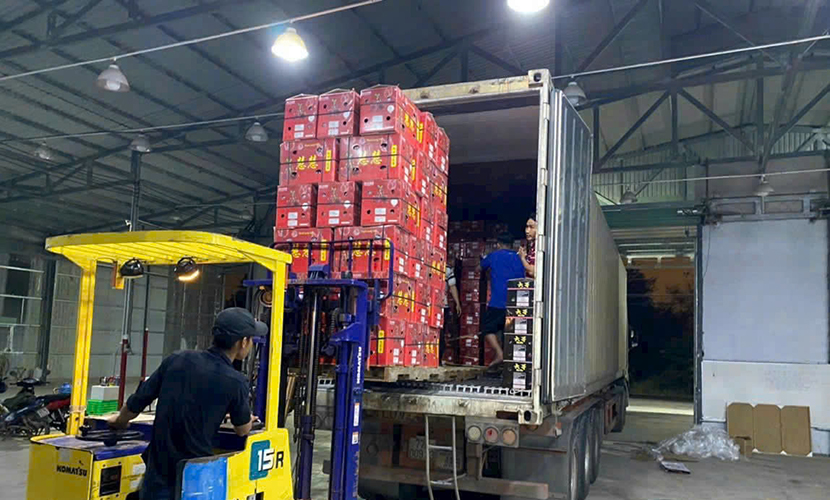
Loading dragon fruits for export
In addition, Mexico has successfully cultivated dragon fruit, directly competing with Vietnam in the US and Canadian markets. According to business representatives, in the early 2010s, Vietnamese dragon fruits were exported smoothly to the US. However, since 2019, Mexico has expanded production by leveraging its geographical proximity to the North American market. Consequently, Vietnam has almost completely lost its exports of white-fleshed dragon fruit to the US and Canada, except for a small volume of red-fleshed varieties.
Businesses forecast that in the short term, both output and export revenue of dragon fruit are unlikely to recover soon. At the same time, prices are also unlikely to rise sharply if China and India continue to expand production. There is even a risk that dragon fruit from these countries could ship back to Vietnam. This could happen if their production costs are lower.
Mr. Dang Phuc Nguyen is the Secretary General of the Vietnam Fruit and Vegetable Association (Vinafruit). He believes that farmers and enterprises need to reassess markets and competitive advantages. In addition to improving product quality and packaging, the dragon fruit industry should adjust cultivation schedules.
It should also increase the share of off-season production, especially at the beginning and end of the year, when China and India face weather-related constraints. This approach is preferable to expanding cultivation areas indiscriminately.
Vietnamese source: https://vnexpress.net/xuat-khau-thanh-long-thap-nhat-11-nam-5001328.html
If you are interested in Vietnamese dragon fruit exports, please contact us:
Company: Agrideco Vietnam Co., Ltd.
Address: No 02, Alley 325 Kim Nguu, Vinh Tuy Ward, Hanoi, Vietnam
Tel/Kakao Talk/Whatsapp: +84 989 649 804
Website: https://agridecovietnam.com
Email: agridecovietnam@gmail.com