
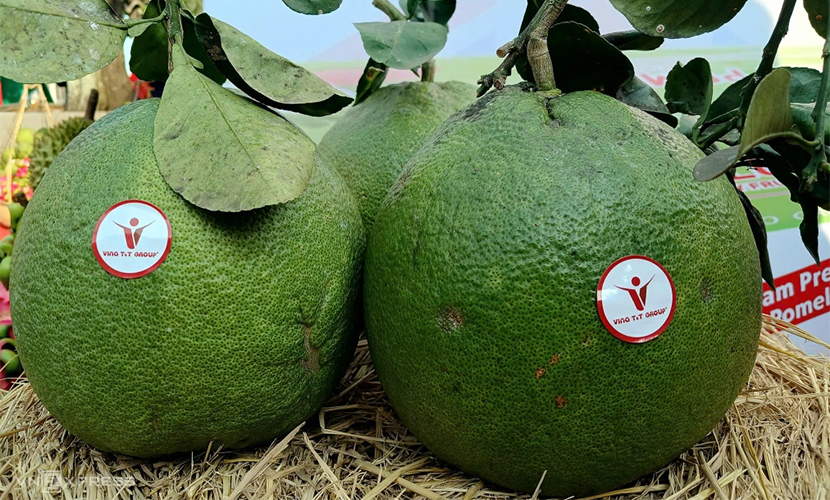
The first shipment of Vietnamese green-skinned pomelos officially exported to Australia this morning after two years of negotiations. This event marked the fruit’s entry into its fourth demanding market.
On April 13, in Vinh Long (formerly part of Ben Tre) and Dong Thap, relevant parties announced the export of the first batches of pomelos under the “Ben Tre green-skinned pomelo” brand to Australia. The total volume of the two shipments reached several dozen tons. Therefore, this marked the beginning of commercial distribution of this fruit in one of the markets with the strictest quarantine standards.
Previously, in October 2025, authorities from both countries completed legal procedures and agreed on technical requirements for imported pomelos. This laid the foundation for companies to begin actual exports, although additional time was necessary to finalize preparations.
Vietnamese green-skinned pomelos
Mr. Nguyen Dinh Tung is the CEO of a Vietnamese fruit company. As one of the participants in the first shipment, he said the company exported 18 tons of pomelos sourced from Ben Tre. The company has experience exporting around 50 tons of Vietnamese green-skinned pomelosper week to the United States. Therefore, he expects the Australian market to reach a similar scale due to comparable consumer behavior.
According to Mr. Tung, the negotiation process between the two countries lasted nearly two years. It focused on technical requirements, quarantine measures, and irradiation procedures. Although the market officially opened late last year, the first shipment received import approval on April 10.
Following the first shipment, the company plans to continue exporting to two major consumption hubs—Melbourne and Sydney. After that, it will expand to other states through its distribution network. Currently, Australian partners have placed orders for nine containers. Each container carries between 14 and 18 tons, indicating positive market signals.
Regarding branding, the actual growing area is the Giao Long commune (Vinh Long). However, the product is available under the name “Ben Tre green-skinned pomelo” to ensure recognition in international markets. The company said it will add information about the growing area to ensure transparency of origin. At the same time, it will leverage the established brand reputation.
Mr. Le Viet Binh is a representative of the Southern Office of the Ministry of Agriculture and Environment. He said Vietnamese fruit and vegetable exports in the first three months recorded strong growth. Australia is also emerging as a notable new market for pomelos.
According to him, Vietnamese pomelos have great potential but remain underdeveloped relative to their capacity. Despite having many well-known growing regions from north to south, the sector has only gradually entered demanding markets. For example, it entered the United States in late 2022, followed by New Zealand, and then South Korea in August 2024.
“Among high-standard markets, Australia is the fourth destination, both promising and highly demanding,” Mr. Binh said. He added that pomelo export turnover reached about $60 million in 2024. It then surpassed $70 million by year-end, based on a cultivation area of over 100,000 hectares.

The first container of Vietnamese pomelos to Australia
However, despite its large scale, the sector’s efficiency has yet to match its potential. With the opening of the Australian market, the agricultural sector expects Vietnamese pomelo exports to grow significantly this year and aims to exceed $100 million.
He also noted that the former Ben Tre area (now part of Vinh Long) was the first locality to export pomelos to the United States. It is now once again the starting point for the first shipment to Australia, highlighting the region’s leading role in developing this sector.
Exporting to Australia is considered a significant milestone as Vietnam continues to expand its agricultural export markets. This is a market with strict requirements on quarantine and biosecurity. Also, it requires products to undergo a pest risk assessment process lasting nearly two years.
This process ensures they are free from 19 harmful organisms. Vietnamese pomelos must come from registered growing areas. They must also be processed at approved packing facilities and undergo irradiation at a minimum dose of 400 Gy (a unit measuring absorbed ionizing radiation) before customs clearance.
Mr. Nguyen Thanh Binh is the Chairman of the Vietnam Fruit and Vegetable Association. She said that exporting the first shipment of pomelos not only opens up a new market. It also affirms the ability of Vietnamese agricultural products to meet high standards.
As more demanding markets gradually accept these products, there will be greater room for expansion. This will help stabilize prices and reduce the situation of bumper harvests leading to price drops.
Currently, Vietnam has more than 100,000 hectares dedicated to pomelo cultivation, with an annual output of nearly 1 million tons. In 2024, pomelo export turnover reached approximately $60 million.
Amid steady demand for tropical fruits in Australia and limited domestic supply there, Vietnamese pomelos are considered to have significant potential to increase market share. This potential can be realized provided that quality and supply consistency are maintained.