

Compared to the past, growers of Hai Duong’s carrots are now much more confident about the future of their crops.
Đức Chính commune is the kingdom of Vietnamese carrots in Cẩm Giàng district, Hải Dương province. One winter morning, with golden sunlight reminiscent of autumn, my colleagues and I visited the commune. The vast carrot fields stretched out in green and were irrigated automatically with sprinklers. Mr. Nguyễn Đức Thuật, Director of the Đức Chính Agricultural Service Cooperative, greeted us.
As usual, I asked Mr. Thuật about this year’s carrot prices and the advantages and challenges in production and marketing. He explained that this winter crop experienced an unusually warm early season. Specifically, in October and November, temperatures frequently exceeded 30°C, causing early-harvest carrots to have pointed roots and large cores.
Hai Duong’s carrots
Fortunately, the cold weather in December improved the quality of later-harvest carrots. Sadly, however, purchasing prices of Hai Duong’s carrots have dropped. They have reached only half of what they were during the same period last year.
According to Mr. Thuật’s assessment, the main reason carrot prices have fallen is that Chinese carrots continue to come Vietnam. In addition, many workers in southern industrial zones have left. Therefore, it reduces the consumption of cabbage and carrots in these areas. Furthermore, unfavorable early-season weather resulted in poorly shaped carrots. These carrots often have pointed roots, large cores, and unattractive appearances.
Another obstacle is that South Korea has banned the import of root and tuber crops, whose edible parts grow underground, since October 3, 2022. This is the second time South Korea has issued such a ban. The reason was the detection of the nematode Radopholus similis in banana corms exported to South Korea. Since South Korea consumes 80% of large-sized carrots, the export of Hai Duong’s carrots to this market has been halted.
What Mr. Thuật is most hopeful for is the reopening of the South Korean market to carrots. More than 20 Vietnamese export companies are waiting to import carrots from Đức Chính. The Hải Dương Sub-Department of Crop Production and Plant Protection has reported this issue to the Plant Protection Department. The department has held discussions with South Korea to lift the ban.
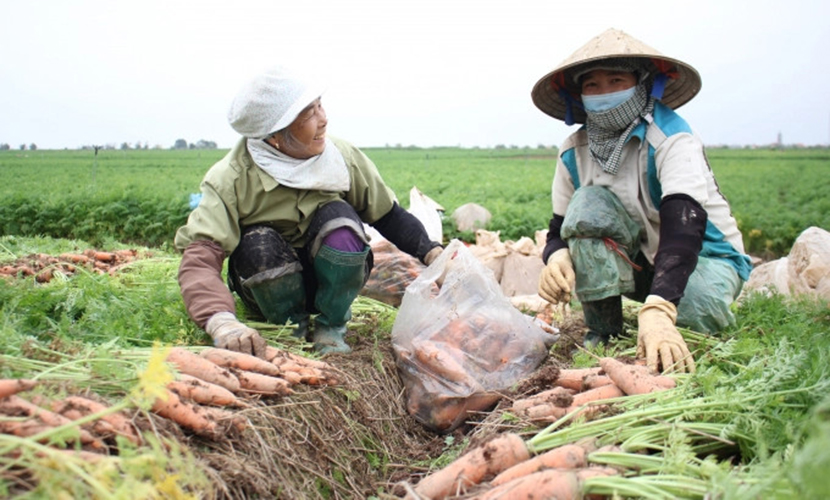
Harvesting Hai Duong’s carrots
I asked Mr. Thuật, “Do you and the local farmers satisfy with what the Project Supporting Agricultural Product Processing and Preservation Facilities in Vietnam has brought?” This project is funded by the Korean Rural Community and the Ministry of Agriculture, Food and Rural Affairs of Korea. Vietnam Academy of Agricultural Sciences plays a role of implement.
He said “Absolutely satisfied! With a processing capacity of 100 tons of carrots per day, the facility can handle 3,000 tons per month. As a result, a total of 15,000 tons of carrots are exported from the processing facility supported by the Project. After harvest, they wash the carrots through five tanks and make precool at -2°C for 16–24 hours until the core temperature reaches 1°C”.
“But that’s just the tangible value. The intangible value the Project has brought is much greater. Since the Project started, many Korean companies have come directly here to buy carrots. We negotiate prices directly with them. In the past, they bought through intermediaries, and farmers should accept low prices. Companies now contact us directly via Zalo—let me show you,” Mr. Thuật shared.
He took out his phone to show me the messages. I was happy to see that one company had messaged him saying that carrots were able to export to South Korea. The company also said they wanted to place orders in January 2023.
Mr. Thuật eagerly shared more intangible benefits the Project had brought. “More than 20 Korean companies want to buy Hai Duong’s carrots. The Samsung Group has been buying Vietnam’s carrots since 2021. Soon, the Vice President of Samsung will visit our cooperative”.
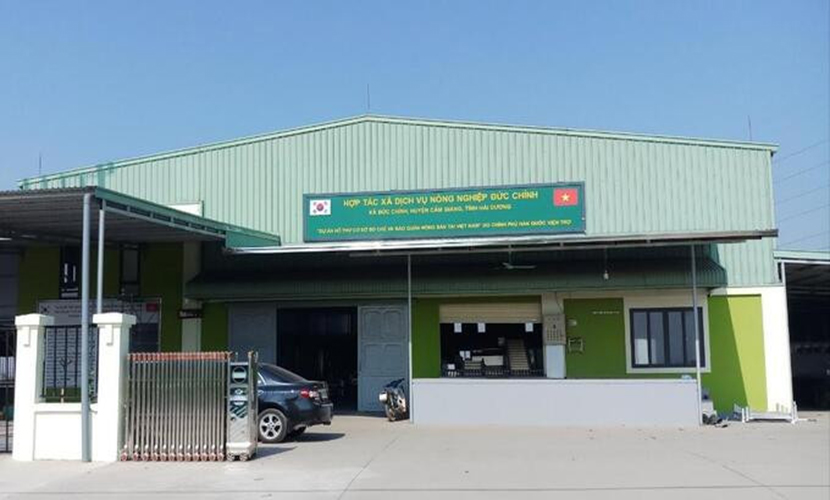
Hai Duong’s carrot packing house
This project has also stimulated other initiatives supporting the concentrated carrot production area in Đức Chính commune. The province has invested in expanding the main road through the carrot fields in Đức Chính. This expansion facilitates carrot transportation. The province has also invested in a water-saving irrigation system. This includes sprinkler irrigation for 100 hectares of carrots outside the dikes. Water for this system comes from the Thái Bình River.
Regarding product safety, in order to export carrots, farmers must comply with regulations to meet buyers’ requirements. In 2020, a company exporting carrots to Japan had its shipment rejected due to excessive residues of Hexaconazole. Farmers had treated dry rot using a milk-based fungicide containing Hexaconazole. They applied it by watering it onto the beds, which involved excessive amounts.
The Hải Dương Plant Protection Sub-Department trained farmers to spray only on the leaves and not onto the soil when treating plant diseases. Watering pesticide solutions into the soil not only risks excessive residue in the product but also kills beneficial microorganisms in the soil.
The Sub-Department also provided guidance on a 25–30 day pre-harvest interval. Since then, carrots can only be exported if the minimum interval of 25 days is observed and no residue issues remain. The total carrot-growing area in the commune was 360 hectares in 2019 and increased to 380 hectares from 2021.
In addition, farmers rent approximately 1,000 hectares of land outside the commune for Vietnamese carrot cultivation each year. With an average yield of 51 tons per hectare, the revenue from carrots in Đức Chính commune rose from 170 billion VND in 2019 to 300 billion VND in 2022. This figure essentially reflects revenue from the 2021 winter crop.
Vietnames source: https://vaas.vn/vi/khoa-hoc/nong-san-an-toan-cau-chuyen-ca-rot-hai-duong
If you are interested in Vietnamese carrot exports, please contact us:
Company: Agrideco Vietnam Co., Ltd.
Address: No 02, Alley 325 Kim Nguu, Vinh Tuy Ward, Hanoi, Vietnam
Tel/Kakao Talk/Whatsapp: +84 989 649 804
Website: https://agridecovietnam.com
Email: agridecovietnam@gmail.com