

Cù Lao Giêng is a commune in Tiền Giang province, which is a land blessed by nature, with fertile alluvial soil year-round. Once known only for low-yield rice fields, the area has now undergone a remarkable transformation. It has become the specialty zone of Vietnam mango exports. Also, it is a shining example on the map of modern agriculture in the Mekong Delta.
Before 2010, the rice-growing areas in Cù Lao Giêng generated low economic value. Despite working diligently from dawn to dusk each harvest, local residents could barely make ends meet. Afterthat, An Giang province implemented the policy of crop restructuring. Then, people boldly began to improve the soil and plant fruit trees. Among them, the Green Skin Mango (xoài tượng da xanh) was the main focus. This choice carried the hope of helping the island community break free from poverty.
Mr. Huỳnh Văn Liếp is a local farmer from Bình Phú hamlet, Cù Lao Giêng commune, An Giang Province. He recalls: “In the past, growing rice brought very little profit, and some years we even suffered losses. Since switching to Vietnamese mango cultivation, my family’s life has improved significantly. With 7 công of land (approximately 7,000 m²), after deducting costs, I earn more than 140 million VND per year. Thanks to mango farming, my children have the opportunity to study. At the same time, our house has been built sturdier.”
Vietnam mango exports
Following pioneers like Mr. Liếp, the movement to convert low-yield rice into Vietnam mango exports quickly spread. By 2014, there was no rice growing in the area. Instead, lush mango gardens, heavy with fruit, stretched across the land all year round.
After the merger of the three communes, the total area of fruit trees in Cù Lao Giêng reached 4,198 hectares. This accounted for more than 98% of the commune’s agricultural land. In which, Green Skin Mango (xoài tượng da xanh) covered 4,135 hectares.
This mango variety generates high productivity, yielding 18–25 tons per hectare per year. Green Skin Mango produces two harvests annually and offers superior quality. Its sweet yet mild flavor, thick and crisp flesh, and low fiber make it highly favored in both domestic and international markets.
Currently, Cù Lao Giêng commune not only has a large area of mango cultivation but also leads in safe agricultural products. To date, the commune owns 32 mango-growing zone codes covering a total area of 2,944 hectares. Of this area, 735 hectares meet Vietgap standards and 49.9 hectares meet Globalgap standards. This provides a crucial foundation for Vietnam mango exports to enter demanding international markets.
There are three efficiently operating cooperatives in the commune: GAP Cù Lao Giêng Cooperative, Chợ Mới GAP Fruit Cooperative, and Cồn Én Cooperative. Among them, GAP Cù Lao Giêng Cooperative stands out with a solar and cold-drying mango system and electronic traceability. As a result, it has formed a closed production, processing, and consumption chain.
Mr. Nguyễn Minh Hiền is the Director of GAP Cù Lao Giêng Cooperative in An Giang province. He shared that from the beginning of this year, the cooperative has exported approximately 1,000 tons of Vietnam mango exports. These exports went to markets including South Korea, New Zealand, Australia, the United States, Russia, and China. These demanding markets require registered growing areas, irradiation, and pesticide residue control. Cù Lao Giêng mangoes meet all these standards.
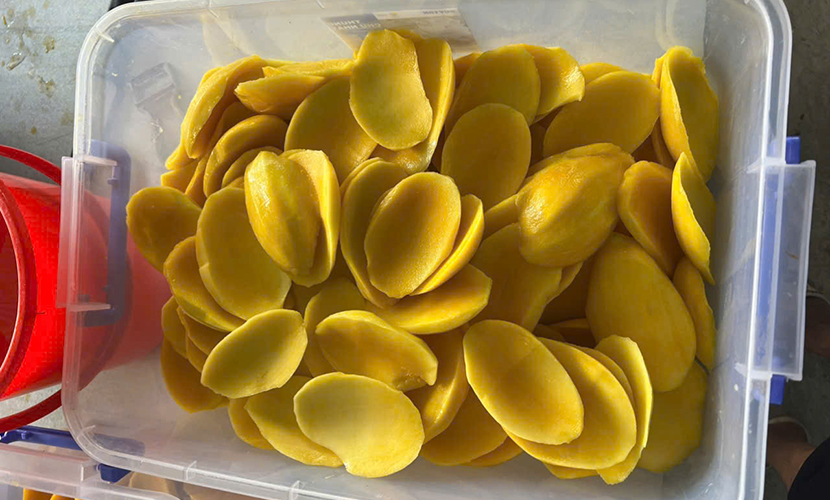
Vietnamese mango slices
According to Mr. Hiền, thanks to smooth exports, mango prices this year have increased. As a result, farmers earn an average of 20–25 million VND per công of mango trees. The cooperative currently maintains more than 500 hectares of Vietnam’s mangoes for export under Vietgap and Globalgap standards. These areas have registered growing codes, giving farmers confidence to invest without worrying about low prices during peak harvests as in the past.
In the commune, two cooperatives have products certified under the OCOP program. These include Green Skin Mango and Cat Hat Lep Mango from GAP Cù Lao Giêng Cooperative, and Three-Color Mango from Chợ Mới GAP Fruit Cooperative. In addition to fresh mangoes, many Cù Lao Giêng mango products are processed into value-added items such as dried mango and mango juice. This opens up sustainable opportunities for the island’s residents.
Although mango has become the “cash crop” of the island, the sector still faces several challenges. Production remains fragmented, linkages are not tight, and value-added processing is limited, keeping profit margins relatively low. In addition, rising agricultural input costs and competition from fruit-exporting suppliers in the region make the question of sustainable development even more urgent.
With its rare natural advantages—fertile alluvial soil, dense rivers, and picturesque landscapes—Cù Lao Giêng not only has great agricultural potential. It is also considered a “gold mine” for ecotourism in the orchard region. Recognizing this, the Party Committee of Cù Lao Giêng commune has identified the future direction. That direction is developing high-tech agriculture linked with ecotourism and community-based tourism.
Mr. Võ Minh Nâng is the Secretary of the Party Committee of Cù Lao Giêng. She said that the commune continues to guide farmers in producing Vietnam mango exports according to Vietgap and Globalgap standards. It also encourages the use of organic fertilizers and biological products to reduce chemical use and protect the environment.

Vietnamese mango boxes for export
At the same time, the local authorities are investing in infrastructure for growing areas. These investments range from transportation and irrigation to processing facilities and storage warehouses. They aim to improve production capacity and post-harvest quality of Vietnam mango exports.
According to Mr. Nâng, the commune is also focusing on building the “Cù Lao Giêng Mango” brand for export. In addition, it is developing OCOP products from mango and expanding agricultural experience tourism. Visitors can tour mango orchards and pick and enjoy mangoes on-site. They can also visit famous spiritual and cultural attractions on the island, creating new livelihoods for local residents.
To ensure Cù Lao Giêng develops according to its potential and natural advantages, the local authorities have made several recommendations. They suggest that An Giang province include the commune in the provincial tourism development plan. They also propose support for farmer training in community-based tourism, trade promotion, and investment connection. In addition, provincial support is requested for projects linking OCOP product development with community tourism.
From a low-yield rice-growing area, Cù Lao Giêng has now transformed into the province’s leading mango export zone. The vast orchards of Vietnam mango exports not only provide a prosperous life for local residents. They also stand as proof of the creativity and innovative spirit of Mekong Delta farmers.
The people of Cù Lao Giêng believe that, with the right direction and ambition to rise, this island in the middle of the Tiền River will achieve even more. It will not only become famous for its exported Green Skin Mangoes but also emerge as a unique ecotourism destination in the Mekong Delta. There, visitors can savor sweet orchard fruits and fully experience the peaceful rhythm of life in this fertile alluvial land.
Vietnamese source: https://baotintuc.vn/kinh-te/vuon-minh-thanh-vung-chuyen-canh-xoai-xuat-khau-20251116110536573.htm
If you are interested in Vietnamese mango exports, please contact us:
Company: Agrideco Vietnam Co., Ltd.
Address: No 02, Alley 325 Kim Nguu, Vinh Tuy Ward, Hanoi, Vietnam
Tel/Kakao Talk/Whatsapp: +84 989 649 804
Website: https://agridecovietnam.com
Email: agridecovietnam@gmail.com