
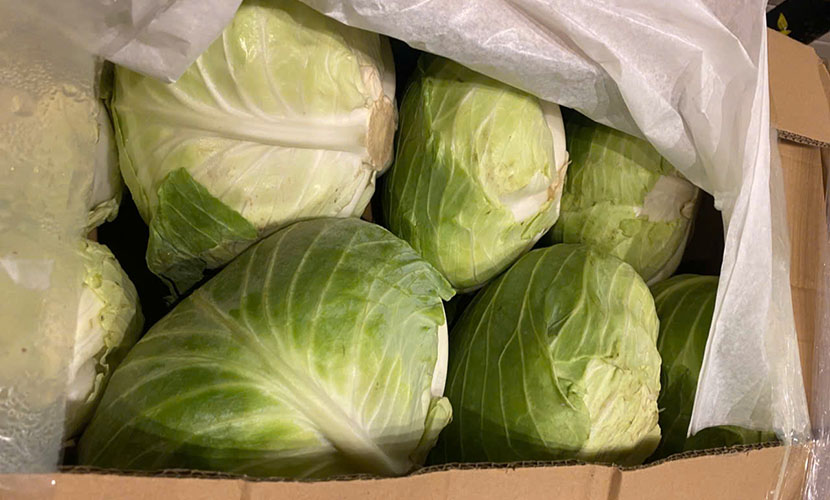
Mr. Dung cultivates Vietgap-certified cabbage in Mộc Châu District, Sơn La Province. Farming more than two hectares of Vietnamese round cabbage, he generates an annual profit of around VND 800 million after expenses.
Mr. Kim Van Dung is a resident of Hamlet 83 in Phiêng Luông Commune, Mộc Châu District, Sơn La Province. He grows vast fields of cabbage in a valley surrounded by barren hills and mountains. His cabbage cultivation follows Vietgap standards. With more than two hectares under cabbage cultivation, he earns an annual profit of VND 800 million after deducting production costs.
The Mộc Châu Plateau enjoys a cool climate and fertile soil. These conditions create a favorable environment for cultivating vegetables, including Vietnam’s cabbage, which can generate substantial income for local farmers. Mr. Kim Van Dung is among the pioneers of Vietgap-certified cabbage cultivation in the area. Through this model, he has successfully improved his family’s economic situation. As a result, he earns hundreds of millions of Vietnamese dong in profit each year.
Mr. Dung recalled: “In the past, I grew corn, cassava, and paddy rice. However, prices for these crops have remained low in recent years. This has made it difficult to cover production costs and continue investing. I knew I had to find a new direction to break out of this cycle of hardship.”
Vietnamese round cabbage
“In 2016, I visited friends in Bảo Lộc District, Lâm Đồng Province. There, I saw that local farmers were earning substantial incomes from Vietnamese round cabbage. After returning home, I converted two hectares of paddy land and invested in an automatic irrigation system. I also purchased cabbage seedlings from reputable nurseries in Mê Linh District, Hanoi, before starting cultivation.”
“As I had little experience in cabbage cultivation techniques, my first crop was unsuccessful. Moreover, the harvest coincided with the peak production season in major vegetable-growing areas in the lowlands. As a result, demand was weak and prices for my produce were low.”
“After learning from that initial set back, I searched the internet, read newspapers, and studied cultivation techniques to improve my farming practices. I also looked for ways to grow vegetables during the off-season to increase production efficiency. Since then, I have grown cabbage from February to October. I then switch to other crops such as kohlrabi and green beans for the remainder of the year. Thanks to this off-season cultivation strategy, my family has secured better market opportunities and achieved significantly higher profits.”
Once his cabbage farm had become well established, Mr. Dung sought to secure stable and long-term market outlets for his produce. He traveled to Hanoi to sign supply contracts with a Vietnam’s vegetable company and several clean-food retail chains in Phu Ly. These buyers agreed to purchase his Vietnamese round cabbage.
Thanks to his willingness to innovate and his effective farming methods, consumers have consistently received Mr. Dung’s vegetables. As a result, this has helped him maintain a stable market and profitable production.
According to Mr. Dung, when cultivating cabbage under VietGAP standards, farmers must strictly avoid using contaminated water sources. These include water polluted by industrial waste, wastewater from densely populated residential areas, livestock farms, fresh manure, or stagnant ponds.

Vietgap cabbage cultivation
At the beginning of the growing season, he watered the crop twice a day. After 10–15 days, soil moisture must be maintained throughout the growing period. In addition, fertilization should be applied in accordance with the prescribed cultivation procedures.
“When the cabbage heads begin to form, I remove the older outer leaves near the base of the plants. This helps improve air circulation and reduces the risk of pests and diseases that could affect crop development. Once the cabbage heads become firm, with smooth surfaces and tightly packed, flat leaves, they are ready for harvest.”
Unlike conventional vegetable farming, cultivating cabbage under Vietgap standards requires strict compliance with a range of production requirements. In addition to meeting standards for soil quality, irrigation water, and input monitoring, farmers must follow regulations at every stage of production. This includes planting, crop management, harvesting, and marketing. Furthermore, all activities must be fully documented in production records.
As a result, farmers need to adopt an appropriate safe-vegetable production model. This helps ensure compliance with these rigorous standards and requirements.
Mr. Dung said: “I obtained Vietgap certification in 2017. Since then, several Vietnamese export companies have purchased my cabbage. This has helped ensure a stable income for my family. On average, I grow three cabbage crops a year. I then cultivate green beans, kohlrabi, tomatoes, and other short-cycle vegetables, generating around VND 800 million in annual income.

Vietnamese cabbage farm
Since switching to vegetable cultivation, I have been able to buy three cars and build a spacious new house. My family’s living standards have improved significantly. We now enjoy a comfortable and financially secure life.”
In addition to his success in farming, Mr. Dung has also created jobs for three local workers. Each earns VND 5 million per month, with accommodation and meals provided. He also took the initiative to establish the Dung Tien Clean Agricultural Cooperative. The cooperative has attracted 15 members from the Dao, Mường, and Thái ethnic groups.
It manages a total cultivation area of 10 hectares, including 6 hectares of cabbage and 4 hectares of fruit and vegetable crops. After deducting production costs, each cooperative member earns an annual profit of between VND 150 million and VND 200 million. This is around eight times higher than what they previously earned from growing corn and rice.
Mr. Ban Van Loi is the Chairman of Phiêng Luông Commune in Mộc Châu District. He said that Mr. Dung’s success has been driven by the application of advanced farming techniques and Vietgap standards in cabbage production. It has also been supported by the selection of high-yield, short-cycle vegetable crops.
“For many years, Mr. Dung’s family has enjoyed a comfortable standard of living. He has been able to support his children’s education and create employment opportunities for many members of the local cooperative. In the coming years, we plan to expand the clean vegetable farming model across the commune. This will help meet growing consumer demand and enable local farmers to improve their incomes and achieve greater prosperity,” Mr. Loi said.
Vietnamese source: https://diendandoanhnghiep.vn/lam-giau-thanh-cong-tu-trong-bap-cai-giua-bon-be-nui-troc-loi-800-trieu-nam-10031293.html
If you are interested in Vietnamese round cabbage, please contact us:
Company: Agrideco Vietnam Co., Ltd.
Address: No 02, Alley 325 Kim Nguu, Vinh Tuy Ward, Hanoi, Vietnam
Tel/Kakao Talk/Whatsapp: +84 989 649 804
Website: https://agridecovietnam.com
Email: agridecovietnam@gmail.com