
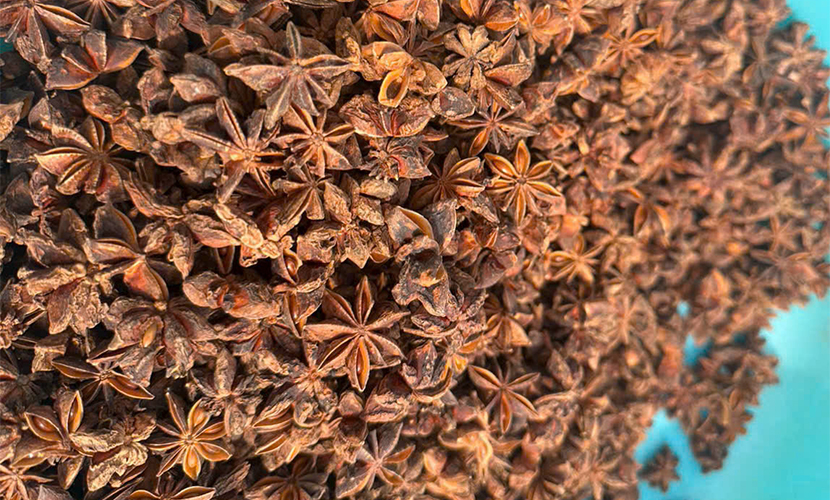
Along the road leading to the center of Yên Phúc Commune (Văn Quan District, Lạng Sơn Province) at the end of the year, vast forests of Vietnam’s star anise flowers stretch as far as the eye can see. During the harvest season, the forests are full of blossoms. Beautifully, they spread a rich fragrance and bring warmth and prosperity to the highland people.
Taking the last coach of the day, we arrived in Yên Phúc Commune—known as the “capital” of Vietnamese star anise—about 40 km from Lạng Sơn City. Mr. Linh Văn Chuyên is the Chairman of the People’s Committee of Yên Phúc Commune. He proudly shared: If star anise from Lạng Sơn is likened to a “green gold mine,” then Yên Phúc is considered the very “heart” of Lạng Sơn’s star anise region. This is thanks to its top-tier yield, quality, and distinctive aroma, attributed to its favorable climate, soil type, and high-altitude terrain.
Vietnam’s star anise flowers
Here, every household grows star anise, which is a legacy that passed down from ancestors. For generations, local people have relied on the star anise tree for their livelihood. Of the commune’s total 1,552 hectares of agricultural land, 1,145 hectares are star anise cultivation forests. Among them, 895.82 hectares are currently under harvest. Out of 1,130 households, more than 900 grow star anise. Income from Vietnam’s star anise flowers accounts for over 50% of the commune’s GDP.
“This year, we had a bumper crop, with output reaching 1,547.8 tons per season and revenue exceeding VND 100 billion. Thanks to the extensive star anise forests, many households earn hundreds of millions of dong per year. Notably, over 90% of Yên Phúc’s star anise output is exported to China, India, and Europe,” Mr. Linh Văn Chuyên said enthusiastically.
Following local officials, we visited the home of Mr. Triệu Văn Phòng in Đông B Hamlet, Yên Phúc Commune. Notably, he is one of the longest-standing star anise growers in the area. A tiny, winding dirt path led us to his house perched on a mountainside. It stands 4–5 meters above the road.
As he busily loaded large sacks of star anise onto an old three-wheeled cart to transport them to the year-end Bãi market, Mr. Phòng beamed. His sun-darkened face glowed with pride as he said in a slightly accented voice: “This year’s harvest is a success. Our ethnic community will enjoy a warm and prosperous Lunar New Year!”
Mr. Nguyễn Trung Trí is a trader of Vietnam’s star anise flowers at Bãi market in Yên Phúc Commune. He shared that star anise gives harvest twice a year. The main crop runs from July to September, and the spring crop takes place in February and March. After harvesting, growers dry fresh star anise fruits in kilns. They change color from green to golden yellow, then are sun-dried for another five to seven days until fully dry before being packed into sacks.
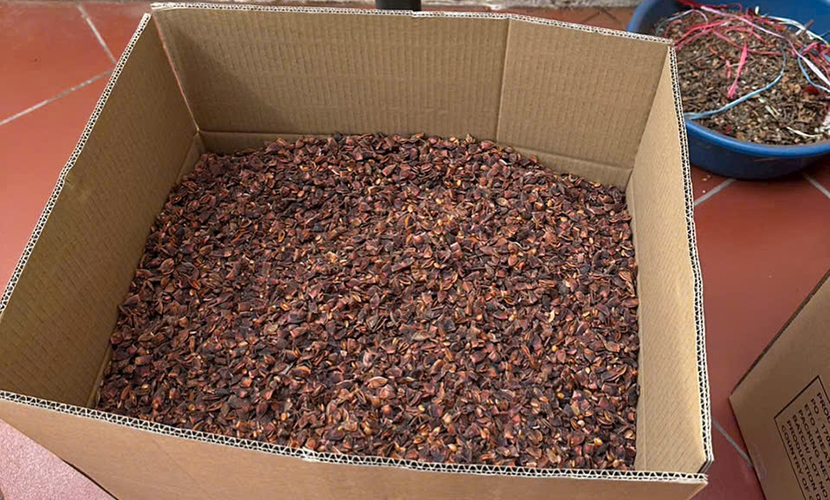
Vietnamese broken star anise
“My family has been trading Vietnam’s star anise flowers for more than 30 years. This year, we have a good harvest and high prices. On some days, I ship out dozens of tons. Without placing orders in advance with farmers, there would not be enough to buy. The essential oil content of star anise here is high. It solidifies at 16 degrees, while in other places it only solidifies at 12–13 degrees,” Mr. Trí explained.
Mr. Linh Văn Chuyên shared that star anise in the area has gone through many ups and downs. At times, prices were so high that supply could not meet demand. At other times, farmers nearly abandoned the crop due to the lack of a market. As a result, they suffered heavy losses from price drops.
It was not until 2007, when the geographical indication for Lạng Sơn star anise was granted protection and recognized as a national asset, that the market began to recover. Notably, in late 2015, the Lạng Sơn Department of Science and Technology completed the dossier to register the geographical indication for Lạng Sơn star anise in Europe. This helped affirm the brand and prevent infringement of star anise products abroad.
To maintain the Vietnamese star anise brand, district and commune authorities regularly organize training sessions. They also transfer techniques on cultivation, care, and harvesting to local farmers. As a result, the lush green star anise forests continue to expand. They follow cleaner processes in cultivation, harvesting, and processing.
Recently, Quế Hồi Company has also mobilized local farmers to establish organic star anise production groups. At the same time, the company is seeking land to set up a cooperative. This cooperative will focus on the production and processing of this crop.
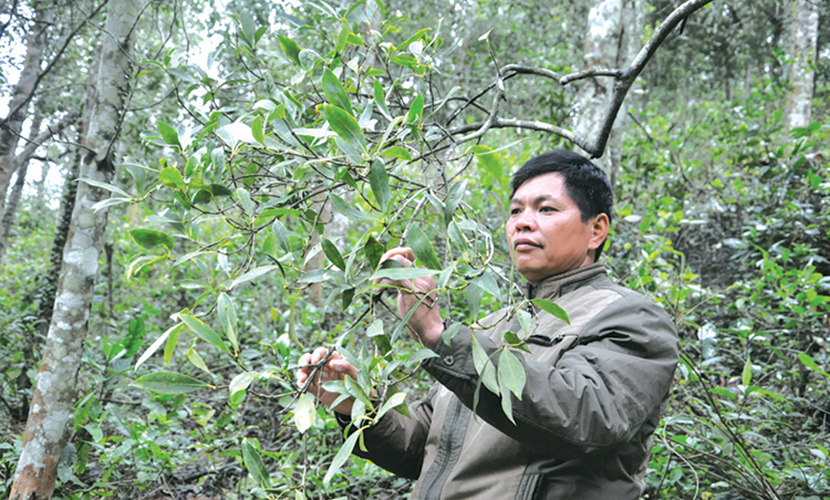
Vietnamese star anise forest
“We are aiming for official export channels and entry into demanding markets. This will ensure a sustainable outlet for Vietnam’s star anise,” Mr. Chuyên emphasized.
Bringing with us the joy of star anise growers in Yên Phúc, we returned to Lạng Sơn City. Mr. Liễu Anh Minh is the Head of the Import-Export Management Division under the Lạng Sơn Department of Industry and Trade. He said that the province currently has about 35,000 hectares of Vietnam’s star anise flowers. Among them, Văn Quan District is the largest “granary” of star anise in Lạng Sơn Province. It has nearly 10,000 hectares and an average output of around 6,000 tons per year.
The Industry and Trade sector has developed a Trade Promotion Program to promote the Lạng Sơn star anise brand at major exhibitions and trade fairs, as well as through mass media channels. In particular, the program also promotes star anise from Yên Phúc–Văn Quan as part of this brand. The aim is to seek and expand both domestic and international markets. T
Through these efforts, farming households can access more information about export market conditions. Therefore, they can produce goods that meet the technical standards and quality requirements of each market. This also helps strengthen linkages between farmers and export enterprises in production and product consumption.
“Lạng Sơn is focusing on turning star anise into a key export commodity in its economic development strategy. Exporting star anise will be the right direction and will bring high economic returns. Therefore, this strength needs to be further tapped,” Mr. Minh affirmed.
As we left the land of Lạng Sơn, mist blanketed the mountains and the temperature dropped to 5°C in the highlands. Meanwhile, we could feel a new, prosperous spring approaching for the people of Yên Phúc.
