
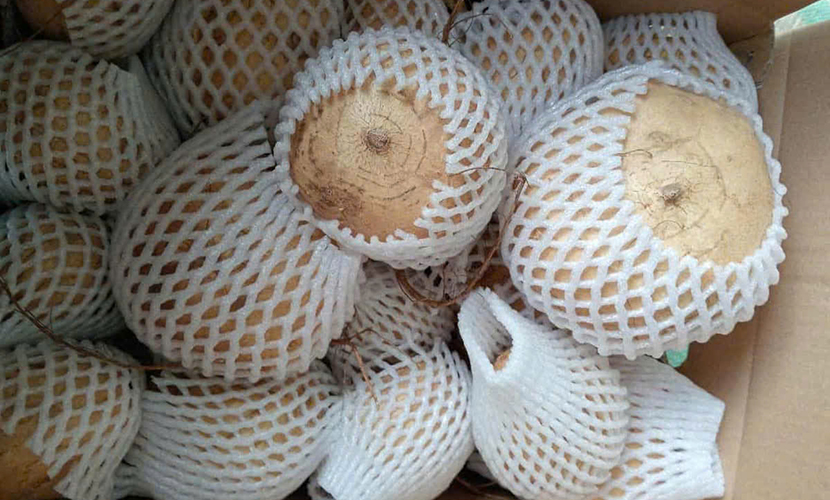
Currently, the average selling price of Vietnam’s yam bean ranges from 5,000 to 6,000 VND per kilogram. Accordingly, the yield per sao reaches 3 to 3.5 tons. With good care, Vietnamese yam bean can reach 4 to 4.5 tons per sao. As a result, it will bring in an income of 10 to 15 million VND per sao per crop.
In recent years, residents of Bang Khanh commune, Loc Binh district (Lang Son) have converted many areas of low-yield rice fields to jicama cultivation. This has brought high economic efficiency, contributed to hunger eradication and poverty reduction, and helped people improve their livelihoods.
Across the vast fields of dark green jicama plants, farmers are busy pulling up the plants and harvesting. Trucks line both sides of the road, waiting to transport the Vietnamese jicama for sale.
Vietnam’s yam bean exports
Ms. Loc Thi May, from Keo Mat village, happily shared: “This year Vietnam’s yam bean has a good yield and a good price, so everyone is very happy. My family planted 2 sao and harvested 6 tons. After harvesting, traders came directly to buy and transport it to other provinces and cities for consumption.”
According to Ms. May, Vietnam’s yam bean is an easy-to-grow crop that can give harvest after only four months. Local people grow two crops a year. The first crop lasts from February to March for an early harvest. The second lasts from August to September for harvest at the end of the year. After four months of focused care, the Vietnamese jicama crop starts generating income.
However, when planted on new land, jicama suffers fewer pests and diseases and produces higher yields. Currently, the average selling price ranges from 5,000 to 6,000 VND per kilogram. The yield per sao reaches 3 to 3.5 tons. With good care, it can reach 4 to 4.5 tons per sao, generating an income of 10 to 15 million VND per sao per crop.
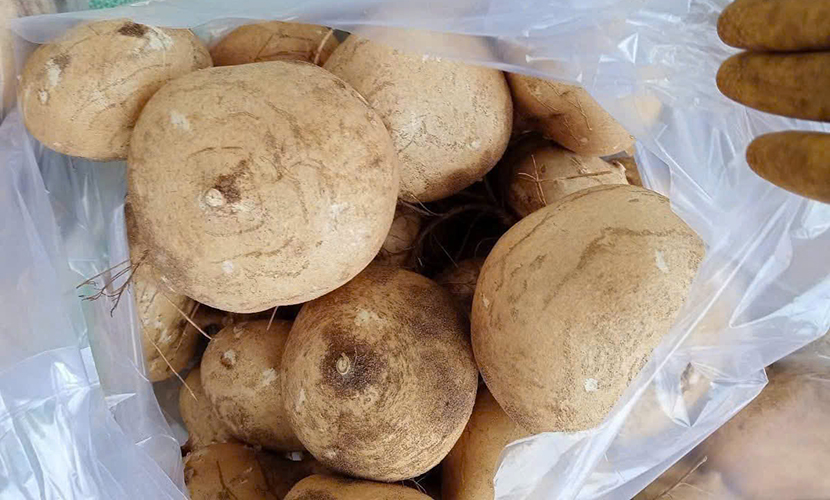
Vietnam’s yam bean materials
Mr. Hoang Van Ninh is the chairman of the Bang Khanh commune people’s committee. He said: “The Vietnam’s yam bean cultivation area in the commune is about 25 hectares, concentrated in Keo Mat, Na Ngan, and Ban Tang villages. Although it is not the main crop, Vietnam’s jicama contributes to increasing local incomes. Each year, Bang Khanh earns hundreds of millions of VND from this crop.”
According to Mr. Ninh, farmers in the commune are currently in the harvest season. Besides being easy to grow, jicama has other advantages such as low pest incidence, low investment costs, minimal care requirements, and the ability to be grown in multiple crops per year.
Therefore, it is one of the vegetable crops that farmers invest in heavily. This is especially true in areas waiting for irrigation water or facing water shortages, where jicama can still grow well.
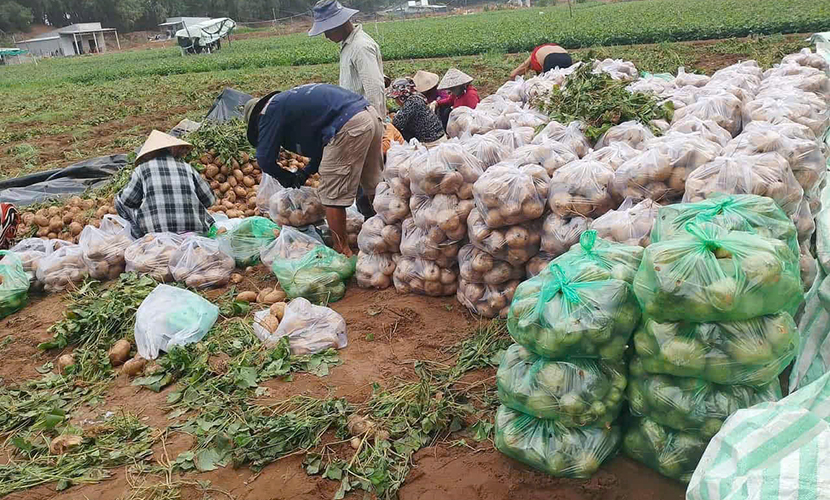
Harvesting Vietnam’s yam bean
Previously, only a few households in Keo Mat village grew jicama on a small scale. However, since 2009, seeing that jicama cultivation was not difficult and brought high economic returns, residents learned from one another and bought seeds to plant. As a result, the cultivation area has expanded steadily. Now nearly the entire commune grows jicama.
With 3 sao of jicama and current high prices, Mr. Hoang Van Van from Ban Tang village is busy harvesting for sale. “After several months of care, the jicama has rewarded us. This year there are fewer pests and diseases, prices are good, and sales are smooth. My family harvested 10 tons of fresh yam bean. We invested about 4 million VND for four sao. Therefore, after deducting costs, we earned over 40 million VND. The profit is several times higher than growing rice,” Mr. Van said enthusiastically.
Although jicama cultivation is still somewhat spontaneous, the model in Bang Khanh commune has brought economic returns many times higher than rice farming. It is also considered an effective approach in restructuring crop seasons and varieties for farmers in Bang Khanh commune, Loc Binh district.
Vietnamese source: https://congthuong.vn/trong-cu-dau-lai-cao-11681.html
If you are interested in Vietnamese yam bean exports, please contact us:
Company: Agrideco Vietnam Co., Ltd.
Address: No 02, Alley 325 Kim Nguu, Vinh Tuy Ward, Hanoi, Vietnam
Tel/Kakao Talk/Whatsapp: +84 989 649 804
Website: https://agridecovietnam.com
Email: agridecovietnam@gmail.com