
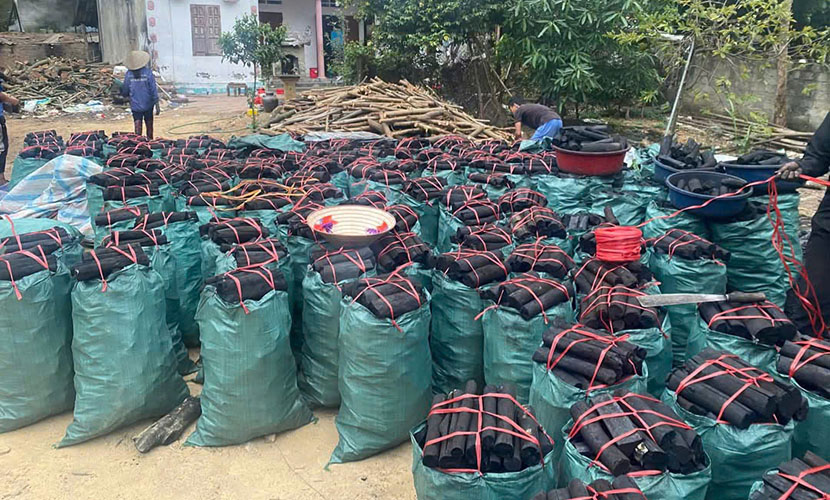
Mr. Ban Van Duong is a young Dao farmer in Bao Ha commune, Lao Cai province. By making use of cinnamon cores, he has boldly invested in a production model of Vietnamese cinnamon charcoal. This approach opens up a new economic direction and increases the value of the cinnamon plant. Also, it creates stable jobs for many local workers.
The former Kim Son commune area (now Bao Ha commune) has long been famous as a key cinnamon-growing region of the province. It has hundreds of hectares of Vietnamese cinnamon under cultivation. Thanks to its cool climate and suitable soil conditions, cinnamon trees here grow well. As a result, they produce abundant quantities of bark and cores each year.
Vietnamese cinnamon charcoal
In Nhai Ten Village 1, most households have involved in cinnamon cultivation and bark harvesting. However, a long-standing issue has been that the cinnamon cores left after peeling often have low prices. Therefore, this issue leads to a waste of this plentiful by-product.
Faced with this situation, Mr. Ban Van Duong sought ways to increase the value of the locality’s key crop. He shared that after each peeling season, large and good-quality cinnamon cores are purchased by wood-processing facilities. Meanwhile, smaller branches or crooked, less attractive cores are often left piled up with no buyers.
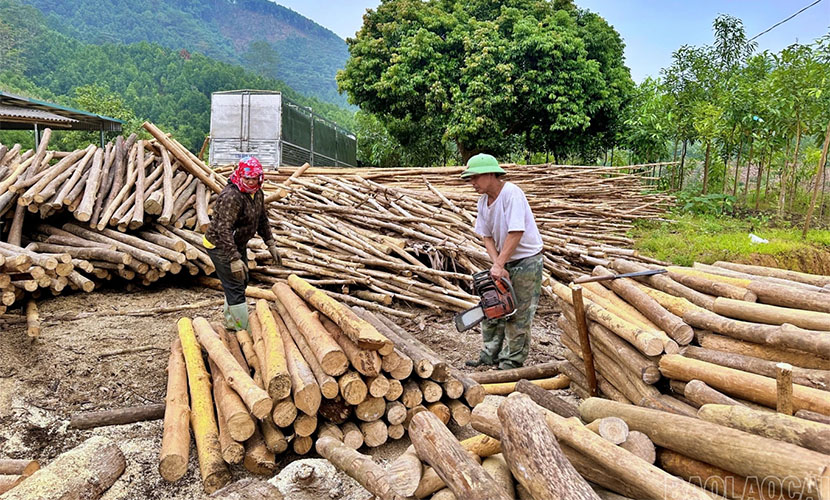
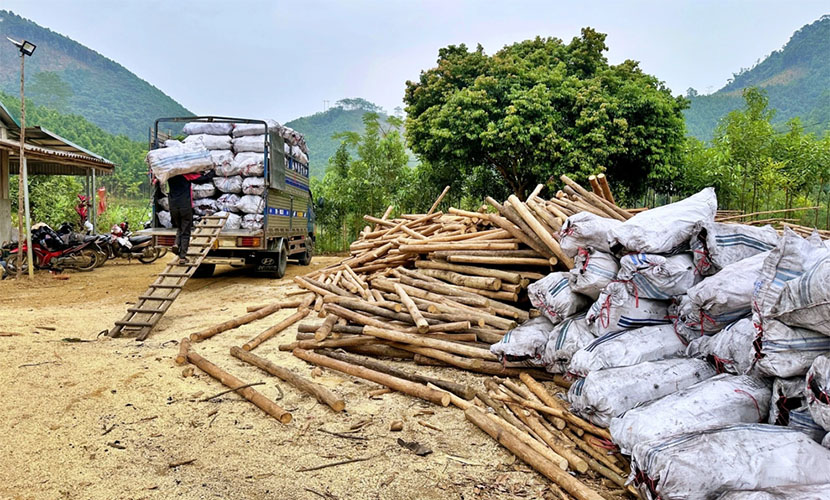
Materials for Vietnamese cinnamon charcoal
“I found it such a waste. When I visited some places, I saw that they used cinnamon cores to make Vietnamese cinnamon charcoal. Then, they sold it at a high price. Therefore, I determined to learn and try it myself,” he said.
Mr. Duong spent time traveling to major cinnamon-growing areas such as Van Ban, Bac Ha, and Van Yen (formerly part of Yen Bai) to learn the techniques of kiln construction. He also studied temperature control methods to produce Vietnamese high-quality charcoal.
In August 2024, he decided to invest in building a Vietnamese cinnamon charcoal kiln right in Nhai Ten Village 1. For him, this decision was a major turning point. It required a significant amount of capital and involved an entirely new field.
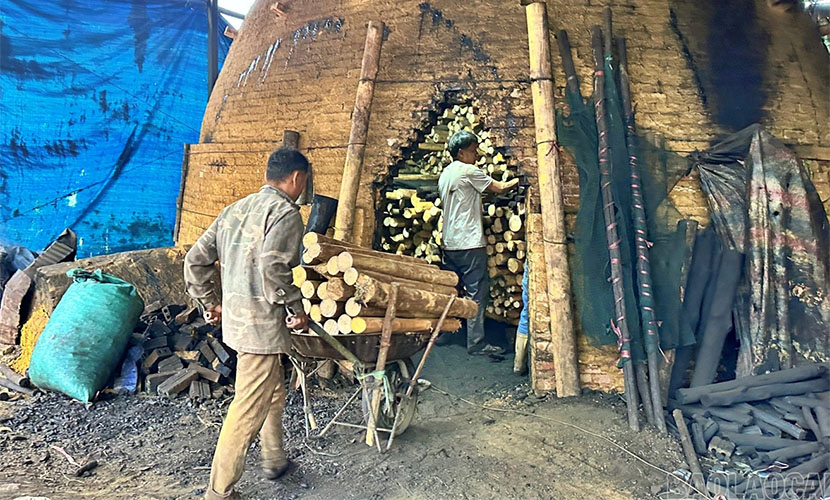
Put cinnamon wood into the kiln
“The first batches of our cinnamon charcoal did not meet quality standards. As a result, they could not be sold. I had to burn them again many times to gain experience. At one point, I even thought about giving up because of the losses,” Mr. Duong recalled.
With perseverance, a willingness to learn, and continuous experience gained from trial and error, he has mastered the technical process. Gradually, he has also brought the model into stable operation.
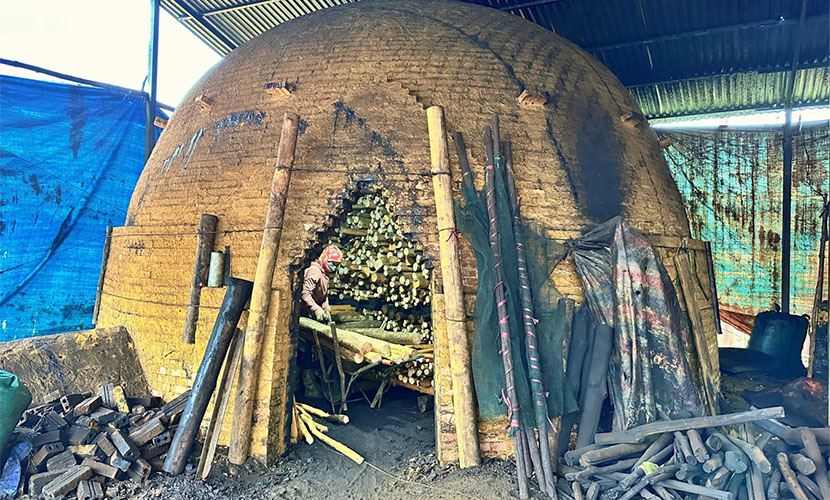
Vietnamese cinnamon charcoal kiln
From the initial two kilns, Mr. Duong has now expanded to three large-scale charcoal kilns. Each kiln can process around 200 tons of cinnamon wood per firing. It produces about 8 tons of Vietnamese cinnamon charcoal. With a selling price of 7,000 VND per kilogram, the model generates a significant and stable income for his family.
Beyond benefiting his own household, the model also creates jobs for around 10 local workers, with an average salary of 7 million VND per month. Workers are assigned tasks such as collecting cinnamon wood, operating the kilns, packaging, and transporting the products. As a result, many households in the village now have an additional source of income right in their hometown.
Ms. Ly Thi Yen from Nhai Ten Village 1 shared: “Previously, I only did farming at home. The work was hard and the income was low. Since working here, the job is not too physically demanding, and the monthly income is stable, so I feel very secure.”
Having worked at Mr. Duong’s cinnamon charcoal kiln for more than five months, Mr. Dang Van Son, also from Nhai Ten Village 1, expressed: “I’m getting older, so finding a job close to home is something I’ve wanted for a long time. Working here provides a stable income. If I have family matters, I can take a day off, and on the days I work, I earn money, so everyone feels satisfied.”
Vietnamese cinnamon charcoal facility
For Mr. Duong, these initial successes serve as motivation to further expand the model. He said he is planning to invest in additional yard space and storage facilities. This will help stockpile wood during periods when locals are not harvesting cinnamon. He also plans to increase the number of kilns and improve the production process to boost productivity.
Mr. Nguyen Thanh Cong is the Vice Chairman of the Bao Ha Commune People’s Committee. He stated: “Mr. Duong’s cinnamon charcoal production model has delivered clear effectiveness. It not only makes use of agricultural by-products, but it also creates jobs and increases income for many local workers. The commune will continue to facilitate the expansion and replication of this model in the coming time.”
Mr. Ban Van Duong’s cinnamon charcoal model has opened up a new direction for economic development for residents of Nhai Ten Village 1 in Bao Ha Commune in particular, and for farmers in cinnamon-growing areas in general. Turning by-products into high-value products not only reduces waste. It also contributes to building a sustainable agricultural sector and providing stable livelihoods for local people.
Vietnamese source: https://baolaocai.vn/hieu-qua-tu-mo-hinh-dot-than-que-cua-nong-dan-bao-ha-post890246.html
If you are interested in Vietnamese cinnamon charcoal, please contact us:
Company: Agrideco Vietnam Co., Ltd.
Address: No 02, Alley 325 Kim Nguu, Vinh Tuy Ward, Hanoi, Vietnam
Tel/Kakao Talk/Whatsapp: +84 989 649 804
Website: https://agridecovietnam.com
Email: agridecovietnam@gmail.com