
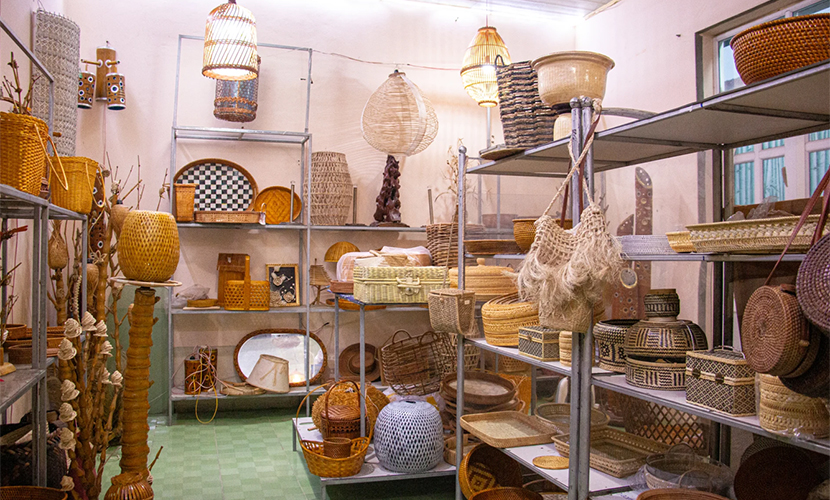
Phu Vinh village has been proud as the homeland of Vietnamese bamboo and rattan handicrafts. Also, Phu Vinh has preserved the essence of its centuries-old craft village in every handmade woven product. Driven by passion, dedication, and creativity, today’s artisans not only carry forward the traditional weaving heritage. They also breathe new life into these rustic crafts, creating distinctive works of art that have earned widespread appreciation.
Phu Vinh is a craft village in Chuong My District, Hanoi. It was originally called Phu Hoa Trang, meaning “a place where heaven has blessed its people with skillful hands.” The villagers are proud for their remarkable craftsmanship and mastery of Vietnamese bamboo and rattan weaving. A walk through the village reveals an astonishing variety of Vietnam’s handcrafted products. These products range from vases several meters tall and food covers woven from rattan strands as fine as thread.
They also include delicate earrings and even vivid woven portraits of national leaders. These creations reflect not only the ingenuity and artistic talent of local artisans. They also demonstrate the vitality of a craft village whose nearly 60 products have been recognized under Vietnam’s OCOP (One Commune One Product) program.
“To create a beautiful and competitive product, skillful hands alone are not enough. We must also use our creativity and put our heart into every piece we make. There is no room for carelessness,” said artisan Nguyen Van Tinh, his hands moving swiftly as he continued weaving. Meanwhile, he reminded fellow craftsmen at a local bamboo and rattan workshop.
Vietnamese bamboo and rattan handicrafts
This is one of the oldest weaving workshops in the village, with six to seven generations of artisans carrying on the family tradition. According to Tinh, meticulous attention to every detail and every weaving pattern is the key to producing high-quality Vietnamese bamboo and rattan handicrafts. This commitment to craftsmanship has enabled it to earn nearly 20 four-star OCOP certifications.
Rather than pursuing mass production or relying on modern machinery, Tinh’s family remains committed to traditional handcrafted techniques passed down through generations. In his view, carefully shaping each strand of rattan and bamboo by hand gives every product a smoother, more refined finish. At the same time, the workshop continuously develops contemporary designs to meet changing consumer preferences.
Working beside his father, artisan Nguyen Phuong Quang added, “We combine traditional craftsmanship with modern design knowledge. This allows us to create Vietnam’s handicrafts that have their own distinctive identity while appealing to both tourists and international markets.”
Handcrafted by skilled artisans and infused with their passion for the trade, every Phu Vinh bamboo and rattan product bears the personal imprint of its maker. It also reflects the identity of the village and embodies the spirit of the times. Traditional household items such as fish traps, baskets, and winnowing trays have evolved into elegant flower vases, coasters, serving trays, and chairs. These feature sophisticated woven patterns.
While preserving techniques handed down through generations, local artisans have transformed familiar materials into contemporary creations. These creations meet modern lifestyles. Their creativity has enabled many families and successive generations in Phu Vinh to continue making a living from this traditional craft.
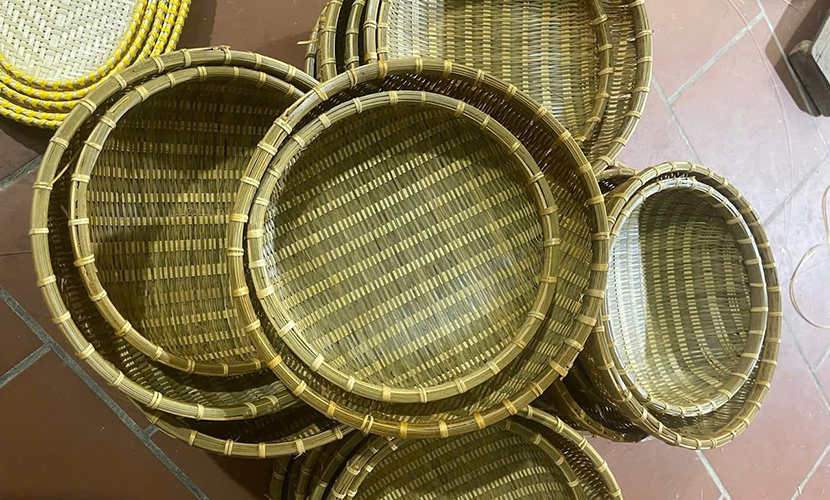
Woven rattan baskets from Vietnam
Artisan Hoang Van Hanh is the Director of May Viet Bamboo and Rattan Company. He said: “Our company was established during the COVID-19 pandemic, when exports were severely disrupted. We therefore focused on producing environmentally friendly products that emphasize aesthetics and creativity. Despite the challenges brought by the pandemic, we were able to sustain both our business and our Vietnamese bamboo and rattan handicrafts.”
Driven by continuous research and innovation, Hanh and his wife, Nguyen Thi Han, have successfully combined ceramics with bamboo and rattan. In doing so, they have breathed new life into Vietnamese traditional handicrafts while adding greater value to them. “I wanted to bring together products from two traditional craft villages—ceramics and bamboo weaving. My goal was to create something new and elevate the value of Vietnamese bamboo and rattan handicrafts,” Han shared.
Their creativity paid off. At one point, the family received an order for four shipping containers of ceramic products wrapped in woven rattan for export to the United States. To meet the delivery deadline, the couple and their craftsmen worked day and night.
The creativity of Phu Vinh’s artisans extends far beyond household items and decorative pieces. In this more than 400-year-old craft village, artisans have also mastered the art of capturing human expressions through woven rattan portraits. Among them, artisan Nguyen Van Trung has become renowned for his woven portraits of national leaders.
Walking with a slight limp from a neighboring room, Trung appeared remarkably energetic despite being in his seventies. Noticing our admiration for a large woven portrait of President Ho Chi Minh displayed prominently on the wall, he smiled and said: “I’m over seventy now. I have spent almost my entire life weaving portraits of national leaders.”
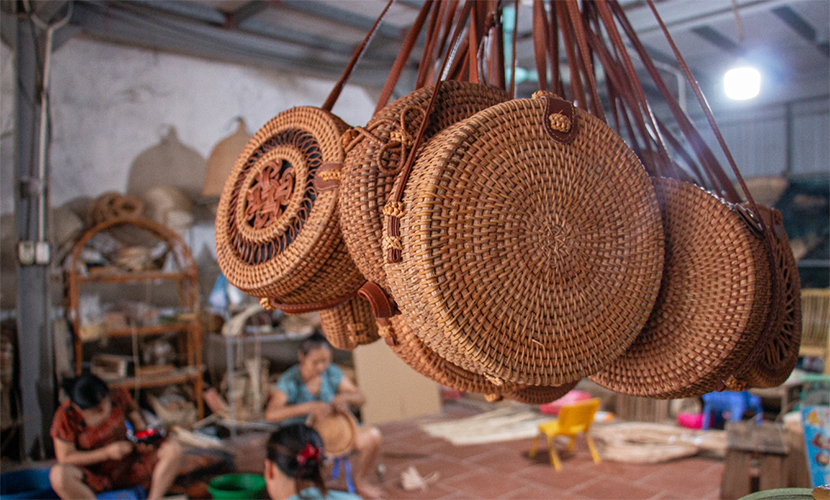
Vietnamese rattan bags
Inside his modest 25-square-meter workshop, his own hands have crafted nearly every object. These included the tea table, the surrounding chairs, the artistic lampshade, and the small woven tea warmer. Speaking calmly about his work, Trung explained that portrait weaving has never been an easy craft. “Weaving with rattan and bamboo strips is already challenging,” he said. “Portraying a human face is far more difficult.”
Local artisans should prepare each slender strand carefully. In addition, they should combine as many as 15 or 16 different weaving techniques to create a single portrait. Working with only black and white materials, artisans must carefully calculate every detail. This enables him to capture not only the subject’s likeness but also their spirit. “If a portrait is beautiful but does not resemble the person, it is worthless. And if it looks like them but lacks spirit, it is equally meaningless,” Trung emphasized.
Created with dedication, passion, and extraordinarily skillful hands, Trung’s woven portraits of President Ho Chi Minh have earned widespread acclaim. In addition to President Ho, he has woven portraits of many other national leaders and senior officials. These have been commissioned as diplomatic gifts or by government agencies, organizations, and private clients. He also creates portraits for exhibitions promoting Phu Vinh Craft Village. Hundreds of these woven portraits have established his distinctive reputation as one of the village’s master artisans.
Through constant learning, experimentation, and innovation, Phu Vinh’s talented artisans have infused contemporary spirit into products once regarded as familiar and traditional. As a result, its Vietnamese bamboo and rattan handicrafts continue affirming their unique identity and enduring value.
Among Hanoi’s many traditional craft villages, Phu Vinh remains one of the few where a large number of families still make their living from the craft. Today, almost every household has at least one member engaged in bamboo and rattan weaving. Some families have practiced the craft for several generations, while others have siblings who all work in the profession.
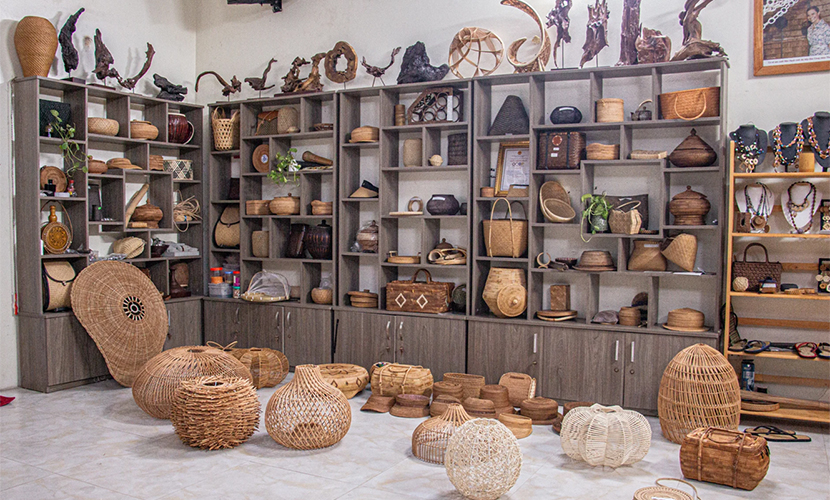
Vietnamese rattan and bamboo exports
Even those who have become doctors, engineers, or pursued other careers can still return home. They can effortlessly weave baskets or trays. From young children to elderly villagers, people often spend their free time weaving. If the people of Phu Vinh have remained devoted to their craft through talent, creativity, and passion, then it is this land itself that has nurtured those qualities across generations.
Returning to the story of artisan Nguyen Van Tinh and his son Nguyen Phuong Quang, their family has now reached its seventh generation of bamboo and rattan artisans. Moreover, three consecutive generations have been officially recognized as master craftsmen. “I knew the craft when I was six or seven years old,” Tinh recalled.
Tinh is the son of the late artisan Nguyen Van Khieu, remembered throughout the region for his extraordinary craftsmanship. Khieu was also the first artisan to successfully weave a portrait of President Ho Chi Minh using traditional bamboo and rattan products.
Recalling his father, Tinh smiled warmly. “I still remember accompanying my father to Hanoi, where he presented Prime Minister Pham Van Dong with a woven flower vase and a rattan walking stick. Seeing how much people admired his work and respected his talent, I quietly wished that one day I would earn the same recognition.” That childhood memory became the inspiration that led him to devote his life to bamboo and rattan weaving.
Like his father before him, Quang was born into a family with a long tradition of bamboo and rattan craftsmanship. From an early age, he inherited both the dexterity and the passion for weaving. “One day I watched my father and older brother weaving beautiful baskets,” Quang recalled. “I carefully observed them and began copying the simplest techniques. To my surprise, it did not take long before I could weave confidently and create products of my own.”
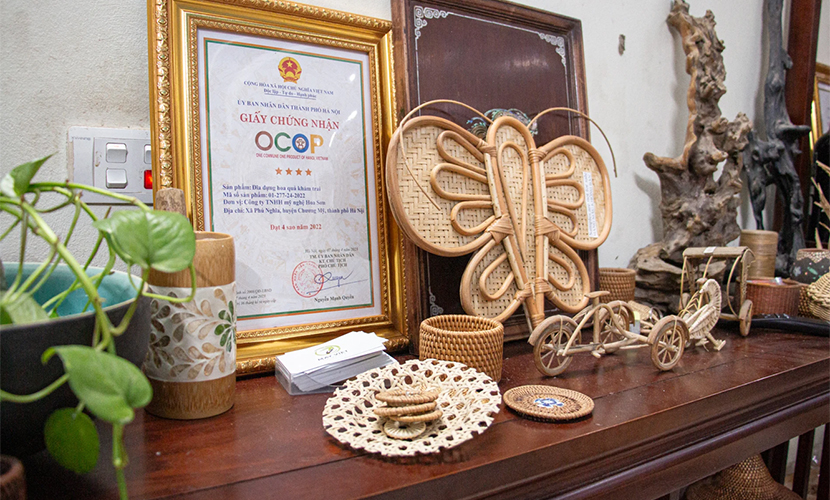
Bamboo mirror frame from Vietnam
He laughed as he continued: “At first, I never planned to follow this profession. But somehow it felt like fate. Every now and then, a new product idea would come to mind. I’d start experimenting, weaving, and refining it. Before I realized it, I had become an artisan.”
Although only 39 years old, Quang has already devoted 29 years to the craft. For him, weaving is less a career choice than an instinct deeply rooted within him. “Everyone born in this village knows how to weave,” Tinh said with conviction. “Even someone who becomes a doctor or an engineer and never practices the craft can come home. They can still weave a basket or a tray with ease.”
Tinh and Quang’s family is far from unique. Many households in Phu Vinh have preserved the craft across multiple generations. Notably, artisan Nguyen Van Trung’s family is another example.
As the eighth generation in his family to practice bamboo and rattan weaving, Trung explained that although his parents never formally taught him every technique, he learned by watching those around him. He imitated their work, corrected his mistakes, and gradually mastered the craft through experience.
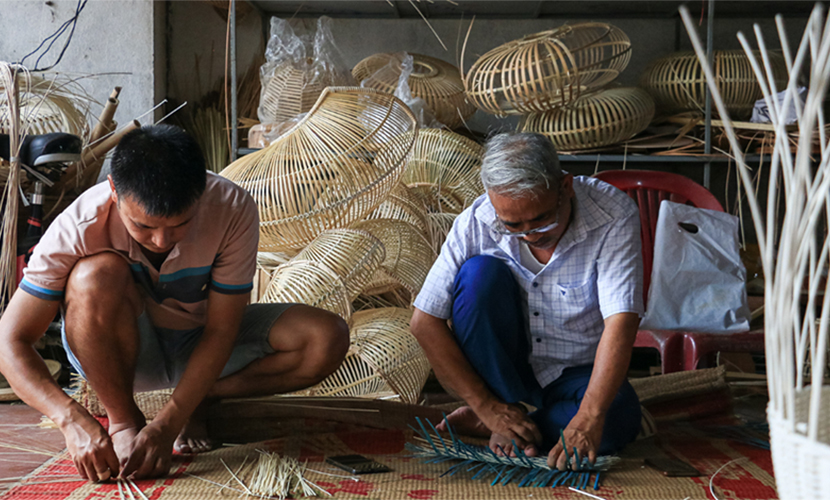
Vietnamese bamboo and rattan workshop
For Trung, weaving is more than a lifelong passion that runs through his veins—it is an instinctive part of who he is. More importantly, Vietnamese bamboo and rattan handicrafts have helped him overcome life’s greatest hardship. At the age of 16, a serious illness left one of his legs permanently impaired. As a result, it became extremely difficult for him to walk and his future was filled with uncertainty.
Yet through traditional bamboo and rattan weaving, combined with his determination to learn and improve, Trung not only built a stable and comfortable life. He also established a distinguished reputation in Phu Vinh as a master artisan specializing in woven portraits of national leaders. For him, shaping bamboo and weaving rattan is more than a profession—it is his breath, his livelihood, and his way of life.
The spirit of passion and creativity runs throughout Phu Vinh, flowing naturally from one generation to the next. Nearly everyone born in the village knows how to weave bamboo and rattan. Young people grow up attending school during the day and weaving in their spare time, while elderly villagers can often be seen weaving baskets as they watch television.
If one were to call it a part of the villagers’ DNA, it would not be an exaggeration. Yet even those who marry into the village or come from elsewhere gradually find themselves captivated by the craft. Their appreciation deepens over time. Nguyen Thi Han, the wife of artisan Hoang Van Hanh, Director of May Viet Bamboo and Rattan Company, is one such example.
To illustrate his wife’s devotion to weaving, Hanh shared with a smile: “One night I woke up in the middle of the night and realized my wife wasn’t beside me. I hurried downstairs and found her weaving something.”
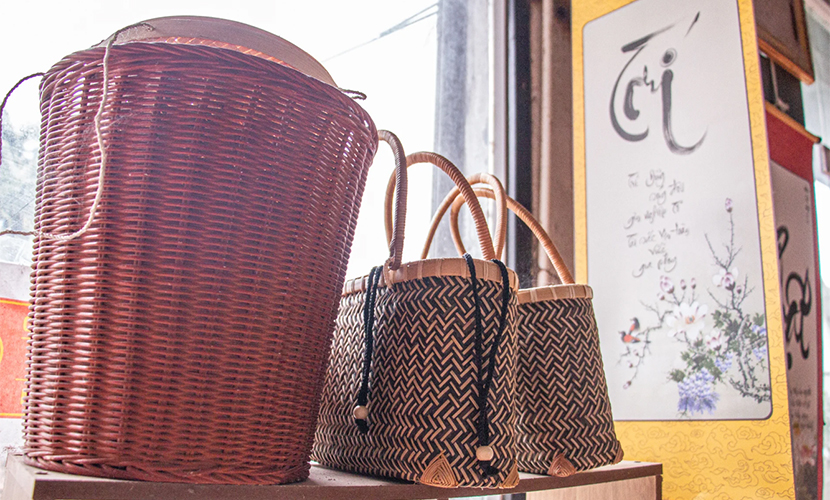
Vietnamese rattan baskets
Glancing affectionately at his wife, he laughed and continued: “She must have come up with a new idea and could not wait until morning. She went straight to work and completely forgot about her husband.”
Watching Han’s nimble fingers skillfully weave strands of rattan and admiring the handcrafted artworks displayed throughout the workshop, it is hard to believe that she was not born in Phu Vinh. Although she did not grow up in the village, she has truly become one of its own. The scent of Vietnamese bamboo and rattan handicrafts has become part of her life.
Meanwhile, a passion for weaving now runs through her veins. In her hands shines the craftsmanship that has defined Phu Vinh for generations. It seems that anyone who comes to live in this village eventually finds a bond with the art of weaving.
Today, every bamboo and rattan product made in Phu Vinh reflects the harmonious blend of traditional craftsmanship and contemporary creativity. Each piece bears the imprint of skilled hands, boundless imagination, and the artisan’s personal dedication.
Above all, every creation embodies a deep love for the craft and a strong commitment to preserving and passing it on to future generations. Together, these qualities have given enduring vitality to Phu Vinh—a traditional craft village where timeless heritage continues to flourish with renewed spirit.
Vietnamese source: https://nhandan.vn/special/may-tre-dan-Phu-Vinh-hon-xua-voc-moi/index.html
If you are interested in Vietnamese bamboo and rattan handicrafts, please do not hesitate to contact us:
Company: Agrideco Vietnam Co., Ltd.
Address: No 02, Alley 325 Kim Nguu, Vinh Tuy Ward, Hanoi, Vietnam
Tel/Kakao Talk/Whatsapp: +84 989 649 804
Website: https://agridecovietnam.com
Email: agridecovietnam@gmail.com