
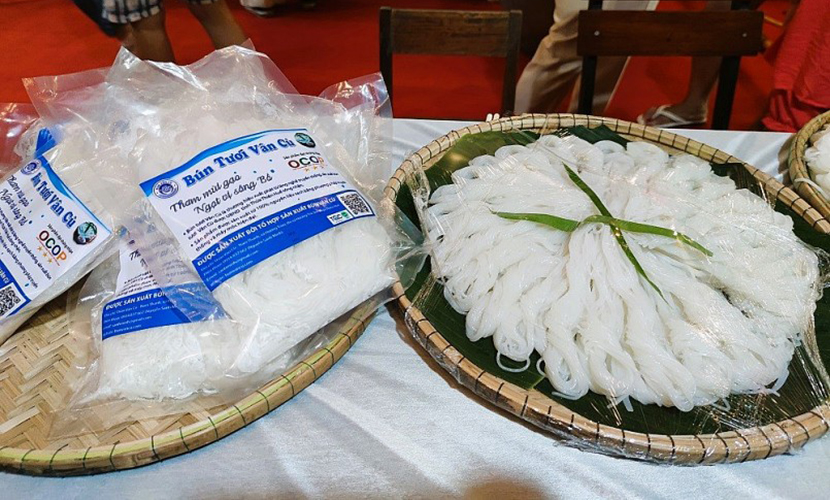
Huế has long been proud as a “culinary paradise,” offering a rich variety of distinctive and flavorful dishes. Among them, its signature rice vermicelli specialties are especially popular. As a result, Vietnamese rice vermicelli has become an essential ingredient in many of Huế’s most beloved dishes.
Huế rice vermicelli has closely associated with Vân Cù Traditional Craft Village. It is one of the most renowned rice vermicelli-producing villages in the former imperial capital. Vân Cù Village lies along the banks of the Bồ River in Hương Toàn Commune, Hương Trà Town, Thừa Thiên Huế City. Located about 10 kilometers northwest of the Imperial City of Huế, it is easily accessible from Đông Ba Market.
According to Ô Châu Cận Lục, a historical work by Dương Văn An, Vân Cù Village has a history of more than 500 years. Originally known as Đào Cù in Đan Điền District, the village was famous for brick making. Over time, local residents shifted to producing Vietnamese rice vermicelli, earning the village the familiar nickname “the vermicelli village.”
Local legend tells of a group of settlers who traveled south from northern Vietnam with Lord Nguyễn Hoàng to establish a new life in Cổ Tháp Village. At that time, the village was part of Hương Điền District and is now located within Hương Trà Town, Phong Điền District, and Quảng Điền District of Thừa Thiên Huế.
Among them was a beautiful and hardworking young woman admired by everyone. While most villagers relied on farming, she chose to transform the region’s rice into Vietnamese rice vermicelli. Thanks to her exceptional skill, Vietnamese vermicelli she produced was remarkably delicious. The villagers affectionately called her Cô Bún (“Miss Vermicelli”).
However, her success also attracted jealousy. After three consecutive years of poor harvests, some villagers claimed that the gods were punishing the community. They believed this was because she had dared to soak, grind, and process “heaven’s precious grains” into vermicelli. Influenced by these rumors, the villagers demanded that she either abandon her craft or leave the village. Determined to preserve the trade, she chose to leave.
Recognizing her kindness, the villagers allowed Cô Bún to choose the direction of her journey and assigned five strong young men to carry her heavy stone grinding mill. The group traveled eastward until the last porter became too exhausted to continue. Believing this to be a sign of destiny, Cô Bún decided to settle there after seeing the fertile land and the clear river. She taught the local people the art of making rice vermicelli. This gave birth to what would become the Vân Cù vermicelli-making tradition.
Vietnamese rice vermicelli
To honor her contribution, the villagers built Bà Bún Temple in her memory. Every year, on the 22nd day of the first lunar month, Vân Cù Village holds a traditional ceremony to pay tribute to the woman regarded as the founder of its Vietnamese rice vermicelli. The event honors her contributions to the development of the village’s traditional occupation.
In the past, making rice vermicelli was an extremely labor-intensive process that relied on traditional tools. These included wooden pestles, stone mortars for pounding rice, manual vermicelli presses, boiling stoves, and bamboo baskets for handling the finished product.
Today, modern machinery has greatly reduced manual labor, increased productivity, and improved food safety standards. Even so, many of the traditional handcrafting techniques have been preserved. This helps maintain the distinctive flavor and texture that have made Vân Cù rice vermicelli famous for generations.
The quality of Vân Cù rice vermicelli begins with selecting the right variety of rice. Local producers use Khang Dân rice, also known as field rice, a variety prized for producing cooked rice that remains firm and light rather than sticky. The rice is thoroughly washed four to five times to remove the outer bran layer before soaking for two days. This allows the grains to absorb water and develop the ideal texture. After soaking, villagers add coarse salt—a closely guarded local secret that enhances the vermicelli’s flavor while preventing sourness during processing.
Villagers then grind the soaked rice into a fine paste and filter to produce rice flour. Once the flour has been partially cooked, it is vigorously kneaded by hand into a smooth dough before being loaded into a vermicelli press. As the dough is extruded through the mold, the strands fall directly into boiling water, where they cook into delicate noodles. They are then quickly cooled in cold water to preserve their natural whiteness and pleasantly chewy texture.
To achieve the perfect balance between tenderness and elasticity, producers blend in a small amount of tapioca starch. Making Vietnamese rice vermicelli requires not only physical effort but also considerable skill. There is no fixed formula for the starch mixture. Instead, the ratio depends on the craftsman’s experience and intuition, which ultimately determine the distinctive quality and flavor of Vân Cù vermicelli.
Once completed, Vân Cù rice vermicelli is distributed by local producers and wholesalers to markets, eateries, and restaurants throughout the province. It has become an essential ingredient in the region’s culinary heritage, especially the world-famous bún bò Huế.
Vân Cù vermicelli is distinguished by its creamy white color and the delicate aroma of freshly milled rice. Remarkably, it needs no elaborate accompaniments. Simply dipping it into a bowl of fish sauce mixed with lime, garlic, and chili is enough to leave diners with a lasting memory. The flavors of this village on the banks of the Bồ River remain unforgettable.
In recent years, as part of Vietnam’s One Commune One Product (OCOP) program, Hương Toàn Commune has selected Vân Cù fresh rice vermicelli as one of its flagship local products. This recognition highlights the value and potential of the traditional craft village. This initiative has strengthened the Vân Cù brand and supported the sustainable development of the traditional craft village.
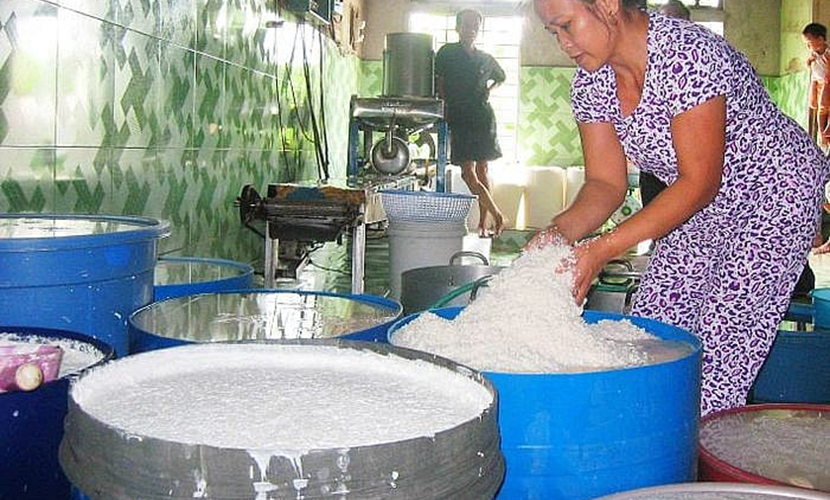
Vietnamese rice vermicelli process
It has also given more visitors the opportunity to enjoy an authentic Huế specialty. At the same time, modern packaging and preservation technologies have helped maintain Vietnamese rice vermicelli quality. They have also expanded markets both within and beyond the province.
Previously, at the end of 2024, Vietnam officially recognized the Vân Cù Vermicelli-Making Craft as part of the National Intangible Cultural Heritage list. The recognition is a source of great pride for the people of Hương Toàn Commune, Hương Trà Town, and Huế City as a whole.
On February 19, 2025, at Vân Cù Communal House in Hương Toàn Commune, representatives of the village formally received the National Intangible Cultural Heritage certificate. The certificate recognized the Vân Cù vermicelli-making craft by the Ministry of Culture, Sports and Tourism.
One of the reasons Vân Cù vermicelli has earned such a strong reputation is its commitment to natural production methods. Iit use no additives during processing. The only ingredient added besides rice is coarse salt, during soaking, washing, and fermenting the rice flour. It removes impurities, eliminates bacteria, and prevents sourness. As a result, Vietnamese rice vermicelli has a natural shelf life of only 24 hours at room temperature. This characteristic has become one of its greatest advantages in earning consumers’ trust.
Today, Vân Cù Village produces between 25 and 28 metric tons of Vietnamese rice noodles each day. On average, each household produces and sells around 200 kilograms daily. The largest producers can reach 600 to 700 kilograms per day. During major holidays and the Lunar New Year, total output can double. It can even increase three to fourfold to meet soaring demand.
Vietnamese source: https://thuonghieusanpham.vn/lang-nghe-truyen-thong-van-cu-noi-san-xuat-bun-noi-tieng-bac-nhat-xu-hue
For more information about Vietnamese rice vermicelli exports, please contact us:
Company: Agrideco Vietnam Co., Ltd.
Address: No 02, Alley 325 Kim Nguu, Vinh Tuy Ward, Hanoi, Vietnam
Tel/Kakao Talk/Whatsapp: +84 989 649 804
Website: https://agridecovietnam.com
Email: agridecovietnam@gmail.com