

Văn Đức is the largest growing area of Vietnam’s vegetables in Hanoi. Văn Đức now belongs to Bát Tràng commune, where it is enriched by alluvial deposits. As a result, planting Vietnamese vegetables will offer better quality. Also, they can also be stored for longer than those from other regions.
For many years, the Văn Đức Cooperative has focused on producing Vietnam’s vegetables in accordance with safe production standards. This has helped its vegetables achieve high quality and gain consumer preference.
The vegetable-growing area of the cooperative covers more than 200 hectares, and 1,200 member households participate in production. As a result, the annual output reaches over 30,000 tons of various vegetables.
Vietnam’s vegetables
Mr. Nguyễn Văn Minh is the Director of the Văn Đức Cooperative. He said that over the years, authorities at all levels and local governments have provided support and favorable conditions. Specifically, they have helped cooperative members participate in training courses on science, technology, and Vietnam’s vegetables processes under Vietgap standards.
The cooperative has also promoted and advertised its brand through media channels, trade fairs, and exhibitions. These activities have introduced Vietgap vegetables to the market. As a result, the cooperative has been able to connect with product distribution channels more effectively.
The cooperative has been granted Vietgap certification for vegetable production on an area of 30 hectares. From 2019 to 2024, it has developed 17 products achieving 3-star and 4-star OCOP ratings. These products include cauliflower, broccoli, cabbage, chili, sweet mustard greens, and flowering mustard greens.
At the same time, the cooperative has proactively conducted outreach, supervision, and guidance for farmers. They have also provided direction to ensure vegetable production follows Vietgap processes and OCOP product standards.
This approach has brought about clear effectiveness. It has reduced the use of plant protection chemicals, including biological pesticides. In addition, it has increased the use of organic and microbial fertilizers to limit pests and diseases.
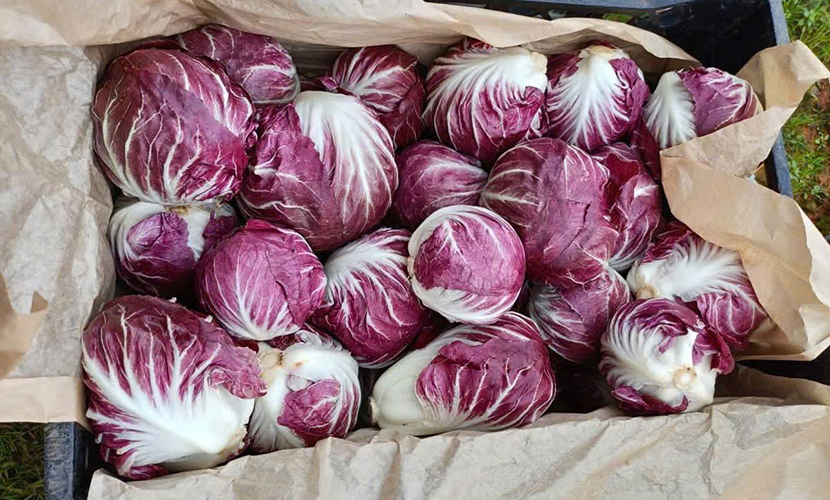
Violet cabbage from Vietnam
As a result, the production environment has improved and living conditions have been enhanced. The quality of the cooperative’s vegetables meets food safety standards. This, in turn, builds trust among enterprises, supermarket systems, traders, and consumers.
Vegetable selling prices for cooperative members are 15%–20% higher than the market average. Consequently, farmers’ material and spiritual lives have improved. In addition, 100% of member households actively comply with safe and Vietgap vegetable production processes.
According to Mr. Nguyễn Văn Minh, to ensure stable production and consumption, the cooperative has proactively established linkages with several companies, supermarket systems, and traders. Each year, the cooperative signs consumption contracts with supermarket chains. Through these contracts, it supplies between 1,500 and 2,000 tons of Vietnam’s vegetables annually.
During the production–consumption linkage process, the cooperative actively develops production plans and allocates planting areas. This ensures product diversification in terms of varieties, output, and quality. Purchasing companies will buy vegetables at stable prices and make payments on schedule.
Meanwhile, the cooperative and farmers take responsibility for product categories, food safety quality, and output volume. In addition, the cooperative organizes field visits for buyers. This allows them to learn about farmers’ production processes, product origins, and quality.
Notably, since 2016, several Vietnam’s vegetables of the cooperative have been available in the global market. They include cabbage, Chinese cabbage, radish, broccolli, chili, and cauliflower.

A chili farm in Văn Đức
Mr. Trần Văn Tuấn is a local farmer from Chử Xá hamlet. He shared that from November to April, his family grows Chinese cabbage and radish. These crops are cultivated according to Vietgap standards, and all products are purchased by the cooperative for export.
Each sào generates an income of 25–30 million VND per crop per year. After the export season ends, households shift to growing gourds, eggplants, sponge gourds, pumpkins, sweet mustard greens, flowering mustard greens, and other vegetables.
Regarding the development orientation for Vietnam’s vegetables, Mr. Minh hoped that the government would introduce supportive policies. These policies would encourage enterprises to invest, cooperate, and participate in production and product purchasing for cooperatives and farmers.
He also suggested that competent authorities consider appropriate land allocation and leasing policies. This would enable cooperatives to invest in vegetable preprocessing facilities and cold storage systems. They could also develop product display centers and apply high technology in vegetable production, linked with the development of experiential agricultural tourism.
Vietnamese source: https://hanoimoi.vn/nguoi-tieu-dung-ua-chuong-rau-an-toan-van-duc-726011.html