

Exports of Vietnamese coconuts continue to hold an 80% share of the Taiwan (China) market. However, Vietnamese coconut exporters must comply with increasingly stringent technical standards and import quota regulations.
The Trade Office of the Vietnam Economic and Cultural Office in Taipei has announced the results of the 2026 coconut import quota auction. The Bank of Taiwan (BOT) released the results following the bid opening on June 11, 2026. The outcome is a positive signal for Vietnamese coconut enterprises, as demand in the Taiwan (China) market remains strong.
According to the allocation results, 19 companies received import rights, with a combined quota of 9,365 tonnes. This nearly exhausted the volume offered in this year’s auction. Under current regulations, Taiwan (China) has applied an import quota system for coconuts since joining the World Trade Organization (WTO). Each year, the territory allows the import of up to 10,000 tonnes of coconuts under the quota scheme. This accounts for approximately 22% of total market demand.
Every year, Taiwan’s (China) Ministry of Agriculture (MOA) organizes between one and four auctions for coconut import rights, depending on market demand. Only companies that successfully secure quotas through these auctions are permitted to import fresh coconuts into the market.
Exports of Vietnamese coconuts
This year’s allocation once again reflected a preference for companies with strong cold-chain logistics capabilities and well-established distribution networks. LONG KAE AGRICULTURAL PRODUCT CO., LTD. received the largest quota of 1,835 tonnes, followed by WUGUODUO TRADING CO., LTD. with 1,325 tonnes. Other major importers awarded substantial quotas included UNCLE DRAGON INTERNATIONAL CO., LTD. (670 tonnes), VERY FRESH INC. (more than 657 tonnes), and FENG XUAN ENTERPRISE CO., LTD. (more than 545 tonnes).
Taiwan (China) produces very few coconuts domestically, making it almost entirely dependent on imports. This creates a significant opportunity for exports of Vietnamese coconuts.
According to the Taiwan International Trade Administration (TITA), throughout 2025 and the first five months of 2026, Taiwan (China) sourced its fresh coconut imports under HS code 090112 primarily from Vietnam and Thailand.
In 2025, Taiwan (China) imported a total of 3,925 tonnes of coconuts, up 26.8% from the previous year. Import value reached USD 2.4 million, an increase of 17.6%. The rising demand was driven by the beverage industry, food processing sector, and retail chains.
Exports of Vietnamese coconuts maintained their dominant position, with 3,003 tonnes and USD 1.75 million. This was up nearly 18% in volume and more than 9% in value in comparison to 2024. As a result, Vietnamese coconuts accounted for 76.5% of total import volume and nearly 73% of import value.
Thailand, meanwhile, recorded strong growth in 2025, exporting nearly 922 tonnes, up 68% year on year. This increased its market share to 23.5%. However, the market shifted further in Vietnam’s favor in 2026.
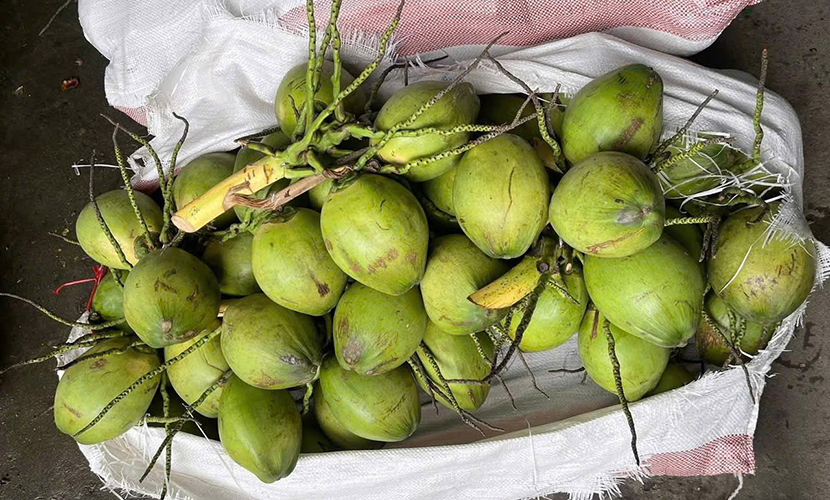
Vietnamese coconuts
During the first five months of the year, Vietnam exported more than 242 tonnes of coconuts to Taiwan (China), capturing 81.9% of the market and generating more than USD 96,000 in export revenue. This represented an increase of 16.2% from the same period last year. In contrast, coconut imports from Thailand declined by more than 11%, reducing its market share to 18.1%.
According to the Vietnam Economic and Cultural Office in Taipei, consumer preferences in Taiwan (China) are shifting rapidly toward natural, low-sugar, preservative-free, and health-oriented products. Vietnamese fresh coconuts are now widely available at major supermarket chains, including PX Mart and Mega PX Mart, as well as numerous traditional fruit retailers.
Demand has also grown steadily for processed coconut products, including trimmed coconuts, vacuum-packed coconuts, canned coconut water, shredded coconut meat, dried coconut, and coconut oil. This growth has been fueled by the increasing popularity of clean eating, macrobiotic diets, and plant-based foods.
However, Vietnamese exporters must continue to meet stringent technical requirements to maintain their competitive advantage. Fresh coconut exporters are required to complete food safety inspections (code F02) and plant quarantine procedures (code B01). They must also comply with packaging, labeling, and import quota auction regulations.

Vietnamese dried coconuts
Speaking with Cong Thuong Newspaper, Nguyen Thi Thu Lien, Vice Chairwoman of the Vietnam Coconut Association, said Taiwan (China) remains a highly promising market for Vietnamese fresh coconuts. This is due to its close proximity, short shipping times, and stable consumer demand. However, because fresh coconuts have a relatively short shelf life, logistics costs remain a key factor affecting exporters’ competitiveness.
“Therefore, fresh coconuts are currently better suitable for nearby markets such as China, Taiwan (China), and several other Asian countries. In the coming years, Vietnam could also expand fresh coconut exports to short-haul markets such as Japan and neighboring countries. This would allow exporters to optimize delivery times and reduce logistics costs,” she said.
For more information about Vietnamese coconut exports, please contact us:
Company: Agrideco Vietnam Co., Ltd.
Address: No 02, Alley 325 Kim Nguu, Vinh Tuy Ward, Hanoi, Vietnam
Tel/Kakao Talk/Whatsapp: +84 989 649 804
Website: https://agridecovietnam.com
Email: agridecovietnam@gmail.com