
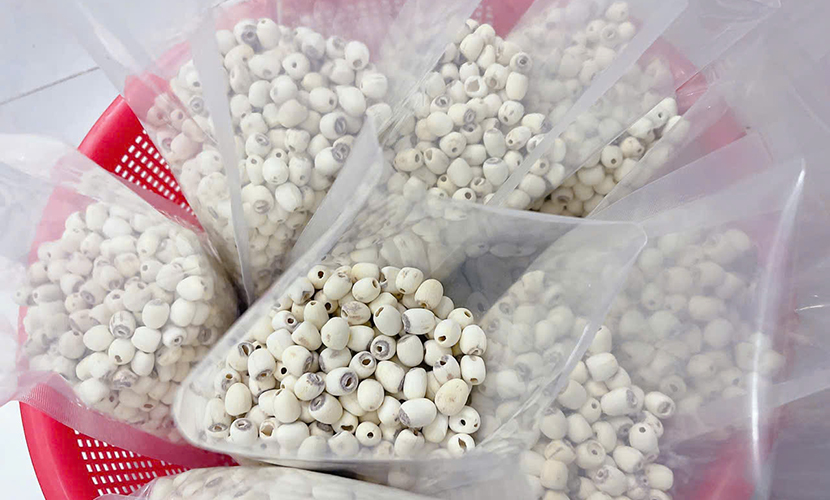
Tân Hưng Commune in Tây Ninh Province is making use of its seasonally flooded wetlands through an integrated model of Vietnamese lotus exports and fish stocking. As a result, the model is generating significant economic, environmental, and climate adaptation benefits.
This model not only helps increase farmers’ incomes but also contributes to soil improvement. In addition, it reduces production costs and supports the conservation of wetland ecosystems.
In the context of agricultural production in the Mekong Delta being affected by climate change, the lotus–fish farming model is a suitable solution. It helps make efficient use of water resources and reduces the use of agricultural chemicals. As a result, it increases the value generated per unit of land area.
In Tân Hưng Commune, households in the buffer zone of the Láng Sen Wetland Reserve have developed a lotus–fish farming model. The model has attracted significant attention from experts. This is due to its economic efficiency and sustainable production characteristics.
Mr. Ngô Văn Thống is a farmer in Tân Hưng Commune. He said that farmers must carefully prepare the soil to ensure good growth for Vietnamese lotus exports. In addition, they should apply lime and dry the soil for 5–6 days to eliminate pathogens. Lotus seedlings are first nurtured for about 20 days before being transplanted into the fields to ensure uniform growth.
After the lotus plants take root for about 20 days, farmers need to actively change the water and maintain clean water sources. They must also promptly treat fungal and bacterial infections. An important practice is not to keep water continuously in the field. Instead, farmers should periodically drain the water and dry the soil to stimulate root development, reduce pests and diseases, and improve yield.
Vietnamese lotus exports
According to Ms. Nguyễn Thị Diễm Trang from Tân Hưng Commune, lotus is usually planted around the seventh lunar month after soil preparation and water filling in the fields. When combined with fish farming in lotus fields, farmers can make use of the water surface. At the same time, they generate an additional stable source of income.
Fish raised in lotus fields can give harvest after about seven months. Prices of Vietnamese lotus exports depend heavily on the market and weather conditions. However, income from fish is more stable, helping reduce risks for producers.
On average, each hectare of Vietnamese lotus combined with fish farming can generate a profit of about 60 million VND per year after deducting costs. This is many times higher than traditional rice cultivation.
To sustain long-term efficiency, local farmers limit the use of pesticides and regularly monitor water quality. They also prioritize environmentally friendly farming practices to protect aquatic ecosystems.
Mr. Trịnh Phước Nguyên is the Vice Director of the Climate Change Institute under An Giang University. He stated that one of the most notable benefits of this model is its soil improvement capacity. After the lotus season ends, farmers should plough back all stems, leaves, and roots into the soil. This creates a natural organic source for the next rice crop.
Rice fields following lotus cultivation can reduce fertilizer inputs while maintaining productivity, according to analytical results. Compared to conventional rice fields, they use about 40% less urea nitrogen fertilizer, 32% less phosphorus fertilizer, and 12% less potassium fertilizer. This significantly reduces production costs and improves soil fertility.

Fresh lotus from Vietnam
Dr. Lê Phát Quới is the former lecturer at the Faculty of Environment, Ho Chi Minh City University of Technology. He stated that the lotus–fish model delivers dual economic and environmental benefits. Lotus stems, leaves, and roots decompose after harvest, creating a source of natural organic matter. This helps improve soil quality and reduce reliance on chemical fertilizers.
In addition, the lotus root system helps improve water and soil conditions, creating favorable environments for aquatic species. In areas with closed dike systems, integrating fish farming within lotus fields is highly feasible. This allows efficient use of water surfaces and increases farmers’ income.
According to experts, developing production models of Vietnamese lotus exports that adapt to natural flood conditions is an urgent requirement. This is particularly important as climate change continues to have increasingly severe impacts on the Mekong Delta.
Beyond economic efficiency, the lotus–fish model also contributes to wetland ecosystem conservation. It reduces the use of chemical fertilizers and pesticides and enables the development of value-added lotus products.
Practical implementation in Tân Hưng Commune shows that the lotus–fish model is opening a suitable direction for flood-prone localities. It contributes to ecological agriculture development, improves farmers’ incomes, and moves toward sustainable development goals.
Vietnamese source: https://www.vietnamplus.vn/mo-hinh-sen-ca-mo-huong-sinh-ke-ben-vung-vung-ngap-lu-post1116053.vnp
If you are interested in Vietnamese lotus exports, please contact us:
Company: Agrideco Vietnam Co., Ltd.
Address: No 02, Alley 325 Kim Nguu, Vinh Tuy Ward, Hanoi, Vietnam
Tel/Kakao Talk/Whatsapp: +84 989 649 804
Website: https://agridecovietnam.com
Email: agridecovietnam@gmail.com