
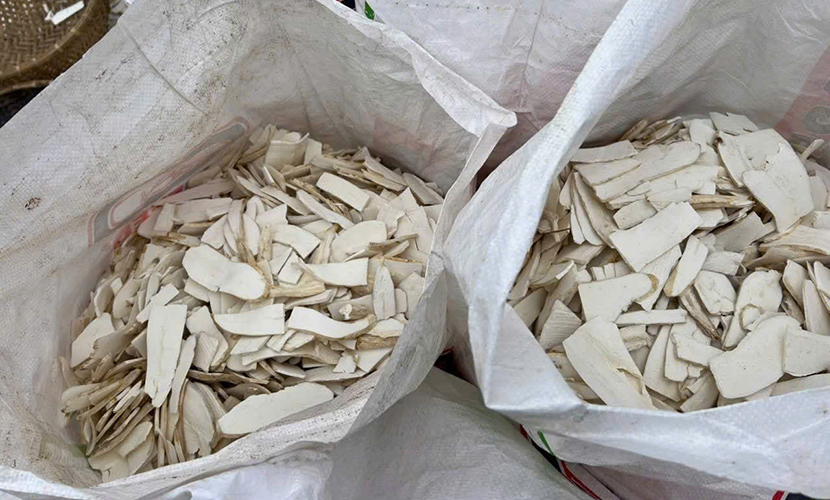
The volume of Vietnamese cassava exports have increased quickly. However, low value and heavy reliance on a limited number of markets have exposed the sector to significant risks. This underscores the urgent need for deeper processing and market diversification strategies.
Vietnamese cassava products contribute to job creation, farmers’ incomes, and a significant share of agricultural export turnover. In the context of increasingly deep international economic integration, cassava exports not only carry economic significance. They also reflect the competitiveness of Vietnam’s agricultural sector in the global marketplace.
In 2025 Vietnam exported more than 3.9 million tons of cassava and cassava-based products. The export value was equivalent to more than USD 1.26 billion. Compared to 2024, export volume surged by 52.2%, while export value increased by only 9.8%. The wide gap between volume and value growth indicates that export efficiency remains inconsistent with shipment scale.
Vietnamese cassava exports
In December 2025 alone, Vietnamese cassava exports reached 373,219 tons worth USD 135.1 million. Notably, they went up 39.4% in volume and 42.6% in value compared to November 2025. While this reflects strong year-end demand, it also highlights the pronounced seasonality and the lack of long-term stability.
Vietnam’s cassava exports in 2025 remained overwhelmingly concentrated in the Chinese market. Exports to China reached approximately 3.7 million tons, valued at USD 1.17 billion. They accounted for 94.1% of total export volume and 92.6% of total export value. Compared to 2024, export volume to China rose by 54.3%, while export value increased by only 10.8%. This gap reflects falling average export prices and mounting price pressure due to market dependence.
Beyond China, Vietnamese cassava exports are available in markets such as Taiwan (China), Malaysia, and the Philippines. However, export volumes to these destinations remain modest and insufficient to rebalance the market structure. Notably, in the Taiwan market, although export volume rose by 15.8%, export value fell by 17.1%. As a result, it indicated a sharp decline in prices and limited competitiveness.
Ms. Vương Thị Oanh is the representative of the Import-Export Department under the Ministry of Industry and Trade. She emphasized that Vietnam’s cassava products are now almost entirely dependent on the Chinese market. Such high concentration exposes the sector to risks stemming from policy shifts, demand fluctuations, and price volatility in that single market.
Although export volumes to China increased sharply in 2025, average export prices trended downward. This reflects limitations in price negotiation capacity and in the global positioning of Vietnamese cassava, which is still largely exported in raw or semi-processed form.
The root of the issue lies in the product structure. Dried cassava chips and minimally processed cassava starch account for a large share of total export turnover. These products have low added value, face intense competition, and are highly vulnerable to price declines when supply exceeds demand.
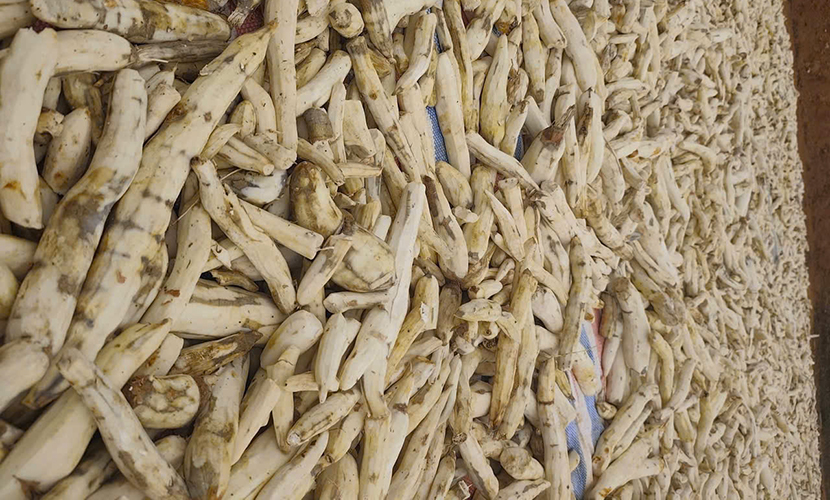
Fresh cassava from Vietnam
The absence of deeply processed, high-tech products has prevented Vietnamese cassava exports from achieving value commensurate with Vietnam’s production scale and potential. Moreover, exports remain seasonal and dependent on short-term demand and customs clearance conditions. Long-term contracts and stable linkages among production, processing, and consumption are still limited, undermining sustainability.
In response to the imbalance between volume and value growth, the Ministry of Industry and Trade has stressed that the fundamental and long-term solution lies in enhancing added value through deeper processing. This involves gradually reducing the share of dried cassava chips and semi-processed starch. Also, it requires encouraging investment in high-tech products such as modified starch. It also calls for developing products that serve the food, pharmaceutical, industrial, and bioenergy sectors.
At the same time, export market diversification has been identified as a key solution to reduce dependence on China. Besides maintaining traditional markets, efforts should be intensified to expand into promising destinations such as Malaysia and the Philippines, as well as other regional and global markets. Diversification would help spread risks, strengthen price negotiation capacity, and enhance overall export stability.
Improving raw material zones and product standards is also critical. Planning concentrated cassava-growing areas, adopting high-yield and high-starch varieties, and strengthening input quality control will enhance raw material quality. Meeting increasingly stringent technical standards, food safety requirements, and traceability regulations in importing markets is essential for penetrating higher-value segments.
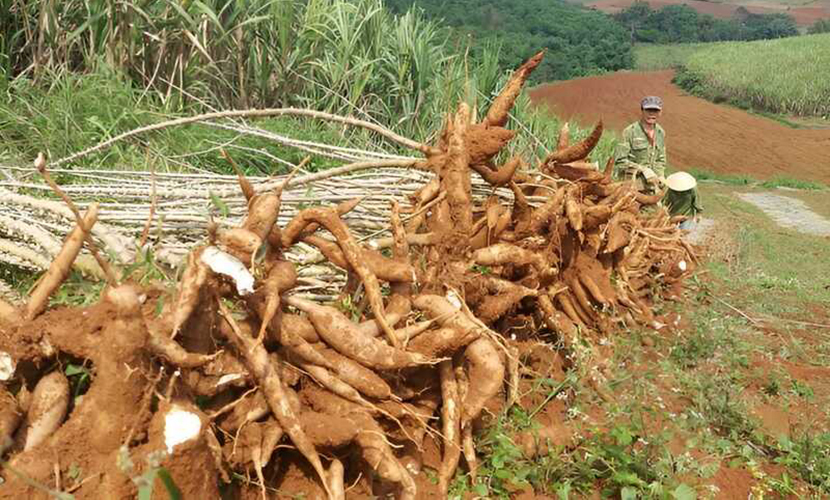
Vietnamese cassava harvesting
Strengthening supply chain linkages among farmers, cooperatives, and processing and exporting enterprises is equally important. Sustainable linkage models can secure stable raw material supplies for enterprises while guaranteeing market access and reasonable prices for growers. Medium- and long-term contracts would help reduce seasonality and improve both efficiency and sustainability.
Finally, reducing logistics costs is a crucial factor in enhancing competitiveness. Investment in storage and drying facilities, improved transport infrastructure, and stronger market forecasting will enable Vietnamese cassava enterprises to operate more proactively. In addition, enhanced export coordination capacity will further strengthen their ability to respond to market fluctuations.
As cassava export volumes continue to rise, the sector faces a clear strategic turning point. Moving from raw material exports to higher-value, diversified products will determine the future trajectory of Vietnam’s cassava industry. This transition will decide whether rapid quantitative growth can be transformed into sustainable qualitative development in the years ahead.
Vietnamese source: https://congthuong.vn/bo-cong-thuong-de-xuat-loi-ra-cho-xuat-khau-san-440921.html