

Vietnamese agricultural sector has just gone through a memorable year in 2025, marked by record-breaking export figures. These achievements reaffirm the transformation of agriculture from a passive “backstop” during periods of economic difficulty into a proactive and powerful growth driver. This shift comes as the country moves toward rapid and sustainable development, with an independent and self-reliant economy closely integrated into the global market.
Above all, the most striking achievement in this journey is reflected in the total export value of agricultural, forestry, and fishery products in 2025. This figure exceeded USD 70 billion—an increase of around 12% compared to 2024 and far surpassing the targets set by the Government. With a record trade surplus of over USD 20 billion, Vietnamese agricultural sector continues to serve as a solid “buffer.” It helps stabilize the exchange rate and bolster national foreign exchange reserves.
Beyond growth in scale, the structure of Vietnam’s agricultural exports has undergone a transformative shift. This shift moves from “quantity” to “quality,” and from a production-oriented mindset to an economic one. The transition has reflected in the gradual replacement of fragmented, output-focused production thinking with a modern agricultural economic approach. This approach has closely aligned with market demand, value chains, and the requirements of sustainable development.
Vietnamese agricultural sector
Within this broader landscape, Vietnamese agricultural sector stood out as a major highlight. Export turnover surpassed USD 8.5 billion for the first time, up nearly 20% year on year. This milestone allowed the sector to overtake several traditional export commodities. It also reflects the effectiveness of strategies focused on deep processing, standardizing raw material zones, and expanding export markets.
At the same time, traditional sectors continued to maintain strong performance. Forestry product exports exceeded USD 18 billion, while seafood exports reached more than USD 11 billion. These results demonstrate a highly proactive ability to adapt to increasingly stringent international technical barriers. Rice exports, meanwhile, declined to around USD 4.1 billion after peaking in 2024.
However, this should not be a sign of crisis. Rather, it represents an adjustment to a “new normal,” signaling a strategic shift toward higher value-added production and reduced greenhouse gas emissions. This shift replaces the pursuit of volume aimed at preserving the status of a “raw-export powerhouse.”
These achievements are all the more remarkable given that they realized in a year marked by severe natural disasters. This underscores the extraordinary resilience of Vietnamese agricultural sector.
Another significant milestone in 2025 was the consolidation of the state management apparatus with the establishment of the Ministry of Agriculture and Environment. This decision fundamentally addressed long-standing conflicts between production development and resource protection. It also unified the management of land and water resources. As a result, it laid a solid foundation for an ecological and climate-resilient agricultural system.
While Vietnam’s agricultural growth figures are undeniably encouraging, real-world developments prevent us from overlooking underlying paradoxes. These paradoxes quietly constrain the sector’s breakthrough potential. They are not merely technical shortcomings. Rather, they are structural issues embedded across the entire industry.
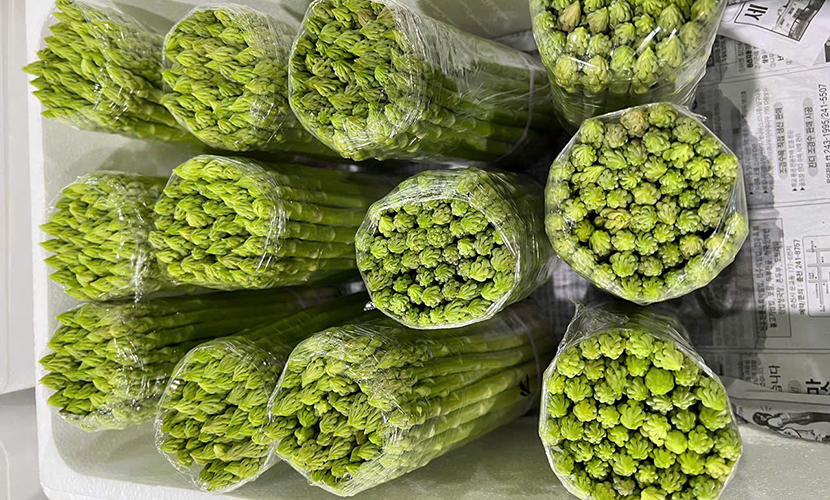
Vietnamese asparagus
One of the most striking paradoxes lies in the relationship between value contribution and labor use. Agriculture currently accounts for around 11–12% of GDP, yet employs nearly 30% of the national workforce. This imbalance indicates low labor productivity.
In practice, a Vietnamese farmer today produces enough food to feed only about 3–5 people. By comparison, a farmer in the United States feeds around 166 people, while in the Netherlands the figure reaches 150–200. This gap highlights the vast room for productivity improvement in Vietnamese agricultural sector
Another paradox emerges from Vietnam’s position as one of the world’s leading agricultural exporters. Despite this status, branding remains weak and value added is not high. The current export structure still relies heavily on resource extraction and primary processing. Meanwhile, innovation, deep processing, and brand building play a relatively minor role.
In reality, when exporting one kilogram of green coffee beans, Vietnam earns only about USD 1.5. Using the same raw material, Swiss companies—after processing and branding—can sell it at prices nearly 20 times higher. This shows that Vietnamese agricultural sector remains trapped in a “contract manufacturing” role within the global value chain, even on its own fields.
In addition, the mindset of small-scale and fragmented production remains a persistent barrier to agricultural modernization. Despite the emergence of large-scale model fields, land fragmentation is still widespread. This makes it difficult to apply high technology, achieve synchronized mechanization, and implement modern production management standards.
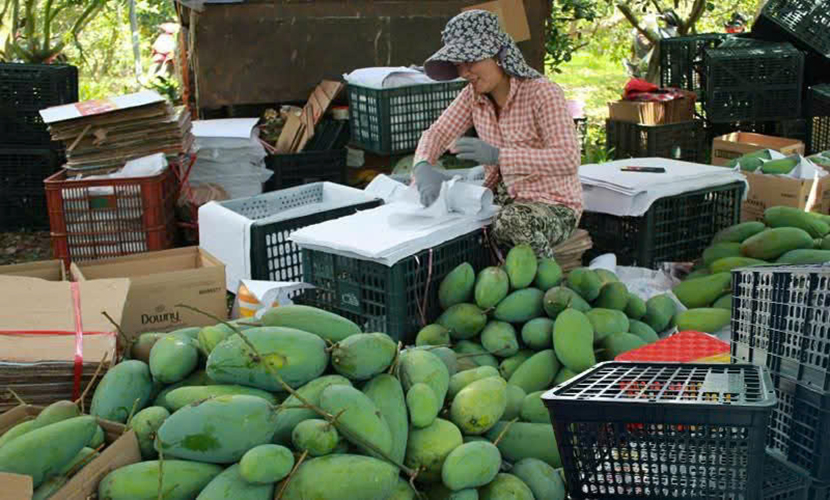
Vietnamese mango packing house
This is precisely the “bottleneck” that must be addressed promptly. Without resolution, Vietnamese agriculture sector cannot transition rapidly toward deeper, more efficient, and more sustainable development.
The documents of the 14th National Party Congress elevated strategic thinking on agricultural development. They clearly define agriculture not merely as a “pillar” of social security, but as a national competitive advantage in the new context. On this foundation, a new development philosophy has shaped around three pillars. These pillars aim to comprehensively restructure agricultural space, rural areas, and production actors.
First, Vietnamese agricultural sector has oriented toward an ecological, modern, and circular model. This represents a decisive shift from the goal of “clean production” to green growth. The approach has closely aligned with greenhouse gas emission reduction targets. The “one million hectares of high-quality, low-emission rice” model in the Mekong Delta has initially demonstrated the feasibility of this direction.
It both increases farmers’ incomes and contributes to environmental protection and climate change adaptation. At the same time, an integrated multi-value approach is being implemented in parallel. This expands the role of agriculture beyond commodity production to include rural tourism, preservation of indigenous culture, and development of renewable energy.
Alongside the transformation of production models, building modern and livable rural areas has identified as the second pillar. Rural development must aim to create civilized living spaces with digital connectivity, comprehensive services, and a sustainable ecological environment. It should not focus solely on infrastructure investment driven by concrete construction.
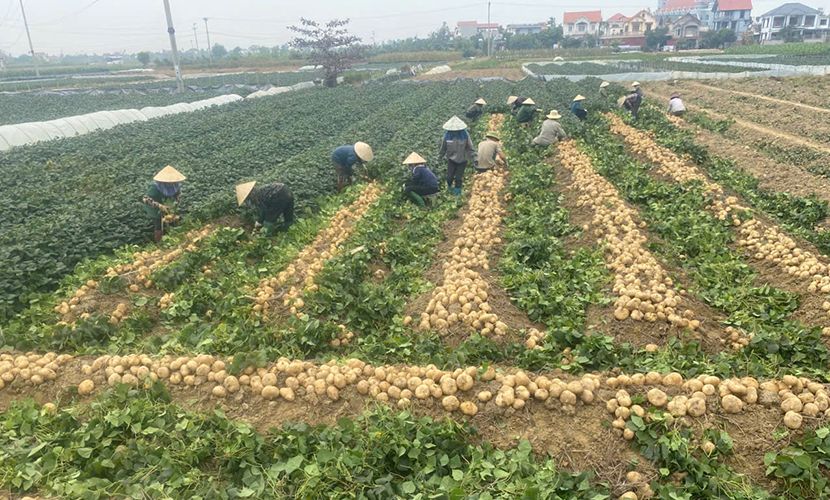
Vietnamese jicama farm
Preserving and promoting traditional cultural identity has placed in harmony with modernization. In this way, rural areas can become truly “livable” places. They will be capable of retaining local residents and attracting high-quality human resources back to these regions.
Notably, the documents of the 14th National Party Congress emphasize the need to build the image of a civilized and professional farmer. This is a decisive factor in the success of the transformation process. The “intellectualization” of farmers has become an urgent requirement in the context of the digital economy and deep international integration.
Farmers in the new era can no longer rely solely on traditional farming experience. They must move beyond “looking to the sky, the land, and the clouds.” Instead, they need to become digital farmers and “agricultural entrepreneurs” who master data, technology, markets, and value chains. This enables them to proactively adapt to change rather than depend on nature and chance.
Vietnamese agricultural sector does not lack potential. What it once lacked was a “big dream” and coordinated action. Today, however, with renewed thinking from the 14th National Party Congress and an increasingly complete infrastructure and institutional foundation, the opportunity has fully matured.
Vietnam has chosen not to bypass agriculture in pursuit of industrialization. Instead, it has opted for the path of “industrializing agriculture.” In doing so, agriculture will no longer be merely a life raft or a “backstop” in times of turbulence. It will truly become one of the driving forces propelling Vietnam’s economy forward. This will usher in a new era in which farmers prosper from the land, and the nation grows stronger through agriculture.
Vietnamese source: https://vnua.edu.vn/tin-tuc-su-kien/tin-hoat-dong-khac/thoi-cua-nhung-giac-mo-nong-nghiep-lon-58221
If you are interested in Vietnamese agricultural exports, please contact us:
Company: Agrideco Vietnam Co., Ltd.
Address: No 02, Alley 325 Kim Nguu, Vinh Tuy Ward, Hanoi, Vietnam
Tel/Kakao Talk/Whatsapp: +84 989 649 804
Website: https://agridecovietnam.com
Email: agridecovietnam@gmail.com