
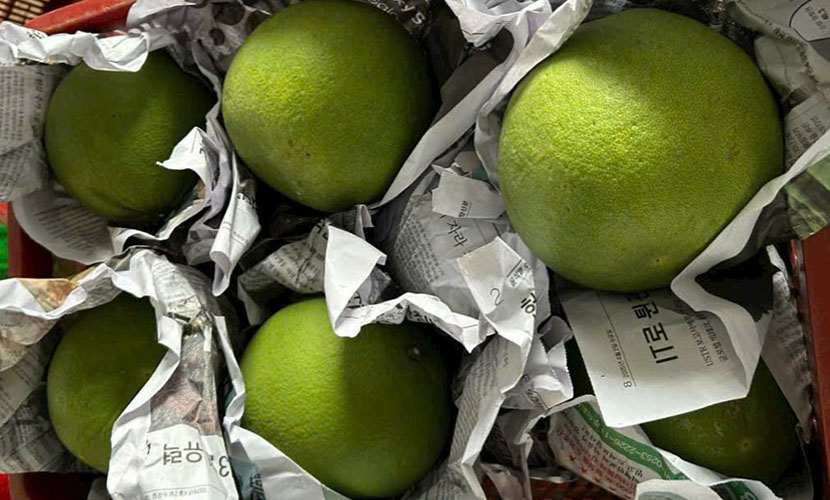
China officially opens its market to Vietnamese pomelos

Vietnamese pomelos

On April 15th 2026, Vietnam and China officially signed the Protocol on phytosanitary requirements for Vietnamese pomelos and lemons exported from Vietnam to China.

The signing of the Protocol is the result of a well-structured technical negotiation process. This process has been ongoing since 2019 between two countries in the fields of plant protection and quarantine.

This achievement not only reflects the close coordination and strong sense of responsibility in harmonizing technical requirements. It also demonstrates the proactive efforts of both sides in selecting and prioritizing market access for products with strong potential and competitive advantages.

Amid continuously strengthening and expanding agricultural cooperation between Vietnam and China, the signing of the Protocol for Vietnam’s pomelos and lemons further confirms the trend toward official and transparent market access. Moreover, this process follows the international standards. It also reflects the increasingly comprehensive and evolving bilateral cooperation mechanism.

Vietnamese pomelos

Vietnamese pomelos

According to the signed Protocol, all growing areas and packing facilities for Vietnamese pomelos and lemons exported to the Chinese market must register with the Ministry of Agriculture and Environment. They must also achieve the approval from both the Ministry and General Administration of Customs (GACC).

Growing areas and packing facilities of Vietnamese grapefruits and lemons must implement measures to control harmful organisms. In particular, growing areas should apply Good Agricultural Practices (GAP) and Integrated Pest Management (IPM). They must also bag Vietnamese pomelos at least 60 days before harvest and install fruit fly traps.

Packing facilities must have clean, hardened flooring and separate areas for processing, treatment, storage, and other functional operations. In addition, they must ensure that pomelos and lemons are selected, sorted, and cleaned during the packing process. This is necessary to remove diseased, pest-infested, rotten, or deformed fruits, as well as branches, leaves, plant debris, and soil.

Pomelos and lemons are among Vietnam’s agricultural products with outstanding advantages. Vietnam currently has approximately 106,000 hectares of pomelo cultivation area. Accordingly, Vietnam is placing the country among the world’s major pomelo producers. In addition, the country has many concentrated and large-scale production zones.

Vietnamese pomelo sections

Vietnamese pomelo sections

In addition to traditional growing areas, pomelo and lemon cultivation has continued to expand in recent years across many localities. These include Hanoi, Phu Tho, Tuyen Quang, Vinh Long, Dong Nai, and Dong Thap. This expansion also includes the cultivation of specialty pomelo varieties such as Dien pomelo, Phuc Trach pomelo, Doan Hung pomelo, Nam Roi pomelo, and Green Skin pomelo. These varieties offer high productivity, good quality, and strong market suitability. As a result, economic efficiency for producers has improved.

China is a key market with enormous potential for Vietnamese fruit products due to its large consumption scale and growing demand. Many agricultural products have already entered the market through official export channels. Building on this success, pomelos and lemons continue to be identified as products with significant potential. Aligning well with consumer demand and market trends, they are becoming increasingly popular among Chinese consumers.

With advantages in quality and supply capacity, these two products are likely to gradually expand their market share and strengthen their position. In addition, they are hopeful to contribute positively to the growth of Vietnam’s agricultural exports.

The signing of the Protocol not only opens opportunities to effectively tap the production potential of Vietnamese pomelos and lemons. The Protocol also contributes to completing the legal framework for official exports. In addition, it helps improve consumption efficiency, increase farmers’ incomes, and enhance the added value of the sector.

At the same time, the Protocol serves as a driving force for reorganizing production toward standardization, higher quality, stricter pest control, and stronger traceability systems. These efforts are necessary to meet the increasingly demanding requirements of international agricultural trade.

Vietnamese fresh lemons

Vietnamese fresh lemons

The technical negotiation efforts between the two sides have not only produced results for these two products. They have also opened opportunities for broader international market access for other promising Vietnamese agricultural products. This will help diversify export markets and enhance the global standing of Vietnamese agriculture.

In the coming period, the Ministry of Agriculture and Environment (Department of Crop Production and Plant Protection) will continue to closely coordinate with local authorities, associations, businesses, and producers to effectively implement the Protocol.

This includes organizing training sessions to disseminate the Protocol’s regulations. Also, it involves promoting the development and standardization of growing areas that meet the Protocol’s technical requirements. Moreover, it includes submitting qualified growing areas and packing facilities to the Chinese side for approval. In addition, inspections of pomelo and lemon packing facilities and growing areas should ensure full compliance with Chinese regulations.

These efforts aim to build a stable and sustainable position in the Chinese market. At the same time, they will provide a foundation for further developing and expanding export markets for Vietnam’s pomelos and lemons.

Vietnamese source: https://congthuong.vn/chinh-thuc-mo-cua-thi-truong-trung-quoc-cho-qua-buoi-chanh-viet-nam-452103.html