
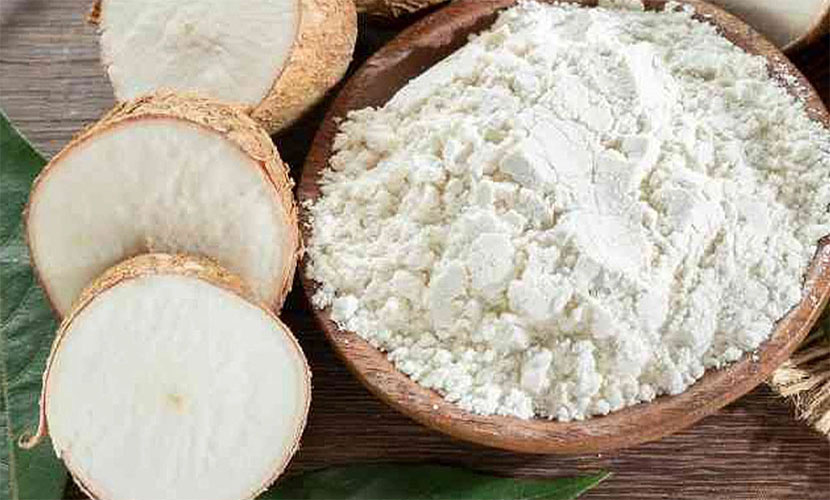
Vietnamese tapioca exports have increased sharply in volumes. However, Vietnam’s tapioca industry has a low export value and depends heavily on a few markets. Therefore, it faces significant risks, highlighting the need for solutions such as deep processing and market diversification.
Tapioca and tapioca-based products are among Vietnam’s key agricultural export commodities. They contribute to job creation, income generation for farmers, and significant agricultural export revenue. In the context of increasingly deep international economic integration, Vietnamese tapioca exports carry significant economic importance. Also, they reflect the competitiveness of Vietnam’s agricultural sector in the global market. Moreover, they play an important role in enhancing the country’s position in international trade.
In 2025, Vietnam’s cassava exports recorded very strong growth in volume, reflecting robust market demand and the development potential of the industry. However, this growth has been accompanied by a series of structural issues. These issues are clearly demonstrated by the large gap between growth in export volume and export value. In addition, the cassava industry depends heavily on a single key export market and produces products with low added value. These factors are creating an urgent need to adjust Vietnam’s cassava export strategy in the coming period.
Vietnamese tapioca exports
According to statistics from the General Department of Customs, Vietnamese tapioca exports in 2025 exceeded 3.9 million tons. The export value was worth more than USD 1.26 billion. Compared to 2024, export volume surged by 52.2%, while export value increased by only 9.8%. This significant disparity between volume and value growth indicates that the export efficiency of cassava products has not matched the scale of exports.
In December 2025 alone, cassava exports reached 373,219 tons, valued at USD 135.1 million. This figure was up 39.4% in volume and 42.6% in value compared to November 2025. This development reflects strong market demand at year-end, but also highlights the seasonal nature of cassava exports and the lack of long-term stability.
Currently, Vietnamese tapioca exports in 2025 remain heavily concentrated in the Chinese market. Specifically, exports to China reached approximately 3.7 million tons, worth USD 1.17 billion. These exports accounted for 94.1% of total export volume and 92.6% of total export value nationwide. Compared to 2024, export volume to China increased by 54.3%, while export value rose by only 10.8%. This reflects a decline in average export prices and the risk of price pressure due to excessive dependence on a single market.
In addition to China, Vietnamese tapioca starch are available in several other markets such as Taiwan (China), Malaysia, and the Philippines. However, export volumes to these markets remain relatively small and insufficient to balance the export market structure. Notably, in the Taiwan market, although export volume increased by 15.8%, export value fell by 17.1%. This indicates a sharp decline in cassava prices and limited competitiveness.

Vietnamese cassava leaves
Ms. Vương Thị Oanh is the representative of the Import-Export Department under the Ministry of Industry and Trade. She stated that Vietnamese cassava exports are currently almost entirely dependent on the Chinese market. Such a high level of market concentration makes the cassava industry highly vulnerable to fluctuations in policies, demand, and prices from this market.
In reality, although export volume to China increased sharply in 2025, average export prices showed a downward trend. This clearly reflects limitations in Vietnam’s pricing power and the position of Vietnamese cassava in the international market. Exports are still mainly in raw or semi-processed forms.
The root cause of this situation lies in the unreasonable export product structure. Currently, dried cassava chips and unmodified cassava starch still account for a large proportion of total export value. These are low value-added products that are highly competitive and subject to strong price pressure when supply exceeds demand. The lack of deeply processed, high-tech products has prevented cassava export efficiency from matching Vietnam’s production potential and scale.
In addition, Vietnamese tapioca exports remain seasonal and heavily dependent on short-term demand and customs clearance conditions. Long-term contracts and stable linkages among production, processing, and consumption remain limited. As a result, the sustainability of export activities has been reduced.
In response to the situation where cassava export volume has risen sharply while export value has grown slowly, representatives of the Ministry of Industry and Trade stated that the fundamental and long-term solution is to increase added value through deeper processing. Accordingly, Vietnam should gradually reduce the proportion of dried cassava chip and semi-processed starch exports. At the same time, the country should encourage investment in high-tech products such as modified starch and products serving the food, pharmaceutical, industrial, and bioenergy sectors.

Vietnamese cassava materials
At the same time, diversifying export markets has been a key solution to reduce dependence on China. In addition to maintaining traditional markets, Vietnam should strengthen efforts to expand into markets showing positive growth signals, such as Malaysia and the Philippines. The country should also explore other potential markets regionally and globally. Market diversification would help spread risks, improve pricing power, and increase export stability.
The Ministry of Industry and Trade also emphasized the importance of improving raw material quality and product standards. Planning concentrated cassava-growing areas, applying new high-yield and high-starch-content varieties, and strengthening input quality control would help improve raw material quality. At the same time, meeting increasingly stringent technical standards, food safety requirements, and traceability regulations imposed by importing countries is essential. These measures would help Vietnamese cassava products penetrate higher-value markets more deeply.
In addition, stronger supply chain linkages among farmers, cooperatives, and processing and exporting enterprises are needed. Through sustainable partnership models, Vietnamese tapioca enterprises can secure stable raw material supplies, while cassava farmers are guaranteed stable outlets and reasonable prices. Signing medium- and long-term contracts would help reduce seasonality and improve both efficiency and sustainability in Vietnamese tapioca exports.
Furthermore, reducing logistics costs is also a key factor in enhancing the competitiveness of Vietnamese cassava. This includes investing in storage and drying facilities, improving transportation infrastructure, and strengthening market forecasting and export coordination capabilities. These are important solutions to help enterprises become more proactive in export activities. They also support the cassava industry’s transition toward more efficient and sustainable development in the future.
Vietnamese source: https://congthuong.vn/bo-cong-thuong-de-xuat-loi-ra-cho-xuat-khau-san-440921.html
If you are interested in Vietnamese tapioca exports, please contact us:
Company: Agrideco Vietnam Co., Ltd.
Address: No 02, Alley 325 Kim Nguu, Vinh Tuy Ward, Hanoi, Vietnam
Tel/Kakao Talk/Whatsapp: +84 989 649 804
Website: https://agridecovietnam.com
Email: agridecovietnam@gmail.com