
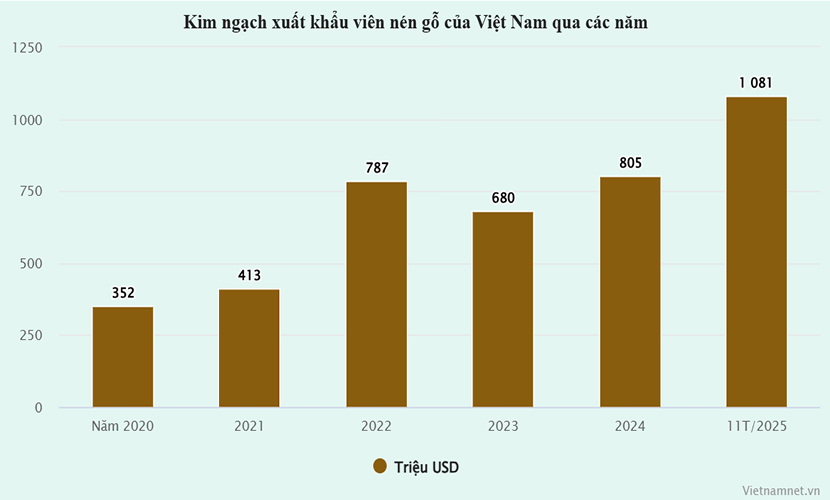
Vietnamese pellet companies utilize many by-products of the wood industry. Then they process them into commodities that are highly favorable by many countries. As a result, such Vietnamese export enterprises have, for the first time in history, earned more than USD 1 billion from exporting this product.
Statistics show that export turnover of wood and wood products has increased strongly year after year. In 2025, it reached USD 17.3 billion, reaffirming the sector as one of Vietnam’s key strengths. During the production process, the enterprises reuse many by-products such as wood chips, sawdust, and small branches. Afterthat, they process these materials to produce wood pellets.
According to data from the Vietnam Customs Authority, in just the first 11 months of 2025, Vietnamese pellet exports reached USD 1.08 billion. This figure surged by 52% compared to the same period in 2024. It represents the fastest growth rate among all products in Vietnam’s wood industry.
As of the end of November 2025, wood pellet exports accounted for 7% of total export turnover of wood and wood products. This was up from 4.8% in the same period of 2024.
Export values of Vietnamese pellet companies
Notably, although full-year 2025 data are not yet available, Vietnamese pellet companies have surpassed the USD 1 billion mark for the first time. This milestone makes wood pellets a new billion-dollar export product.
Wood pellets are characterized by low cost and high energy efficiency. They burn for a relatively long time, providing stable heat output and producing little ash. In addition, the combustion process generates less smoke and fewer harmful emissions compared to many traditional fuels.
As a result, rising demand for bioenergy in markets such as Japan, South Korea, and the EU has become the main driver. This demand explains the sharp increase in Vietnam’s wood pellet exports in 2025.
In 2024, Vietnam exported 6.03 million tons of wood pellets, earning USD 805.27 million. This represented an increase of 29.1% in volume and 18.5% in value compared to the previous year. South Korea and Japan were the two largest buyers. Together, they accounted for as much as 94% of Vietnam’s total wood pellet export volume.

Vietnamese wood pellets
Policy analysts from Forest Trends note that despite contributing more than USD 1 billion to wood export turnover, Vietnamese pellet companies still face many challenges. For example, the sector has yet to establish dedicated raw material zones.
It also remains dependent on secondary supply sources from other wood-processing industries. This dependence makes wood pellet production vulnerable to seasonality, fluctuations in by-product prices, and unstable supply. The risk is particularly high as demand from Japan continues to rise.
In addition, increasingly stringent requirements on quality and sustainability from export markets pose significant challenges. South Korea has recently tightened quality standards, pushing up export prices. Meanwhile, Japan requires FSC and PEFC certification and is gradually applying SBP certification for low-emission supply chains.
Given these realities, experts recommend that enterprises invest in developing their own raw material areas. This approach would help reduce reliance on secondary supply sources. At the same time, greater emphasis should be placed on ensuring product legality and sustainability. These efforts must comply with regulations in export markets.
Vietnamese source: https://vietnamnet.vn/bien-phe-pham-thanh-hang-co-gia-cao-doanh-nghiep-lan-dau-om-ve-ty-usd-2480030.html