

While many rural areas are still struggling with the question of “what crops to grow to escape poverty,” Thang Binh commune (formerly part of Nong Cong district, Thanh Hoa province) has gradually found its own path. This progress has been achieved through local adaptation and agricultural restructuring. This shift has been driven by the bold decision of a pioneering farmer, Mr. Xanh, head of My Quang village. By shifting from low-efficiency sugarcane to Vietnamese galangal—a familiar spice that had rarely been considered a key crop—Mr. Xanh has not only transformed his own family’s livelihood. He has also demonstrated the economic potential of crop restructuring in the locality. He has also helped dozens of other households escape poverty, opening up a more sustainable direction for rural economic development.
Once a key crop in Thang Binh, Vietnamese sugarcane has been long as a “lifeline” for many local households. However, harsh realities gradually eroded farmers’ confidence in this crop. These included high production costs, heavy dependence on weather conditions, unstable purchasing prices, and an unreliable market. In many seasons, sugarcane growers earned less than VND 50 million per hectare. In some years, they even suffered losses. Mr. Xanh had also closely associated with sugarcane farming for more than a decade. “Sugarcane farming is hard work, but the profit is not worth it. For one hectare of land, despite all the labor and input costs, the return is very modest. We always had to farm with the constant fear of price drops,” Mr. Xanh recalled.
Vietnamese galangal
Refusing to let poverty persist, he began to independently seek new knowledge. He researched online, read agricultural books, and directly traveled to other provinces to learn new farming models. During a visit to a spice-growing area in central Vietnam, he noticed a seemingly ordinary plant. It delivered surprisingly high economic value: Vietnamese galangal. Unlike many other crops that require intensive care, Vietnam’s galangal is relatively easy to grow. It is resistant to pests and diseases, adaptable to different soil types, and does not require elaborate irrigation. It can also give harvest year-round. Notably, it has high economic value in food processing, pharmaceuticals, and cosmetics. These sectors are experiencing strong growth both domestically and internationally.
Immediately after returning to his hometown, Mr. Xanh boldly converted his entire 1-hectare sugarcane field to galangal cultivation. Although he was initially met with skepticism and criticism from some locals who considered it an unconventional choice, he remained steadfast in his decision. He ultimately persisted with his chosen direction despite the doubts. In practice, his approach proved successful. After just one year, he harvested nearly 70 tonnes of galangal, generating revenue of VND 400–500 million. This was 8 to 10 times higher than Vietnamese sugarcane farming. After deducting production costs such as fertilizers, labor, and irrigation, his net profit still reached around VND 300 million per hectare, an impressive figure for farmers in the region.
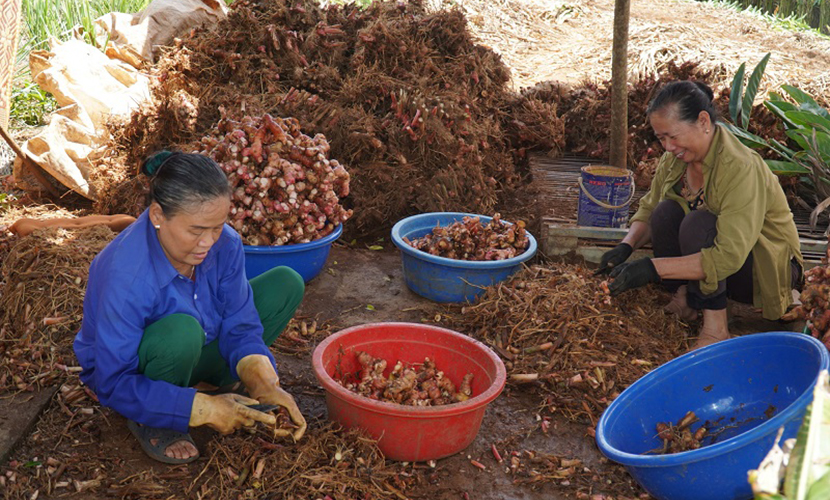
Vietnamese galangal processing
“Ten years of growing sugarcane cannot compare to a single season of growing Vietnamese galangal,” Mr. Xanh said with humor. However, his remark also reflects a vivid reality. Beyond enriching his own household, he actively encouraged local farmers to switch crops. He shared his cultivation experience, provided seedlings, and even helped connect farmers with traders to secure product sales. From Mr. Xanh’s model, the galangal farming movement quickly spread across My Quang village and neighboring communities. Dozens of households decided to convert part or all of their farmland to this spice crop. Among them is Mr. Nguyen Ba Que, a typical example of livelihood transformation thanks to galangal cultivation.
“I have been growing galangal for two years now, and I currently have 2 hectares producing more than 100 tonnes per year. After deducting costs, my family earns nearly VND 700 million in profit. Not only is it enough to live on, but it also allows us to reinvest,” Mr. Que said. In addition, his galangal model has created stable jobs for 3–4 local workers, with monthly incomes of around VND 6–7 million. Sharing the same view, Ms. Mach Thi Hong, a farmer in My Quang village, said: “Vietnamese galangal is very suitable for the local soil conditions. It is easy to grow, less prone to pests and diseases, and has a stable market. Thanks to galangal cultivation, my family’s economic situation has improved significantly. I also hire several local workers for harvesting and weeding, which helps create jobs for people in the community.”
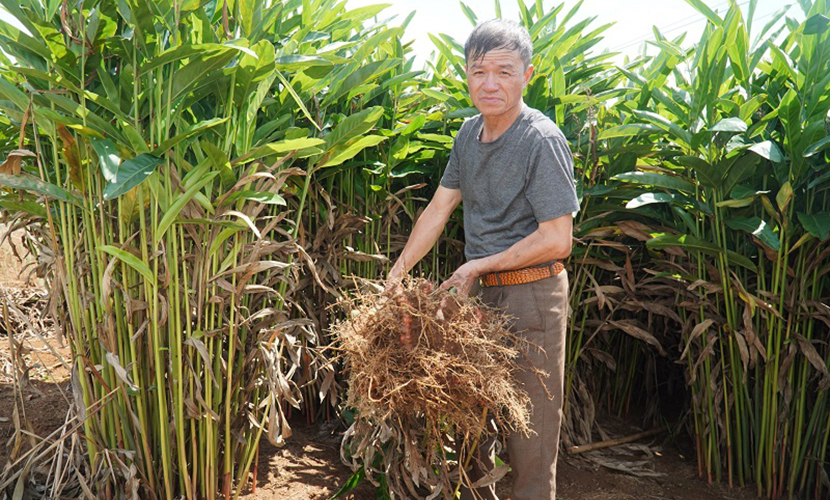
Vietnamese galangal farm
She said that if local authorities provide support in terms of seedlings, technical guidance, and market linkages, she is ready to expand her galangal cultivation area. She also expressed willingness to encourage other households to join in order to form a concentrated raw material zone. Notably, galangal is not only helping local people escape poverty but is also opening up a pathway toward more sustainable wealth creation. With an expanding market—ranging from domestic food processing companies to exporters serving Japan, South Korea, and Europe—galangal is gradually emerging as the “red gold” of rural Thanh Hoa.
However, according to Mr. Xanh, the biggest barrier at present is that production remains fragmented, unlinked, and small in scale. “Farmers are still working spontaneously and individually, so we cannot generate enough supply to sign long-term contracts with Vietnam’s galangal enterprises. If we want to go further, it is essential to establish concentrated raw material zones, form production groups or cooperatives, and receive state support in planning and technical guidance,” he emphasized. Not only acting as a pioneer, Mr. Tran The Xanh has also become a key connector among local galangal growers. Together with several households, he is helping build production groups. He also shares high-quality seedlings, provides cultivation techniques, and seeks more stable market outlets.
“Local farmers can now clearly see the effectiveness, but to invest on a larger scale with confidence, there must be a value chain linkage. If the government can support planning of growing areas, provide technical training, establish cooperatives, and connect farmers with purchasing enterprises, then galangal could fully become a key crop for poverty reduction in the locality,” Mr. Xanh said. His vision goes beyond household-level economic development. It aims instead to build a new model of rural economy: production along a value chain, on a concentrated scale, closely linked with processing and stable market demand. This is precisely the kind of thinking that many localities are seeking as they work toward advanced new rural development programs.
Vietnamese source: https://nnmt.net.vn/cu-rieng-va-hanh-trinh-lam-giau-tren-dat-thang-binh
If you are interested in Vietnamese galangal, please do not hesitate to contact us:
Company: Agrideco Vietnam Co., Ltd.
Address: No 02, Alley 325 Kim Nguu, Vinh Tuy Ward, Hanoi, Vietnam
Tel/Kakao Talk/Whatsapp: +84 989 649 804
Website: https://agridecovietnam.com
Email: agridecovietnam@gmail.com