
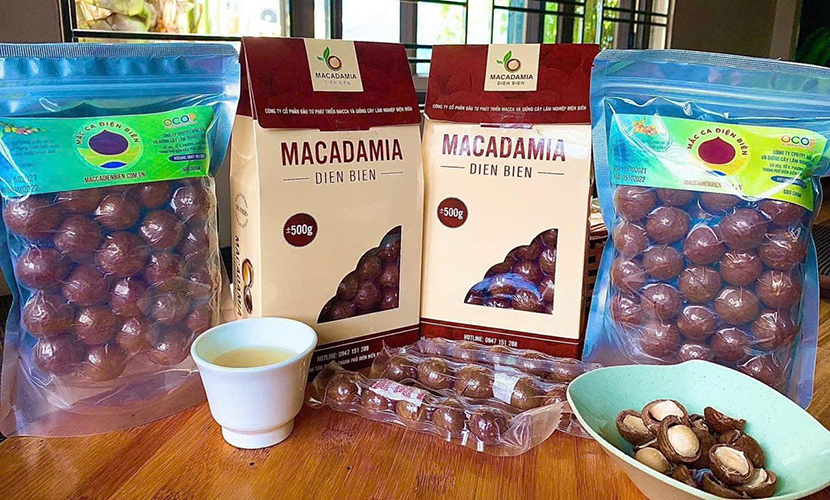
Across the country, there are 29 provinces that are now cultivating Vietnamese macadamia. Accordingly, the total area reaches more than 20,000 hectares, mainly available in the Northwest and Central Highlands regions. Specifically, there are 7,000 hectares that are currently in the harvesting stage, generating 9,000 tons of Vietnamese macadamia nuts.
Vietnam’s macadamia trees are primarily available in mountainous, remote, and isolated provinces. These provinces include Điện Biên, Lai Châu, Sơn La, Lâm Đồng, Đắk Nông, and Kon Tum.
Recognizing the significant potential for macadamia development, the Vietnam Macadamia Association has set an ambitious target. By 2030, Vietnam aims to cultivate 130,000–150,000 hectares of macadamia. Also, the export value will be able to achieve more than $100 million of macadamia-based products.
Vietnamese macadamia products
The Ministry of Agriculture and Rural Development encourages farmers to expand cultivation areas and increase output. In addition, it encourages enterprises and cooperatives to invest in preliminary processing and deep processing to enhance product value. This will be a key factor in increasing the competitiveness of Vietnamese macadamia nuts.
In September 2023, the export value of Vietnam’s macadamia-based products reached approximately $2.07 million. This figure represented a decrease of 47.7% compared to August 2023 and a decline of 15.7% compared to September 2022. In the first nine months of 2023, Vietnam’s total export value of macadamia reached $18.79 million. This represented a decrease of 6.4% compared to the same period last year.
Regarding product categories, Vietnam mainly exported dried, unshelled macadamia nuts. In the first nine months of 2023, the export value reached $13.22 million, down 5.7% year-on-year. In September alone, exports of this product reached $1.5 million. This was down 49.5% from August 2023 and down 27.9% compared to September 2022.
During the first nine months of 2023, Vietnam exported macadamia nuts to 23 countries and territories. China remained Vietnam’s largest market for fresh macadamia. In the first nine months of 2023, export turnover to China reached $4.85 million. It was down 11.2% from the same period last year.
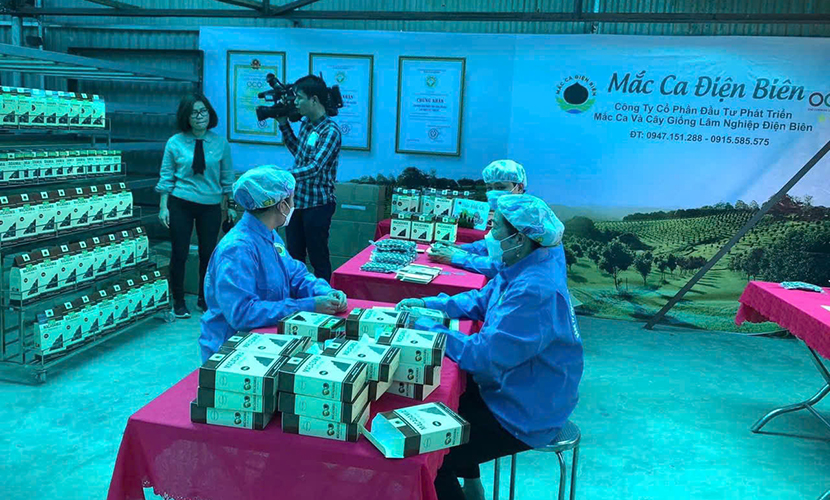
Vietnamese macadamia factory
Based on the above data and analysis, it is clear that Vietnam’s macadamia exports still have significant potential. This will have a positive impact on macadamia-growing regions, especially in mountainous and remote areas.
According to the International Nut and Dried Fruit Council (INC), global macadamia supply currently meets only 25% of market demand. At the same time, consumption continues to grow. INC forecasts that by 2030, global supply will meet only 50% of demand.
Data from the Ministry of Agriculture and Rural Development indicates that global demand for macadamia products is rising. Forecasts show that by 2025, the market will require around 220,000 tons of macadamia kernels. There remains substantial market potential for Vietnamese macadamia in Japan, South Korea, China, the United States, the Netherlands, and Germany.
In addition, compared with major macadamia-producing suppliers in Africa and South America, Vietnam has an advantage. Specifically, Vietnam has participated in multiple free trade agreements with most import markets.
Vietnamese macadamia nuts are of high quality and fully capable of competing with well-known products from Australia and the United States. Vietnam’s macadamia kernels are famous for their uniform size, thin and light-colored shells, and naturally cracked shells after drying.
Notably, they are also valuable for their mild buttery aroma and rich, creamy flavor. Advantages in terrain, soil structure, and fertile land also positively contribute to the nutritional quality of Vietnamese macadamia.

Vietnamese macadamia on supermarkets
Vietnam’s macadamia export market is expanding. Vietnamese macadamia has received the approval to enter the Japanese market, which is high-end and highly demanding. This approval marks a significant opportunity for Vietnam and opens the door for the country to further increase its global export footprint.
As a premium product, macadamia quality must always be the top priority throughout the production, processing, and export stages. For stable and sustainable Vietnamese macadamia exports, the nuts must meet nutritional standards and be free from harmful chemicals.
Additionally, Vietnamese macadamia nuts should ensure food hygiene and safety, especially in the processing stages. Beyond investing in machinery and equipment, clean and safe operating procedures should also be maintained.
Regarding packaging, Vietnamese macadamia nuts must be vacuum-sealed or packed in airtight containers. They should be stored in cool warehouses at temperatures below 16°C. In addition, they should be preserved in well-ventilated and dry conditions, to prevent mold and exposure to direct sunlight.
Vietnamese source: https://sanphamvungmien.vn/san-xuat-tieu-thu/2023/11/trien-vong-xuat-khau-hat-mac-ca-cua-cac-dia-phuong-thuoc-vung-nui-vung-sau-vung-xa