
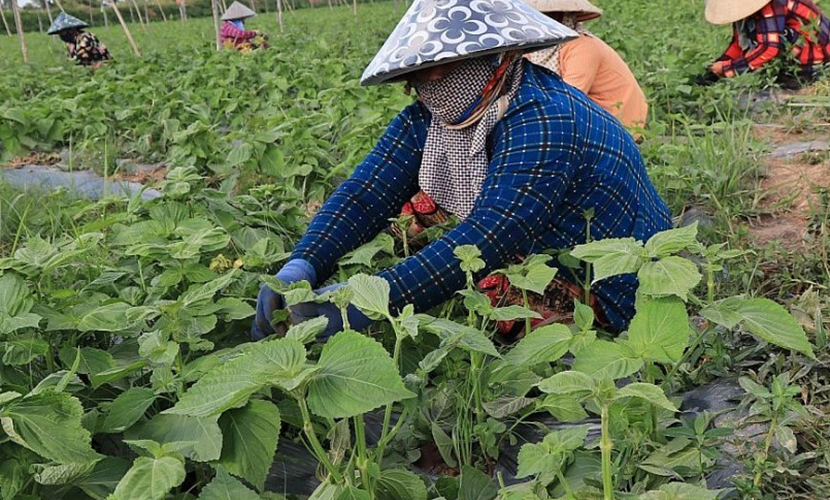
Vietnamese perilla leaves for export are generating millions of dollars in revenue. This success is creating new opportunities for farmers to diversify their crop production. However, meeting export standards for leafy vegetables requires a highly systematic and rigorous cultivation and care process.
Mr. Ngo Minh Dat is a resident from An Thanh Trung Commune, Cho Moi District, An Giang Province. Since 2018, he has attracted widespread attention by exporting Vietnamese perilla leaves to the South Korean market. Perilla leaves growing on his farm have also drawn interest from partners in Japan and Australia. They are seeking to establish business partnerships.
Mr. Dat recalled that his family’s land had previously been used mainly for rice and upland crop cultivation. It generated just enough income to make ends meet. The turning point came when his son, who was studying in South Korea, discovered that Korean perilla varieties had strong potential for cultivation in Vietnam’s Mekong Delta. After conducting extensive research, he brought the seeds back to Vietnam for trial cultivation.
Despite his initial concerns, Mr. Dat decided to conduct a pilot project on about 0.25 hectares of perilla after spending time studying cultivation techniques. However, after four months, yields remained low because he had not yet fully understood the growing requirements and characteristics of the Korean perilla variety.
Vietnamese perilla leaves for export
Nevertheless, the experience he gained from cultivating and caring for the crop gave him the confidence to gradually expand the planting area to 2 hectares. He later expanded it further to 4 hectares of Vietnamese perilla leaves for export
According to Mr. Dat, Korean perilla is highly sensitive to waterlogging. Therefore, he grew it on raised beds in neatly arranged rows covered with plastic mulch. The plants grow tall and produce abundant leaves. One of the crop’s key advantages is that it is relatively easy to cultivate. In addition, it can give harvest continuously and is resistant to most pests and diseases. Moreover, years of cultivation have shown that the variety adapts well to the local climate and soil conditions.
Export-grade perilla is relatively easy to grow. However, achieving high yields while meeting export standards requires strict adherence to cultivation protocols. It also requires a substantial initial investment.
At Mr. Dat’s farm, establishing one hectare of perilla requires an average investment of around VND 150 million. The seeds are imported directly from South Korea. The first harvest takes place about 1.5 to 2 months after sowing, and the harvesting period continues for 8 to 9 months. Productivity has steadily improved. It has increased from around 4 tonnes per hectare per month in the early years to as much as 12 tonnes per hectare.
Drawing on years of experience gained through both research and hands-on cultivation, Mr. Dat has developed extensive expertise in growing perilla. He believes that installing an artificial lighting system is essential for extending its harvesting period. The lights are available on at night to prevent the plants from flowering, thereby prolonging leaf production.
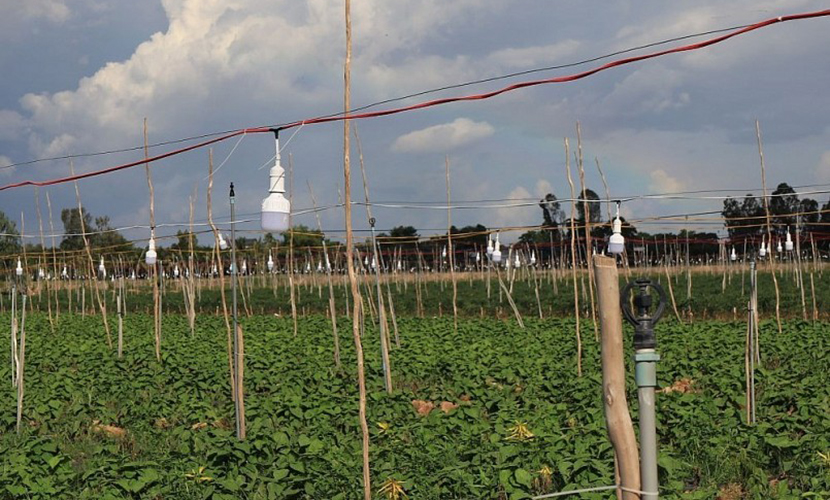
Farm of Vietnamese perilla leaves
This practice also helps reduce pest pressure. At the same time, it encourages the plants to produce larger, more attractive leaves that meet export standards.
“Because our buyers have very strict requirements, every stage of perilla cultivation and care must strictly follow the technical protocols established in South Korea, particularly those relating to clean and safe production. In addition, all fertilizers and crop protection products must comply with the approved list specified by our partners. As for the lighting system, the plants are exposed to artificial light for about four hours every night. In other words, we keep the plants ‘awake’ to prevent them from flowering. This allows the perilla to produce larger, better-looking leaves that satisfy export quality standards,” Mr. Dat explained.
According to Mr. Dat, each perilla plant can produce between two and six leaves per day, depending on its maturity, with leaf widths ranging from 8 to 13 centimeters. On average, he exports around 20 tonnes of perilla leaves to South Korea each month. Prices range from VND 22,000 to VND 30,000 per kilogram, depending on leaf size.
Export-oriented leafy crop models are attracting increasing interest from farmers across the country. Many local authorities have encouraged growers to shift to crops with higher economic value. However, achieving success requires more than simply changing crops. A thorough understanding of cultivation techniques is essential for farmers. Equally important is strict compliance with the rigorous quality standards required for exporting these high-value leafy products.
Vietnamese source: https://thuonghieusanpham.vn/index.php/la-cay-xuat-khau-trieu-do-duoc-cham-soc-the-nao
If you are interested in Vietnamese perilla leaves, please do not hesitate to contact us:
Company: Agrideco Vietnam Co., Ltd.
Address: No 02, Alley 325 Kim Nguu, Vinh Tuy Ward, Hanoi, Vietnam
Tel/Kakao Talk/Whatsapp: +84 989 649 804
Website: https://agridecovietnam.com
Email: agridecovietnam@gmail.com