
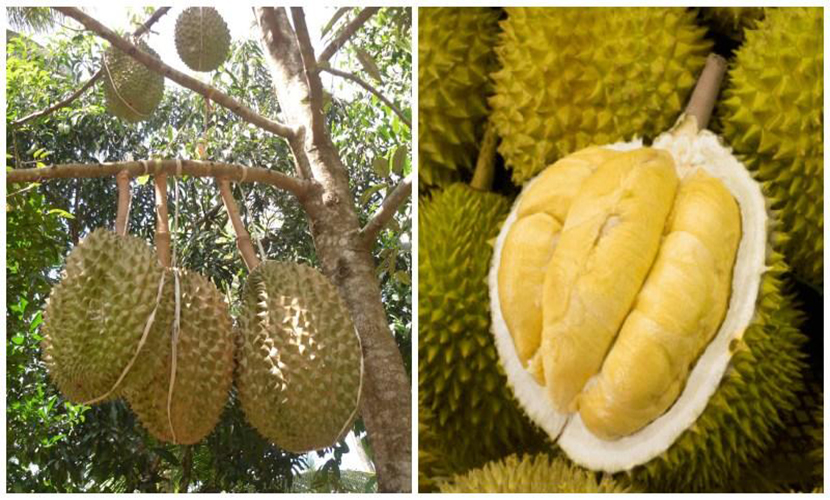
The 2026 durian harvest in Dong Nai has highlighted a clear contrast between the Dona and Ri6 varieties. Export markets are imposing increasingly stringent requirements on quality standards and growing area codes. In response, Vietnam’s Dona durian has become the preferred variety because of its higher market value and its stronger ability to meet the demanding requirements of international buyers. This has reinforced its position as one of Vietnam’s leading premium durian varieties.
This year’s durian harvest has witnessed unusual price fluctuations, creating a striking contrast in returns among growers. The biggest difference lies between the Dona and Ri6 varieties. Export-quality Ri6 durians have been purchased for just over VND 30,000 per kilogram.
In comparison, Vietnam’s Dona durian has consistently sold for between VND 70,000 and VND 80,000 per kilogram, with prices occasionally reaching VND 90,000 per kilogram. This gap reflects more than a simple imbalance between supply and demand. It serves as a clear indicator of the premium value that export businesses place on high-quality agricultural brands.
Mr. Tran Minh Tan is the Director of the Xuan Bac Trade, Service and Tourism Cooperative in Xuan Bac Commune. He said: “During this harvest season, Dona durians have been selling for twice—and at times three times—the price of Ri6. Even at VND 60,000 to VND 70,000 per kilogram, Vietnam’s Dona durian growers are still earning substantial profits. This significant price difference is encouraging many farmers in the area to gradually shift toward cultivating more Dona trees.”
Mr. Nguyen Quoc Nghi is a grower of Vietnam’s Dona durian in La Nga Commune. He shared: “Although we all grow durians, some orchards have enjoyed excellent returns while others have suffered heavy losses. Well-managed Dona orchards have been purchased by traders at VND 60,000 to VND 70,000 per kilogram. However, orchards with a high proportion of poor-quality fruit have received only VND 30,000 to VND 40,000 per kilogram.”
“In some cases, orchards affected by physiological disorders that reduced fruit quality sold for just over VND 10,000 per kilogram. With increasingly unpredictable weather, farmers who lack sufficient cultivation experience are more likely to face poor harvests. As a result, they fail to meet export standards and ultimately receive much lower prices—or even struggle to sell their produce at all.”
Vietnam’s Dona durian
Mr. Truong Bao is a durian trader in eastern Dong Nai Province. He noted: “Durian prices have fluctuated far more sharply this season than in previous years, sometimes changing from one day to the next. At the beginning of the harvest, export-grade Dona durians reached VND 90,000 per kilogram. During the peak season, traders contracted entire Dona orchards at around VND 65,000 per kilogram. They then sold the fruit to export companies for approximately VND 78,000 per kilogram.”
“The sustained strength of Dona prices reflects the consistently high demand from exporters purchasing large volumes. It also demonstrates that the market is becoming increasingly selective. The market now clearly favors professionally managed growing areas that can meet stringent export requirements.”
Ensuring the long-term sustainability of the durian industry no longer depends on expanding cultivation areas. Instead, it requires more professional production practices and strict compliance with international standards. Vietnam’s Dona durian is a long-established specialty of Dong Nai. The variety was the development of Dona Techno Biotechnology Development Joint Stock Company (Dona Techno). It has since become Vietnam’s first branded durian exported to the United States. This has created new opportunities for farmers to generate higher incomes.
Tran Minh Tan said, “Our cooperative has expanded its durian-growing area to around 51 hectares, with more than 70% planted with Dona. Vietnam’s Dona durian commands higher prices and enjoys more stable market demand because export markets increasingly favor this premium variety. Our members are continuing to expand cultivation, but Dona also requires much stricter cultivation and orchard management practices. Without proper techniques, the risk of crop failure is significantly higher than with other varieties.”
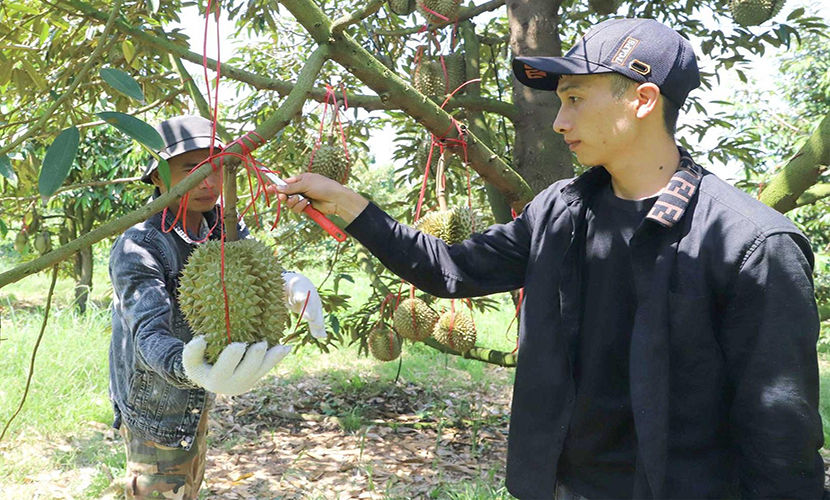
Vietnamese durian farm
Mr. Hoang Quoc Hung is a farmer in Nghia Trung Commune. He shared: “This harvest season, more than 400 of my Thai durian trees have produced fruit. Although most of them are only in their second harvest season and some are bearing fruit for the first time, the orchard has yielded nearly 30 tonnes.”
“With traders purchasing the entire orchard at around VND 62,000 per kilogram, I still earned profits exceeding one billion dong this season. I also have several dozen Ri6 trees, but because prices have fallen so low, their economic contribution has become negligible. Focusing on export-quality Dona durian is the only viable way for us to maintain profitability under today’s increasingly challenging weather conditions.”
Ms. Pham Thi My Nhan is the Deputy Director of the Plant Quarantine Center II. She emphasized: “Vietnamese fresh fruit exports still have tremendous growth potential. However, gaining wider access to official export markets is becoming increasingly challenging. Importing countries are imposing ever stricter requirements, particularly regarding growing area codes and product traceability. There is no longer any room for fragmented, spontaneous production.”
“Farmers must adopt standardized cultivation practices and operate more professionally. They must also consistently produce fruit that meets both quality and appearance requirements. Only then can Vietnamese fruit secure a stronger position in international markets. It can also transform brand recognition into sustainable economic value for local communities.”
These perspectives from industry leaders underscore the need for a fundamental shift away from traditional agricultural production. Instead, the industry should adopt a more market-oriented approach that prioritizes professionalism, product quality, and brand reputation. This goes beyond a short-term strategy for improving profitability.
It represents a long-term pathway for Dong Nai’s durian industry to enhance its global competitiveness. In today’s increasingly integrated markets, product quality and certified growing area codes have become essential for accessing the world’s most demanding export destinations. They are the most powerful “passport” to international markets.
If you are interested in Vietnamese durian, please do not hesitate to contact us:
Company: Agrideco Vietnam Co., Ltd.
Address: No 02, Alley 325 Kim Nguu, Vinh Tuy Ward, Hanoi, Vietnam
Tel/Kakao Talk/Whatsapp: +84 989 649 804
Website: https://agridecovietnam.com
Email: agridecovietnam@gmail.com