
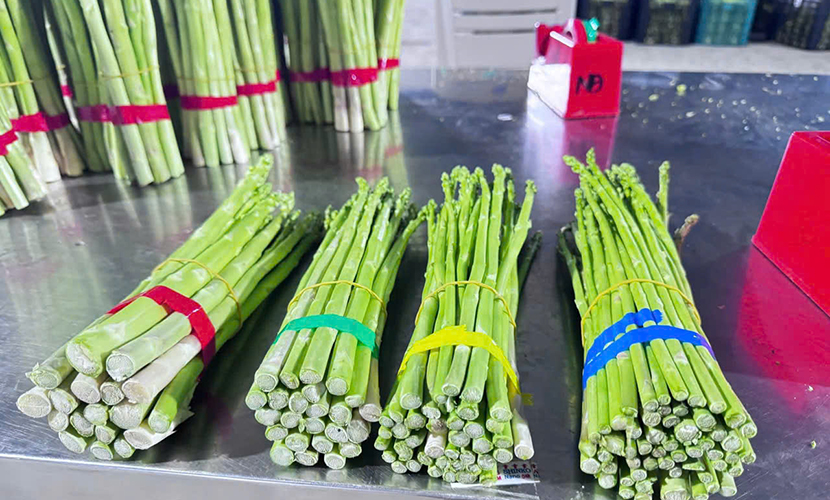
Chuong Xa is a mountainous Commune in Cam Khe District, Phu Tho Province. In recent years, Vietnam’s asparagus cultivation on water-scarce farmland here has generated significant economic benefits. It has also provided stable employment for dozens of local residents.
Ms. Nguyen Thi Lam is a worker at the Bac Bo Organic Agriculture Cooperative. Like every other day, she begins her day at 4 a.m. Together with her colleagues, she harvests Vietnamese asparagus every day. They clean, pack the asparagus, then deliver it to markets across northern Vietnam.
After a single night, the asparagus spears grow noticeably taller. During peak growing periods, they can reach up to 15 centimeters overnight. Few people once imagined that the water-scarce fields along the hillsides of Chuong Xa Commune, Cam Khe District, could successfully produce this vegetable. It is often referred to as the “king of vegetables.”
“Years ago, farmers in the water-scarce fields of Doc Ngat in Chuong Xa Commune grew rice, vegetables, and other short-term crops. However, the land was difficult to cultivate, overrun with weeds, and crop failures were common. As a result, life was especially hard for farming households,” Ms. Lam recalled.
According to Ms. Lam, many local residents gradually lost interest in farming at that time. This left an increasing area of agricultural land abandoned or underused.
Vietnam’s asparagus cultivation
There was a need to make better use of underutilized farmland and diversify local crop production in Chuong Xa Commune. In response, the Bac Bo Organic Agriculture Cooperative launched a pilot project to cultivate Vietnam’s asparagus cultivation on the land.
The cooperative initially consolidated nearly 3 hectares of farmland. It invested approximately VND 700 million in seedlings, land preparation, fertilizers, an automated irrigation system, and labor.
Thanks to careful research, sound cultivation techniques, and a thorough understanding of the crop’s growing requirements, Vietnam’s asparagus fields developed well. The first harvest was obtained just eight months after planting. The cooperative’s asparagus quickly gained popularity among consumers, with demand consistently exceeding supply. Prices have remained relatively stable at around VND 50,000–70,000 per kilogram.
Despite the challenges posed by the COVID-19 pandemic, the cooperative continued to expand its operations year after year. It now cultivates 16 hectares of Vietnam’s asparagus cultivation. The operation provides stable employment for dozens of local workers, who earn average monthly incomes of VND 5–6 million.
Ms. Dinh Thi Tam is a worker at the Bac Bo Organic Agriculture Cooperative. She said that before joining the cooperative, her family faced considerable financial hardship. They relied mainly on cassava and maize cultivation, and poor harvests often left them struggling to make ends meet.
“My work is much the same as it was before—I still weed the fields and care for crops. The difference is that I now have a stable monthly income. As a result, my family’s living conditions have improved significantly,” Ms. Tam said.
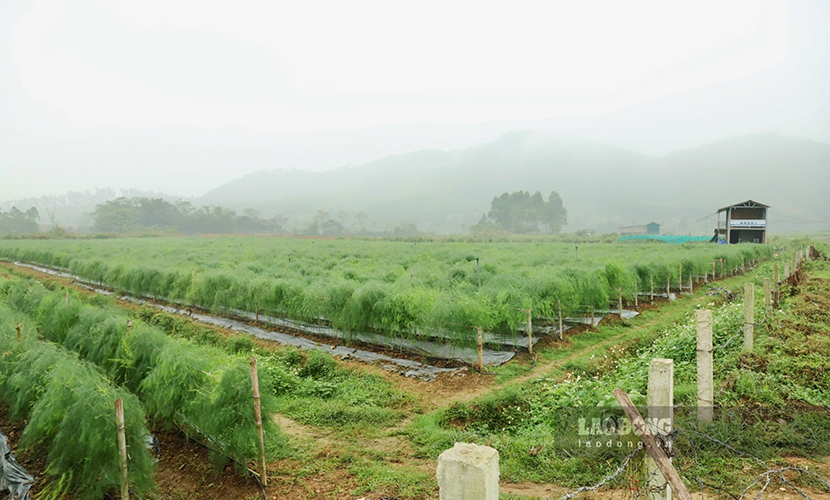
Vietnam’s asparagus farm
Ms. Nguyen Thi Hang is the Director of the Bac Bo Organic Agriculture Cooperative. According to her, growing asparagus under organic farming practices not only ensures food safety for consumers but also produces spears with an attractive deep green color. Once cooked, the asparagus remains crisp and retains its naturally sweet flavor.
The cooperative’s asparagus has been certified as a three-star OCOP product. It is now supplied to agricultural import-export companies, supermarkets, and fresh produce retailers. These buyers are located across several northern provinces and cities, including Hanoi, Bac Ninh, and Hai Phong.
Mr. Do Huu Huy is the Chairman of the People’s Committee of Chuong Xa Commune, Cam Khe District. He said that under the One Commune One Product (OCOP) Program, local authorities at all levels have encouraged farmers to diversify their crop production. The goal is to improve productivity and raise incomes.
“Vietnam’s asparagus cultivation has been a priority crop for further expansion, with the goal of making it a signature product of the commune. Since the initial 3-hectare plantation was established in 2019, the cultivated area has grown to more than 16 hectares by 2022,” Mr. Huy said.
Vietnamese source: https://laodong.vn/kinh-doanh/hieu-qua-khong-ngo-tu-viec-trong-mang-tay-tren-dat-ruong-khan-o-phu-tho-1086145.ldo
If you need more information about Vietnamese asparagus, please do not hesitate to contact us:
Company: Agrideco Vietnam Co., Ltd.
Address: No 02, Alley 325 Kim Nguu, Vinh Tuy Ward, Hanoi, Vietnam
Tel/Kakao Talk/Whatsapp: +84 989 649 804
Website: https://agridecovietnam.com
Email: agridecovietnam@gmail.com