
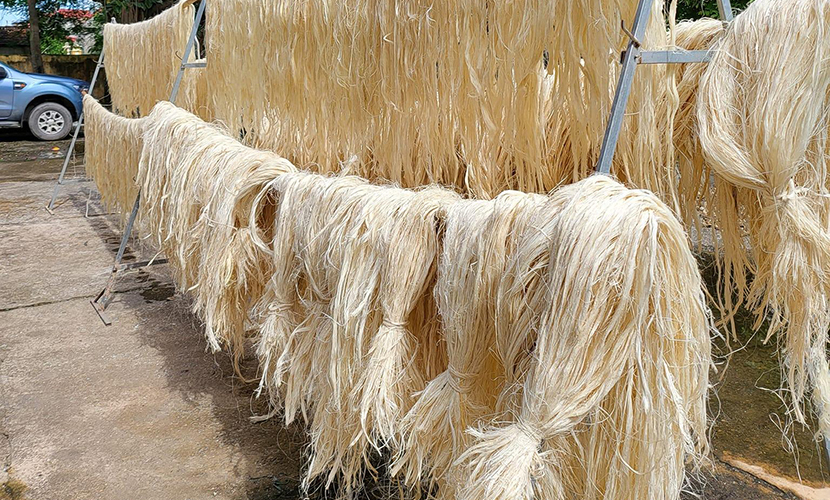
Recognizing that banana plants offer value beyond their fruit through fibers that can be used to produce handicrafts, Bùi Khánh Dũng has spent the past seven years pursuing his vision of elevating the value of Vietnamese agricultural products. By transforming Vietnamese banana fiber into materials for fashion and household goods, he has created jobs for hundreds of workers.
During a visit to the low-lying rural district of Phú Xuyên in Hanoi, we discovered a range of unique products made from banana fiber. The district’s fertile alluvial soil, deposited by the Red River, provides ideal conditions for banana cultivation. These include handbags, flower vases, dusters, floor mats, and lampshades. The products are purchased by a Vietnamese handicraft company and exported to international markets.
The company is currently partnering with 10 banana-growing cooperatives across northern Vietnam to develop raw material production areas and organize local manufacturing. The initiative has created jobs for between 400 and 600 workers. Their monthly incomes range from VND 5 million to VND 8 million per person.
Vietnamese banana fiber
Speaking about the one-of-a-kind machine, which is not yet available on the market, Dũng explained that Vietnamese banana fiber is extremely fine, even thinner than sewing thread. As a result, the machine must operate at speeds of more than 1,400 revolutions per minute. Even a slight inaccuracy in the fiber-separating mechanism can damage the fiber structure. This produces only pulp instead of usable fiber.
The machine he designed uses U-shaped blades with rounded edges, evenly spaced and aligned parallel to the rotating shaft. As the machine operates, the blades strike the banana sheath to remove the soft pulp while preserving the fibers. The machine then reverses to make the extracted fiber easier to collect. “My machine costs only half as much as imported models, while remaining easy to operate and safe for workers,” Dũng said.
Notably, the company’s Banana Stem Fiber Extraction Device received a Utility Solution Patent by Vietnam’s National Office of Intellectual Property on March 22, 2022. Its Method for Processing Fibers from Banana Stems also received a Utility Solution Patent on July 31, 2024. In addition, three other inventions have been accepted for patent applications and are currently undergoing examination.
Vietnam currently has around 150,000 hectares of banana plantations, producing more than two million tonnes of Vietnamese bananas annually. Bananas rank among the country’s top three agricultural export commodities. This provides an abundant source of raw materials for fiber production.
It allows manufacturers to create handicrafts and other value-added products for export instead of relying solely on fresh fruit exports. Dũng added that the banana pulp remaining after fiber extraction is composted into organic fertilizer for crops. This helps reduce agricultural waste and support environmentally friendly farming.
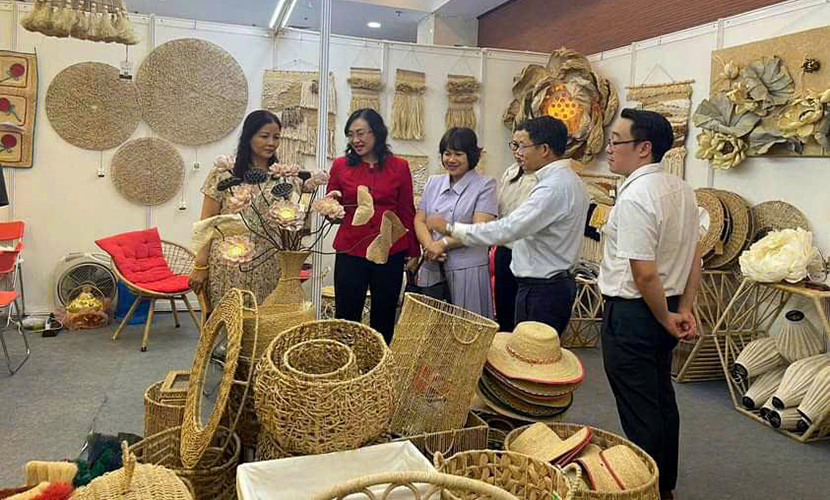
Vietnamese banana fiber factory
After conducting extensive research into the banana fiber market, Dũng found that internationally renowned fashion brands have already incorporated the material into premium apparel, particularly for luxury consumers. As a result, his company has successfully entered the market. It now exports banana-fiber textiles to Japan, France, Canada, India, and the United Arab Emirates, among other countries.
Over the past four years, Dũng’s banana fiber cultivation project has implemented in rural areas across Hanoi, Phú Thọ, Lào Cai, and Ninh Bình provinces. The initiative has helped improve local economies by encouraging farmers to preserve existing banana plantations and expand cultivation areas.
“The company is investing nearly VND 500 billion in two factories in Thanh Hóa to produce textile fibers and banana starch. We are also investing nearly VND 400 billion in another factory in Lào Cai. We hope these investments will help transform deep processing into a key industry that enhances the value of Vietnam’s banana sector,” Dũng said.
Banana fiber products handcrafted by ethnic minority artisans are not only beautiful, durable, and meticulously made but also embody rich traditional cultural values. They also help promote Vietnam’s image to the world. For Dũng, building a brand rooted in local identity is a top priority. He believes that bringing Vietnamese banana fiber to international markets is about more than exporting a product. It is also a way to share the essence of Vietnamese culture with the global community.
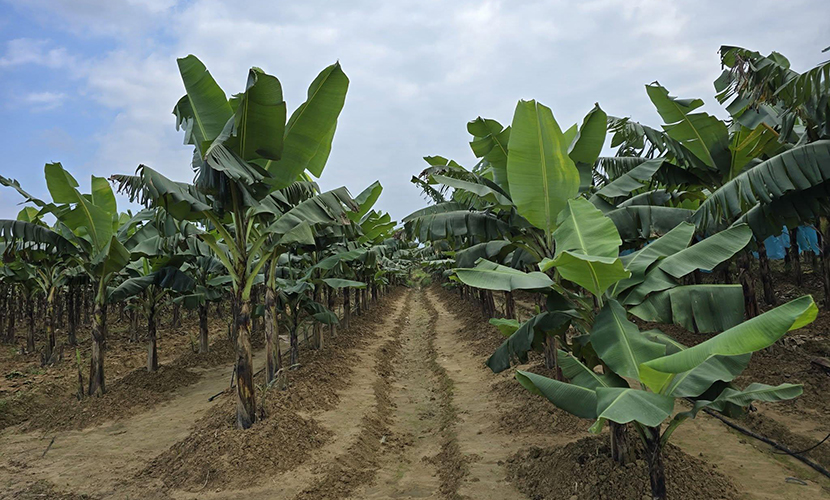
Vietnamese banana farm
Mr. Đào Văn Hùng is a member of the Khai Thái Agricultural Trade and Services Cooperative in Hanoi. He said: “In the past, we only used banana stems as pig feed, and whatever was left was simply discarded along the dikes. Since learning the company’s banana fiber extraction techniques for handicraft production, local farmers have become much more enthusiastic. They have expanded banana cultivation to supply raw materials for the factory’s export products. As a result, farmers and elderly people now have stable jobs and significantly higher incomes.”
Looking ahead, the company is focusing on developing new products, including banana corm vermicelli, banana powder, and banana blossom tea. The company is also breeding new banana varieties with higher fiber and fruit yields to deliver greater benefits to growers. “Creating more jobs for farmers, developing products that improve people’s lives, and contributing to environmental protection are what bring me joy every day,” the founder said.
Vietnamese source: https://thuonghieusanpham.vn/khat-vong-tao-dung-thuong-hieu-soi-chuoi-viet
For more information about Vietnamese banana fiber exports, please contact us:
Company: Agrideco Vietnam Co., Ltd.
Address: No 02, Alley 325 Kim Nguu, Vinh Tuy Ward, Hanoi, Vietnam
Tel/Kakao Talk/Whatsapp: +84 989 649 804
Website: https://agridecovietnam.com
Email: agridecovietnam@gmail.com