
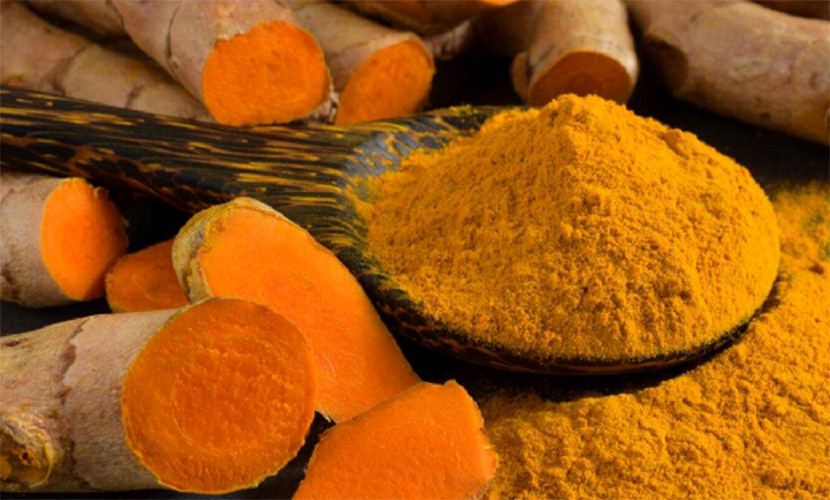
Harvest season brings a lively atmosphere to villages across Chi Minh Commune, where farmers are busy digging up Vietnamese turmeric. Some households cultivate only a few sao of land, while others grow the crop on several mau. Many families have improved their livelihoods. Some have even built considerable wealth by cultivating Vietnamese turmeric and investing in value-added processing.
Mr. Nguyen Phu Phong is a resident of Village 5, has been growing turmeric for more than 20 years. He currently cultivates about one hectare of Vietnamese turmeric. This year’s harvest is likely to reach around 30 tons of fresh rhizomes. By intercropping turmeric with peanuts or soybeans, his family improves soil fertility and generates additional income. As a result, it earns an average profit of about VND 10 million per sao, three times higher than rice cultivation.
Many local farmers have gone beyond producing raw materials by investing in processing to increase the value of turmeric. Nguyen Van Thiem is a local farmer from Tan Hung Village. He said that he purchases nearly 100 tons of turmeric from local farmers each year. He processes it into products such as turmeric powder and dried turmeric. His facility annually produces around 5–7 tons of turmeric starch and 20–30 tons of dried turmeric.
Vietnamese turmeric products
Dried turmeric sells for VND 50,000–60,000 per kilogram, while turmeric starch fetches VND 150,000–300,000 per kilogram. Consequently, his business generates approximately VND 3 billion in annual revenue. It also provides stable employment for dozens of local workers. According to Mr. Thiem, deep processing not only increases product value but also helps secure stable market outlets. In addition, it reduces dependence on traders. Vietnamese turmeric is an easy-to-grow medicinal crop that adapts well to various soil types and is resistant to most pests and diseases.
It also requires relatively low seed costs and has a growing cycle of about one year. On average, each hectare of Vietnamese turmeric in Chi Minh Commune yields around 27 tons of fresh rhizomes. With fresh turmeric selling for VND 8,000–13,000 per kilogram, the crop generates an estimated VND 220–400 million per hectare. This figure excludes additional income from intercrops such as peanuts and beans. These advantages provide a solid foundation for developing turmeric into a sustainable commercial crop.
In the past, fresh turmeric was available mainly through small-scale trading channels and depended heavily on middlemen and market fluctuations. In recent years, however, Chi Minh Commune has established an increasing number of professionally managed turmeric processing facilities. These enterprises have played an important role in ensuring stable raw material consumption. They have also diversified processed products and gradually built a complete value chain for turmeric.
Thanks to its high quality, turmeric from Chi Minh Commune has gained growing recognition in the marketplace. In addition to strong domestic sales, many processed products have established their reputation. Vietnamese turmeric exports are available in global markets including India, Laos, Cambodia, Japan, China, and South Korea.
The commune currently has nine turmeric-based products recognized under Vietnam’s OCOP (One Commune One Product) program, including four 4-star products and five 3-star products. Representative products include turmeric starch, turmeric powder, Nano Collagen turmeric milk, curcumin powder, and Nano Curcumin Gel. In 2017, the Chi Tan Turmeric brand received trademark protection from the National Office of Intellectual Property of Vietnam. Two years later, in 2019, the Chi Tan turmeric production and processing craft village was officially recognized by the provincial People’s Committee.

Vietnamese turmeric farm
Dao Manh Nghia, a consumer from Hanoi, said that he regularly uses turmeric products from Chi Minh Commune, such as turmeric starch and honey turmeric starch capsules. He believes the locally grown turmeric stands out for its excellent quality, vibrant color, natural aroma, and health benefits.
Assessing the crop’s future potential, Do Khac Nam, Head of the Economic Division of Chi Minh Commune, noted that the commune lies along the Red River and has a total cultivated area of approximately 1,673 hectares. Of this total, around 230 hectares are dedicated to turmeric. This provides significant advantages for expanding turmeric production. He added that local farmers possess many years of cultivation experience and that transportation infrastructure is convenient for product distribution.
Moreover, numerous purchasing, preliminary processing, and processing facilities have already been established within the raw material area. However, to ensure sustainable development, the commune will continue working with relevant authorities to strengthen farmer training and technology transfer. It will also develop VietGAP-compliant production zones that meet food safety standards, invest in processing infrastructure and post-harvest storage facilities, promote trade and product marketing, and improve environmental protection in the traditional craft village.
With a strong production base, the entrepreneurial spirit of local farmers, and supportive government policies, turmeric has become—and is likely to remain—the “golden crop” of Chi Minh Commune. It contributes to higher incomes, more employment opportunities, and the sustainable modernization of the rural economy.
Vietnamese source: https://nhandan.vn/lam-giau-tu-cay-nghe-duoc-lieu-post935374.html