
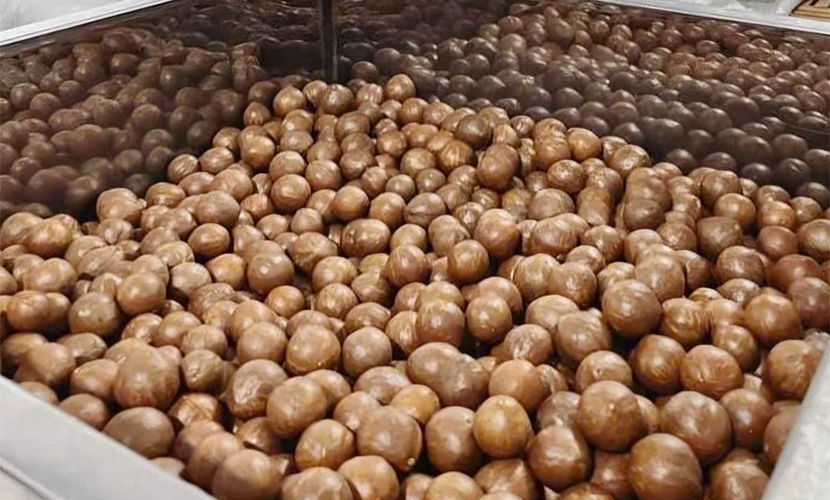
Compared with many of Lang Son’s other key crops, Vietnamese exported macadamia arose relatively late. For many years, local farmers have cultivated it only on a small scale in several localities with suitable climatic conditions. However, practical results have shown that macadamia trees grow well and produce stable yields. In addition, they generate significantly higher economic returns than many other crops grown on the same area of land.
In recent years, the cultivation areas of Vietnamese exported macadamia in the province have expanded. Therefore, several Vietnamese macadamia enterprises in the province have begun investing in deep processing. They no longer rely solely on the sale of raw nuts. Among them, the cracked-shell dried macadamia product of Lang Son has recognized as a 4-star OCOP (One Commune One Product) product.
The quality of the raw material area is the key factor determining the quality of the final product. Therefore, the province places great emphasis on cooperating with local farmers in production. It also closely monitors cultivation, harvesting, and post-harvest handling practices before processing raw materials.
Vietnamese exported macadamia
From being a local specialty, Vietnamese exported macadamia is now demonstrating strong potential to develop into a commercial crop. When sufficient raw material are available, Vietnamese export enterprises actively participate in processing and marketing.
Mr. Hoang Van Chieu is the Deputy Director of the Lang Son Department of Agriculture and Environment. According to him, macadamia among the province’s key crops aims to make more effective use of local land and climate advantages. It also supports the development of concentrated raw material areas linked to processing and product marketing.
Mr. Chieu added that the province plans to develop the macadamia sector sustainably by using high-quality varieties and applying advanced agricultural technologies. It will also promote climate-resilient farming practices for Vietnamese macadamia exports. Alongside expanding cultivation areas, the local government will encourage stronger partnerships between enterprises and farmers to improve production efficiency.
This development strategy is already being translated into new investment projects. Most recently, the province approved the investment policy for a macadamia plantation project in the Trang Dinh and Quoc Khanh areas. Once implemented, the project is likely to strengthen the supply of raw materials for processing activities. It will also create additional employment opportunities for local residents.

Vietnamese fresh macadamia
In addition to its economic value, Vietnamese macadamia is a long-term perennial crop. It aligns well with the orientation of sustainable forestry development. Some localities also expect that the development of concentrated cultivation areas will create opportunities for agro-tourism and eco-tourism activities associated with agricultural production.
According to the province’s development targets, by 2030, macadamia cultivation area is likely to reach between 6,000 and 8,000 hectares. It will have an average yield of around 2.5 tons per hectare per year and a total output of approximately 2,100 tons.
To achieve this goal, the province will implement synchronized solutions. These range from supporting seed supply, transferring technical know-how, and establishing planting area codes. They also include attracting Vietnamese macadamia companies to invest in preliminary processing and deep processing. Farmers participating in macadamia development are supported with 100% of the cost of seedlings. This support is up to a maximum of VND 30 million per hectare.

Vietnamese macadamia trees
In parallel with expanding cultivation areas, the province aims to develop a synchronized system of processing facilities linked to raw material zones. It will also diversify product offerings and strengthen consumption linkages. This is a key requirement as macadamia production shifts from small-scale farming to commodity-oriented production.
Lang Son has the advantage of trade connectivity through its international border gate system. It is also actively promoting the development of high value-added agricultural products. Macadamia is being developed with an orientation toward concentrated raw material zones linked to processing and consumption. This creates more favorable conditions for expanding its domestic market and moving toward export markets.
From a crop that was trialed many years ago, Vietnamese exported macadamia has now been included in the province’s agricultural development resolutions. The establishment of raw material zones, the attraction of enterprises to invest in processing, and the development of integrated value chains are essential. Therefore, they will be decisive factors in transforming the potential of this crop into a high-value commodity sector in the coming years.
Vietnamese source: https://nongnghiepmoitruong.vn/mac-ca-lang-son-huong-toi-thi-truong-quoc-te-d817929.html
If you are interested in Vietnamese macadamia exports, please contact us:
Company: Agrideco Vietnam Co., Ltd.
Address: No 02, Alley 325 Kim Nguu, Vinh Tuy Ward, Hanoi, Vietnam
Tel/Kakao Talk/Whatsapp: +84 989 649 804
Website: https://agridecovietnam.com
Email: agridecovietnam@gmail.com