
Kim Bon is a mountainous commune of Son La province. It consists of 13 villages, where ethnic communities such as the Hmong, Mường, and Dao live together. The livelihoods of local residents have long faced many difficulties. The economy mainly depends on maize, cassava, and Vietnamese macadamia cultivation.
In order to seek sustainable livelihoods, Kim Bon Commune has boldly introduced new crop and livestock varieties into production. Among them, Vietnam’s macadamia trees have initially shown good adaptability to the local soil and climate. This opens up a promising direction for economic development for ethnic communities in the highlands.
The journey of macadamia taking root in this area began with pioneering households in Suối On village. They were bold enough to think and act in late 2014. Mr. Vàng A Lử is the Party Cell Secretary and Head of Suối On village. He shared that villagers mainly cultivated maize and cassava, which brought very low economic efficiency.
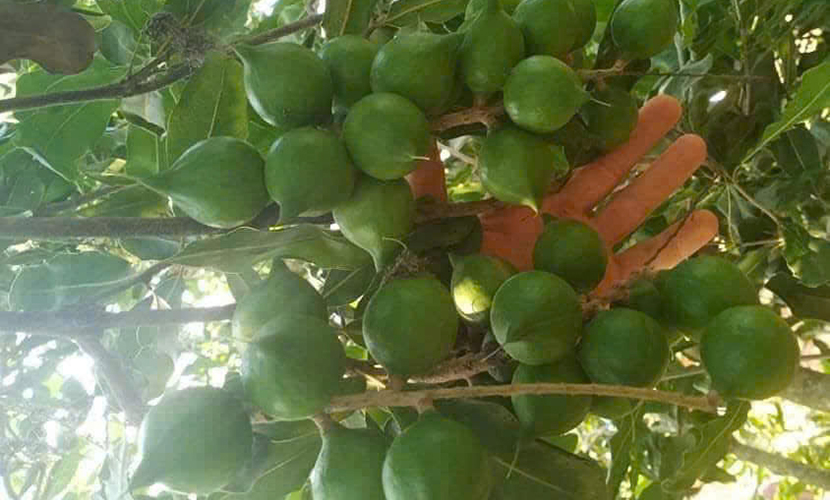
Vietnamese macadamia cultivation
Recognizing that the local climate and soil were suitable for macadamia, the village agreed to allocate 12 hectares for pilot cultivation in 2014. Initially, 7 households participated in the project of Vietnamese macadamia cultivation.
Although the highland weather was harsh, macadamia trees still grew and developed well. This was thanks to strict adherence to cultivation and care techniques. This initial success encouraged local people to expand the planting area of Vietnamese macadamia.
To date, the village has 27 households growing macadamia with a total area of 33 hectares. Of this, 12 hectares are already in harvest, with an average yield of 2 tons of fresh nuts per hectare.
Macadamia prices remain stable at around 35,000 VND per kilogram of fresh nuts and 80,000 VND per kilogram of shelled kernels. Therefore, the crop generates many times more income than traditional crops. As a result, the number of poor households in the village has decreased significantly from 77 households in 2018 to 46 households in 2025.
As one of the first people to bring macadamia to the village, Mr. Vàng A Xen said that Vietnamese macadamia cultivation requires great care and attention. In particular, it is necessary to firmly secure the tree trunk during the first three years. This helps prevent strong winds and storms from shaking the base and affecting the roots.
From the sixth year onward, when the trees become well-established and start yielding harvests, maintenance becomes relatively easy. Farmers only need to weed twice a year, clean the base of the trees, and apply balanced fertilizer before and after the harvest season.

Vietnamese macadamia nuts
Currently, Mr. Xen’s family owns more than 1 hectare of macadamia. It produces nearly 3 tons of shelled macadamia nuts and generates a profit of nearly 200 million VND after deducting expenses.
Along with the seven pilot macadamia-growing households, Mr. Vàng A Thông’s family was also once a poor household in Suối On village. In 2014, after being provided with awareness and technical support, he boldly converted more than 1 hectare of sloping land to Vietnamese macadamia cultivation.
To maintain income during the early years when the trees had not yet formed a closed canopy, he adopted a “short-term supports long-term” approach. He intercropped maize and cassava during this period. To date, his macadamia area has reached stable production. It yields nearly 3 tons of fresh nuts per year and generates over 80 million VND in revenue.
Mr. Thông happily shared that since switching to Vietnamese macadamia cultivation and receiving technical guidance from agricultural officers, his family’s economic situation has significantly improved. In 2022, his family escaped poverty, built a solid house, and gained better conditions to support their children’s education.

Vietnamese macadamia exports
Mr. Đinh Văn Tư is the Vice Chairman of Kim Bon Commune People’s Committee. He said that the commune currently has nearly 38 hectares of macadamia, mainly concentrated in Suối On village.
Of this, 12 hectares have entered stable production, with an average yield of over 2 tons of fresh nuts per hectare. In 2025 alone, the commune’s total output is estimated at about 15 tons of Vietnamese macadamia nuts. However, product consumption still largely depends on traders, informal retail markets and Vietnamese export companies.
In the coming period, Kim Bon Commune plans to expand an additional 50 hectares of Vietnamese macadamia cultivation. The commune will direct the Integrated Service Center to transfer scientific and technical knowledge and guide farmers in proper cultivation procedures.
The long-term goal is to develop Vietnam’s macadamia into a local OCOP product. It also aims to diversify value-added products such as dried nuts, oil, and macadamia milk to enhance commercial value.
Challenges remain, including limited transport infrastructure and a high poverty rate in mountainous areas. However, the initial results from macadamia cultivation affirm that this is the right direction. It contributes to improved incomes and living standards for the people of Kim Bon Commune.
Vietnamese source: https://baosonla.vn/nong-nghiep/trien-vong-cay-mac-ca-o-vung-cao-kim-bon-DMHgp6bvg.html